WWith regards to real estate development in India, CLU is often discussed, mainly in cities in Haryana, Punjab and Uttar Pradesh. As a property buyer, investor or developer, knowing about CLU is important so you can prevent legal difficulties and ensure your project adheres to local rules.
This blog post explains the CLU for properties, why it matters, the procedure for getting it and the penalties for not complying. We’ll also respond to some usual questions related to CLU in India.
What is CLU in Property?
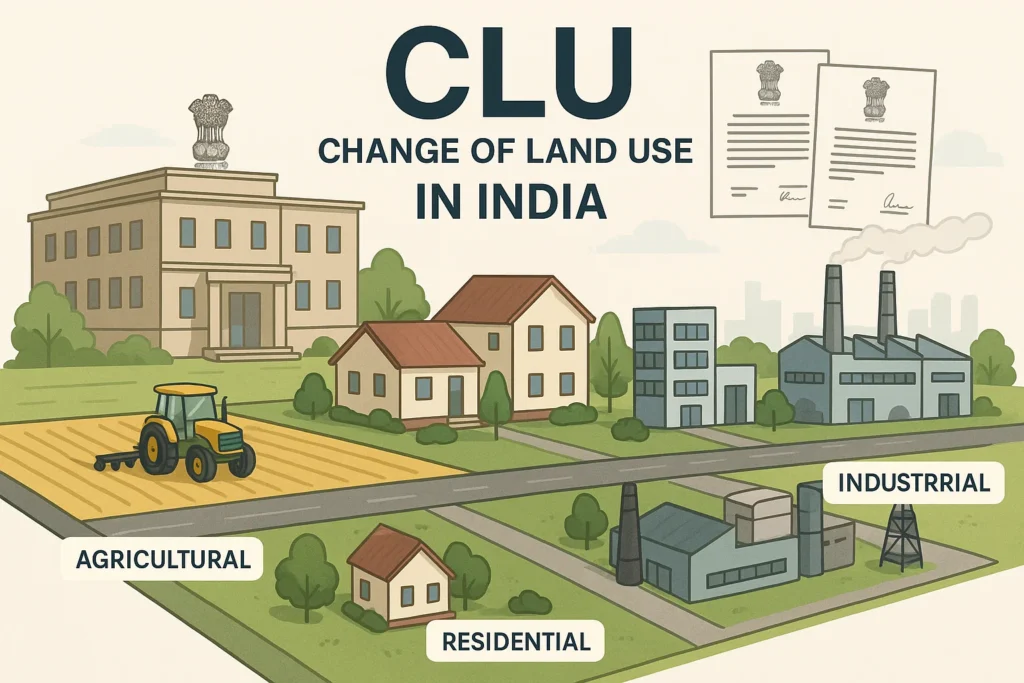
CLU stands for Change of Land Use.
In India, land is typically categorized for specific uses such as:
- Agricultural
- Residential
- Commercial
- Industrial
- Institutional
The majority of rural and city edge land is used for farming at the start. To change agricultural land to be used for building houses, malls, factories or other similar projects, you must first get CLU approval from the appropriate authority.
This process legally changes the land’s category and allows its development according to the new use.
Why is CLU Important in Real Estate?
Here’s why CLU is a crucial aspect of real estate in India:
1. Legal Compliance
CLU must be considered before land for agriculture is used for houses or shops. Because of this, there may be penalties levied, buildings may be torn down or people may be prevented from getting occupancy certificates.
2. Access to Infrastructure
Land development in a CLU area generally allows access to basic infrastructure such as water, electricity, roads and sewage which are part of the national urban planning rules.
3. Increases Land Value
The value of the land often rises a lot after receiving CLU approval. You can buy a lot more land with residential or commercial value than with agricultural.
4. Enables Loan and Project Approvals
Banks usually ask for CLU clearance before allowing construction or purchase loans. To register your project under RERA and get any project licenses, CLU is mandatory.
Who Grants CLU Approval?
The State Town and Country Planning Department or Urban Development Authority is responsible for granting CLU permissions. Some examples:
- In Haryana, it’s the Department of Town and Country Planning (DTCP).
- In Uttar Pradesh, it’s the Development Authorities like Noida Authority, Greater Noida Authority, or YEIDA.
- In Punjab, it’s the Punjab Urban Planning and Development Authority (PUDA).
CLU Application Process in India
Getting CLU approval involves several steps. Though it may vary slightly from state to state, here’s a general overview:
Step 1: Submit Application
Submit an application to the concerned authority with required details:
- Land ownership documents
- Site location map
- Proposed land use
- Khasra/killa numbers
- Revenue records
Step 2: Site Inspection
The authority inspects the site to check its suitability for the proposed use. They verify if the land lies within the urbanizable limits or master plan of the city.
Step 3: NOC from Departments
Approvals may be needed from:
- Agriculture department (for converting farmland)
- Environment department
- Pollution Control Board
- Fire department (for commercial/industrial)
Step 4: Scrutiny and Fees
The authority scrutinizes the application and calculates the CLU conversion charges, development charges, and other applicable fees.
Step 5: Approval Letter Issued
If all documents and conditions are met, a CLU approval letter is issued. It specifies the new land use and the validity period (usually 2–3 years).
CLU Charges and Fees
The CLU fees vary depending on:
- Location of the land (urban, peri-urban, rural)
- Proposed use (residential, industrial, commercial)
- Size of the land parcel
For example, in Haryana, CLU charges are higher for commercial use than for residential or industrial. Charges are updated periodically by state governments and local development authorities.
What Happens If You Don’t Get CLU?
If a landowner or developer uses agricultural land without CLU approval, they may face:
- Legal action under local urban planning laws
- Heavy penalties or fines
- Demolition orders on unauthorized constructions
- Denial of occupancy certificates
- Refusal of bank loans
Hence, it is strongly advised to check the CLU status of a property before buying or starting any construction.
CLU in Haryana – A Case Study
Haryana is one of the most active real estate markets in North India, especially regions like Gurgaon, Faridabad, and Panipat. The DTCP Haryana plays a crucial role in granting CLU approvals.
Key highlights of Haryana CLU policy:
- Haryana Town and Country Planning Department issues CLU for residential, commercial, group housing, industrial, and educational projects.
- Master Plans of cities guide the eligibility of CLU applications.
- Land should fall in designated zones like Residential, Commercial, or Industrial in the Master Plan.
For instance, a land parcel in New Gurgaon (Sectors 81–95) must lie within the residential zone to get CLU for group housing.
Key Documents Required for CLU Application
Here’s a checklist of commonly required documents:
- Ownership proof (sale deed or jamabandi)
- Site plan and layout
- Khasra or Killa numbers
- NOCs from relevant departments
- Affidavit for compliance
- Application form duly filled
- Fee payment receipt
Frequently Asked Questions
1.What does CLU mean in property terms?
CLU stands for Change of Land Use. It is the legal process of converting agricultural land into non-agricultural purposes such as residential, commercial, or industrial use. This permission is granted by the Town and Country Planning Department of the respective state.
2.Why is CLU important before buying land?
CLU approval ensures that the land is legally authorized for the intended use. Buying or developing property without CLU can lead to legal penalties, demolition orders, or cancellation of property registration.
3.Who grants CLU approval in India?
CLU permission is granted by the District Town and Country Planning (DTCP) office or the Urban Development Authority, depending on the location and type of land use proposed.
4.What is the process to get CLU approval?
The landowner must apply to the local planning authority with ownership documents, site plans, and the proposed land-use details. After inspection and verification, the authority issues a CLU certificate if the land qualifies under the master plan.
5.How long does the CLU approval process take?
Typically, CLU approval takes 45 to 90 days, depending on the state regulations and document verification speed. However, delays may occur if there are objections, zoning conflicts, or incomplete documentation.