Investors have considered both appreciation and income to decide when coming up with a decision on investing in farmland and commercial property in India as a method of investment in the real estate. Yet, another issue that is vital is tax benefits.
It is important to understand the taxation of these assets as you may be able to reduce your tax liability and maximize taxation. This post will do a deeper comparison of tax benefits between farmland and commercial property, show real-world examples, and some of the tips that investors utilize.
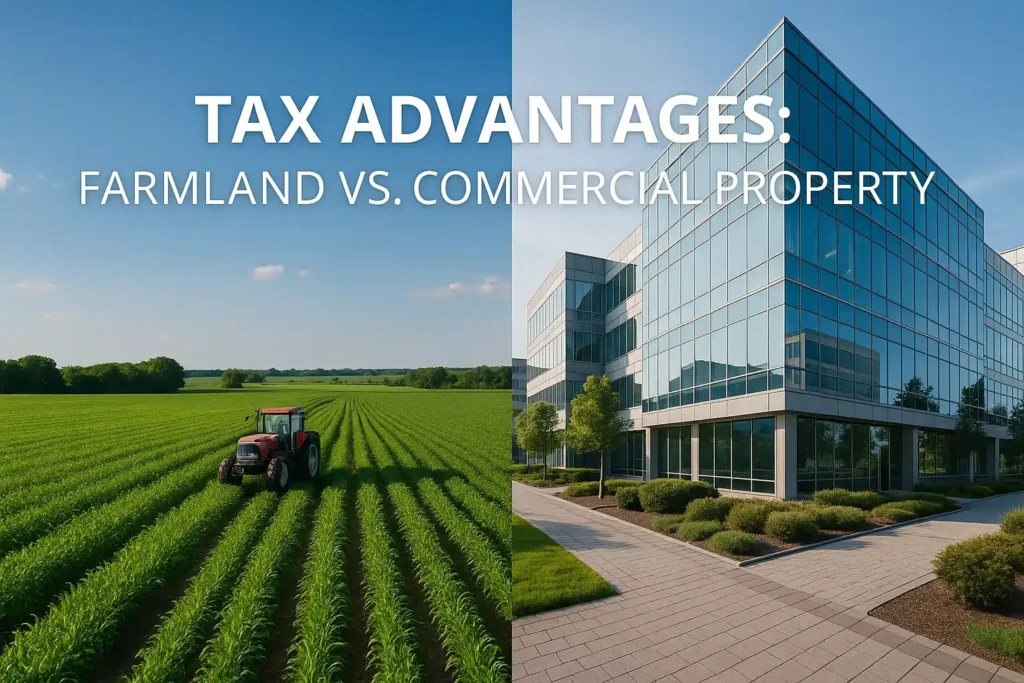
What Are the Tax Benefits of Farmland in India?
Farm land is turning out to be an interesting investment asset in India, much liked by HNIs and long term investors. In addition to long-term appreciation in value, the following are the tax benefits of the same:
1. Agricultural Income is Completely Tax-Free
Under Section 10(1) of the Income Tax Act, any income earned from agriculture is fully exempt from income tax.
Example:
If you earn ₹10 lakh annually from cultivating crops or leasing farmland for farming purposes, this entire income is not taxable.
Pro Tip:
To qualify, ensure the income is from legitimate agricultural activity. Income from non-agricultural uses like leasing for a factory or warehouse will not be exempt.
2. No Capital Gains Tax on Rural Agricultural Land
In case of farmland in the countryside it is not treated as capital asset under Section 2(14). Thus, sale of agricultural land in the countryside is not a subject of capital gains tax.
Criteria for Rural Land:
- Situated outside municipal limits (based on population limits)
- Used solely for agricultural purposes
Example:
A piece of land in Alwar, used for growing wheat and located 10 km from municipal boundaries, qualifies as rural land. If sold after 5 years, no capital gains tax applies.
Pro Tip:
Check the exact classification of the land in the Jamabandi or revenue records before purchasing.
Read More:
- Tax Planning for NRIs: How Non-Resident Indians Can Save on Property Taxes
- Capital Gains Tax Hacks How to Minimize Tax
- Tax Benefits Showdown What You Gain from Farmland vs SCO Ownership
- Municipal Tax on Commercial Property Understanding and Management
- Can You Legally Sell a Property in Cash?
3. Wealth Tax Exemption on Agricultural Land
Likewise, agricultural land is not considered as part of net wealth and therefore it is not subject to wealth tax under the Wealth Tax Act, though the law is currently abolished (though this may still be applied should the wealth tax be revived in the future).
What Are the Tax Benefits of Commercial Property in India?
Commercial real estate—such as office spaces, shops, and SCOs—offers regular rental income and multiple deductions that can significantly reduce taxable income.
1. Depreciation Benefits Under Section 32
Owners of commercial properties can claim depreciation on both the structure and assets within it:
- Building: 10% annually
- Furniture and equipment: 15%–40%
Example:
If your retail space is worth ₹1 crore, you can reduce your taxable income by claiming ₹10 lakh in depreciation per year.
Pro Tip:
Keep a detailed record of your property valuation and asset list to claim this deduction effectively.
2. Interest Deduction on Property Loans
Under Section 24(b), interest paid on loans taken to buy or construct a commercial property is fully deductible from rental income.
Example:
Paying ₹6 lakh per year in interest for a commercial unit loan? You can deduct the entire amount from your gross income.
Pro Tip:
Combine this benefit with depreciation for maximum tax savings.
3. Input Tax Credit (ITC) Under GST
If your commercial property is used for a GST-registered business, you can claim input tax credit on the GST paid for construction, renovation, and operations.
Pro Tip:
This benefit does not apply to residential leases or non-registered commercial uses. Make sure your tenant is GST compliant.
4. Exemption on Capital Gains Through Reinvestment
Selling a commercial property can result in a large capital gains tax. However, you can avoid this by reinvesting the proceeds:
- Section 54F: Buy a residential property
- Section 54EC: Invest in capital gains bonds (NHAI, REC)
Example:
Selling an office space with ₹30 lakh profit? Invest in NHAI bonds within 6 months and save on capital gains tax.
Farmland vs Commercial Property Tax Benefits
| Tax Benefit | Farmland | Commercial Property |
|---|---|---|
| Income Tax on Earnings | Fully exempt (agricultural income) | Taxable (but deductions available) |
| Capital Gains Tax on Sale | None (if rural agricultural land) | Exemptions under 54F/54EC if reinvested |
| Depreciation Claim | Not applicable | 10%–40% allowed annually |
| Loan Interest Deduction | Not allowed | Fully deductible under Section 24(b) |
| GST Input Credit | Not applicable | Available for GST-registered usage |
| Wealth Tax | Exempt | Not exempt (if reintroduced) |
Which is Better for Tax Efficiency?
Invest in Farmland If:
- You want completely tax-free income from agriculture
- You’re planning long-term appreciation without capital gains tax
- You aim for minimal maintenance and regulatory complexity
Invest in Commercial Property If:
- You seek monthly rental income and depreciation deductions
- You want to use interest and GST benefits to reduce taxes
- You’re comfortable with tenant management or professional leasing
Pro Tips for Tax-Smart Real Estate Investing
1. Always Consult a Tax Expert
The Income Tax Act and GST laws evolve frequently. Work with a CA to optimize your returns legally.
2. Maintain Clear Documentation
Whether it’s a Jamabandi, loan sanction letter, or GST invoice, accurate paperwork is crucial for claiming tax benefits.
3. Diversify Your Real Estate Portfolio
Mix both assets:
- Use farmland for long-term, tax-free appreciation
- Use commercial for monthly income and tax deductions
4. Understand Land Classification Before Purchase
Misclassification (e.g., buying urban land thinking it’s rural) can lead to denial of tax benefits.
Both farmland and commercial property offer distinct tax benefits. Farmland gives income and capital gains tax exemptions, while commercial properties allow multiple deductions and tax planning opportunities.
Choosing the right one depends on your income needs, holding period, and investment objectives.
Want Expert Help Choosing Between Farmland and Commercial Property?
At The Whitelisted Estate, we guide investors through tax-optimized real estate investments across Delhi-NCR and Tier 2 cities. Whether you’re eyeing a high-yield SCO unit or tax-free rural farmland, we can help you make the right move.
Call us at 7428812398 for a free consultation
Get expert assistance with legal checks, documentation, tax strategy, and resale support.
Start building your tax-smart property portfolio today.
FAQ,s Frequently asked questions
1. What are the main tax benefits of investing in farmland compared to commercial property?
Farmland often qualifies for special tax treatments, including lower property taxes in certain regions and eligibility for agricultural exemptions. Commercial properties, while subject to standard property taxes, allow depreciation deductions and business expense claims that can reduce taxable income.
2. How do depreciation rules differ for farmland and commercial properties?
Farmland itself generally cannot be depreciated, though farm-related structures and equipment may be. In contrast, commercial property can be depreciated over its useful life, allowing investors to deduct a portion of the building’s value annually from taxable income.
3. Can losses from farmland or commercial property be offset against other income for tax purposes?
Yes, but rules differ. Farm losses may sometimes be used to offset other income depending on whether farming is considered a business or hobby. Commercial property losses, including depreciation and operating costs, can usually offset other business income, reducing overall tax liability.
4. Are there specific government incentives or subsidies for farmland that don’t apply to commercial property?
Yes. Farmland investors may benefit from government programs like agricultural subsidies, conservation easements, or tax credits for sustainable farming practices. Commercial properties rarely qualify for such agriculture-specific incentives, though they may access business-related tax credits.
5. How does capital gains tax apply differently when selling farmland versus commercial property?
Long-term capital gains from farmland may qualify for favorable rates, especially if it has been held for a long period or used for farming purposes. Commercial property gains are also subject to capital gains tax, but depreciation recapture may increase taxable income upon sale, making the effective tax higher than farmland in some cases.