All investors, homebuyers, developers, and agents need to understand how economic indicators affect the values of the real estate. Consumers who intend to invest in residential property or are looking into a commercial deal are strongly impacted by macro economical environment which sets the trends in the market. This guide to real estate investment provides information on how the main economic markers influence the prices of the properties so that you can be able to make decisions wisely in 2025 and beyond.
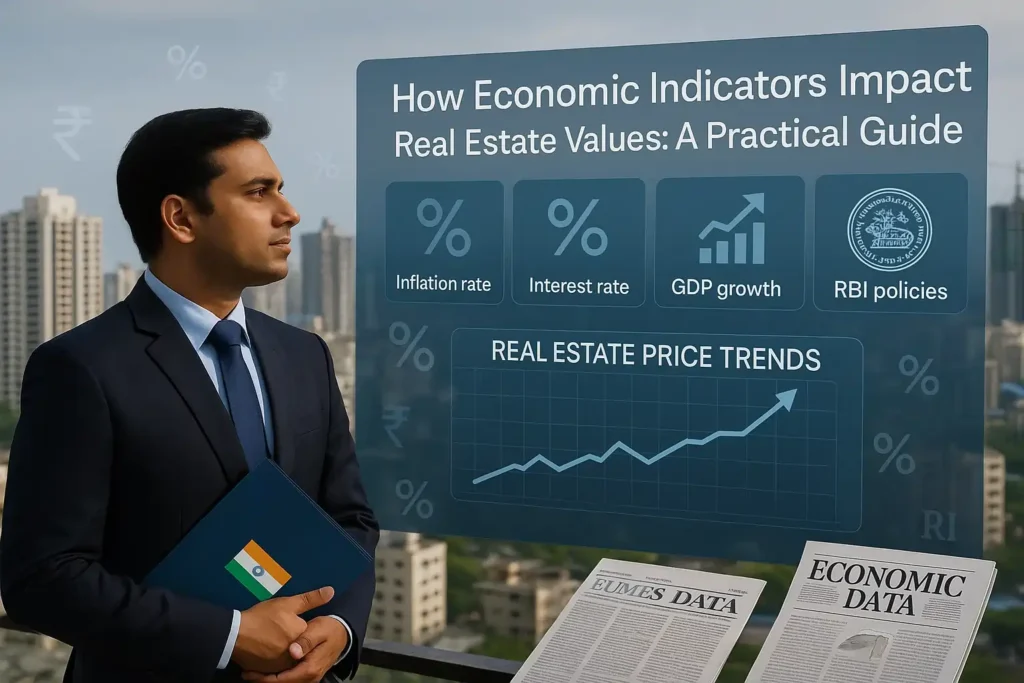
What Are Economic Indicators?
Economic indicators refer to statistical values that show the health and the trend of the economy in general of a nation. It is one of the figures that are published by governments and various institutions such as the RBI (Reserve Bank of India), Ministry of Statistics and the global agencies.
These indicators include:
- GDP (Gross Domestic Product)
- Inflation Rate
- Interest Rates (Repo, Reverse Repo)
- Employment/Unemployment Rate
- Consumer Confidence Index (CCI)
- Housing Starts
- Money Supply (M3)
Each of these plays a role in determining real estate demand, pricing trends, construction activity, and investor sentiment.
Also Read:
- Buy and Hold vs. Fix and Flip Which Strategy
- Downsizing in Tier-1 vs Tier-2 Indian Cities – Which Is Smarter?
- Where Should You Put Your Money in 2025? Real Estate or Stocks?
1. GDP Growth and Real Estate Demand
What it means:
GDP measures the total economic output of a country. A growing GDP indicates a healthy economy, increased income, and rising purchasing power.
Impact on real estate:
- Higher GDP growth boosts household income, leading to more homebuyers entering the market.
- Developers become more confident, launching new residential and commercial projects.
- Commercial real estate demand rises as businesses expand.
Example:
In India, when GDP growth crossed 7% in 2021–2022 post-pandemic, cities like Pune, Bangalore, and Gurgaon saw a spike in property launches and demand.
2. Interest Rates and Loan Affordability
What it means:
Interest rates, especially the RBI’s repo rate, directly influence mortgage loan rates. Lower interest rates make borrowing cheaper.
Impact on real estate:
- Lower interest rates = cheaper home loans = increased buying activity.
- Higher rates can slow down property sales and reduce affordability.
- Developers may delay projects when borrowing costs rise.
Practical Tip:
Keep track of RBI's monetary policy announcements. A rate hike could signal a slowdown in home sales, while cuts might indicate an upcoming boom.
3. Inflation and Construction Costs
What it means:
Inflation depicts the increase in cost of commodities and services. Although low inflation is healthy, high inflation causes effects on cost of materials and purchasing power.
Impact on real estate:
- High inflation leads to rising construction material costs (cement, steel, labor).
- Developers may increase property prices to maintain margins.
- Buyers might delay purchases, waiting for price stabilization.
Investor Insight:
During inflationary periods, real estate can act as a hedge. Rental income and property values tend to rise, preserving investment value.
4. Employment Rates and Housing Demand
What it means:
Employment rate indicates how many people are actively working and earning.
Impact on real estate:
- High employment supports housing demand, especially in urban centers.
- Low unemployment encourages renters to become homeowners.
- Job losses reduce buying power and can trigger a drop in home prices.
Example:
IT hubs like Bangalore and Hyderabad have resilient housing demand due to strong job markets and consistent hiring in tech sectors.
5. Consumer Confidence Index (CCI)
What it means:
CCI reflects how optimistic consumers are about the economy, employment, and their financial future.
Impact on real estate:
- High consumer confidence boosts homebuying and investing activity.
- Low confidence leads to fewer transactions and market stagnation.
Why it matters:
Real estate decisions often involve long-term commitments. Buyers need to feel secure about their income and future.
6. Housing Starts and Inventory Levels
What it means:
Housing starts measure the number of new residential projects begun in a period.
Impact on real estate:
- High housing starts indicate a growing market and builder confidence.
- Oversupply can lead to price stagnation or correction.
- Low starts may indicate future inventory shortages and rising prices.
Pro Tip:
Track local housing starts to gauge supply-demand dynamics in specific cities like Gurgaon, Noida, Pune, or Navi Mumbai.
7. Money Supply and Liquidity
What it means:
Money supply, particularly M3 in India, reflects the total funds circulating in the economy.
Impact on real estate:
- Increased money supply boosts liquidity and bank lending.
- Easy access to credit fuels real estate purchases and construction activity.
- Tight money supply (due to inflation control) can reduce lending and investment.
Practical Advice for Real Estate Investors
a. Monitor the RBI and Government Announcements
Real estate is highly sensitive to policy changes. Keep an eye on:
- RBI repo rate changes
- Credit-linked subsidy schemes (CLSS)
- Infrastructure spending announcements
b. Study Local Trends Alongside National Indicators
National economic health matters, but local job markets, infrastructure development, and migration patterns have direct influence on specific cities or towns.
c. Use Data to Time Your Entry and Exit
Understanding when the economy is entering expansion or contraction can help you:
- Buy before price hikes
- Sell before market slowdowns
- Avoid overpaying in a saturated market
It is not all about the location of real estate, but also the economy indicators that detect the time to buy and the time to sell. However, analyzing the situation in the whole economy will help to minimize risks and to get the maximum income.
By 2025 as digital transparency increases and financial data becomes accessible there are no more excuses to be making blind bets on real estate. Make use of the information provided by GDP, interest rates, inflation among other indicators in your due diligence.