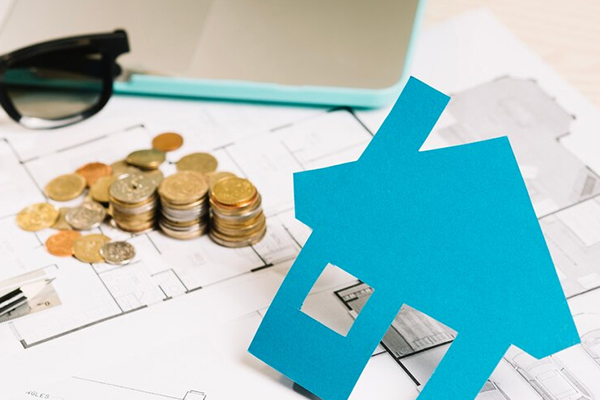
There is just something magic about compound growth in real estate: Time, reinvestment, and patience. With the correct location, which is good properties in good growth areas, reinvestment of income and no panic selling, you can use this one property to create a multi property portfolio over time.
These smaller cities led by the growth of infrastructure, government policies, affordability, and an explosion of employment opportunities are gaining the interest of both domestic and Non-Resident Indian investors. This trend cannot be considered a speculation only, but also can be backed with the information and economic foundations in the long run.
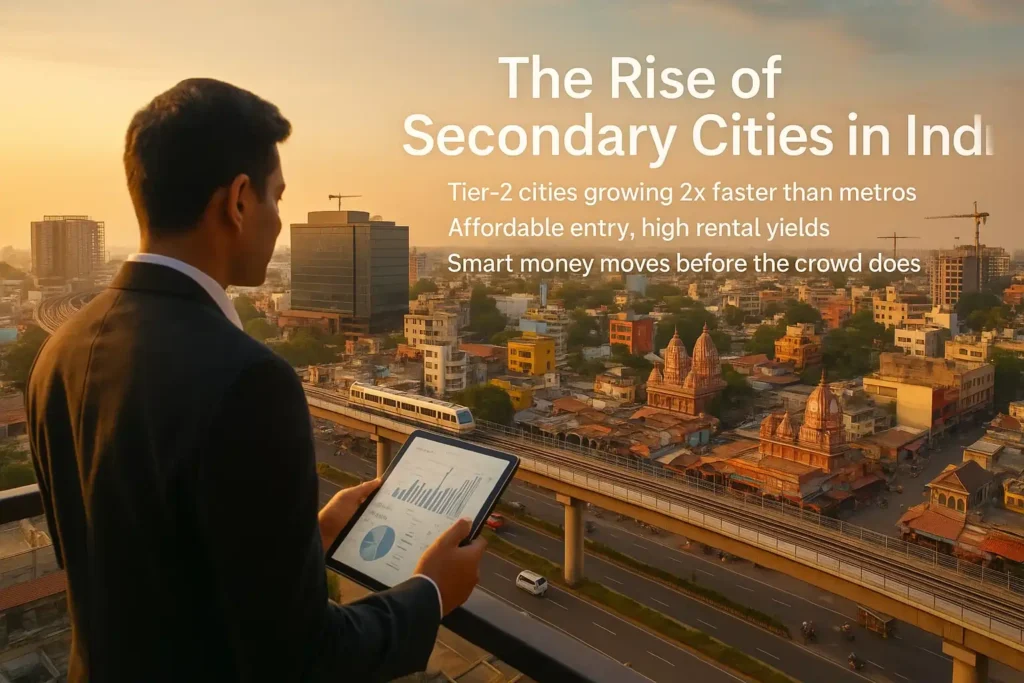
What Are Secondary Cities?
Tier-2 / Tier-3 cities, also referred as secondary cities, are major regional centers with lesser population and economy than Tier-1 metros. Indore, Coimbatore, Surat, Lucknow, Jaipur, Bhubaneswar, Nagpur, Vizag are examples.
They typically feature:
- Lower property costs compared to metros
- Rising commercial and industrial activity
- Ongoing infrastructure projects (airports, metro lines, highways)
- Quality of life advantages (less congestion, cleaner air)
Why Secondary Cities Are Now in the Spotlight
The investment momentum in these cities is the result of multiple economic, technological, and policy-driven factors.
1. Affordability and Higher ROI Potential
- In metros, the cost of prime real estate has reached a saturation point for many buyers.
- Secondary cities offer lower entry prices and higher rental yields.
- Example: A mid-segment apartment in Gurugram can cost ₹1.2–1.5 crore, while a similar unit in Jaipur may cost ₹60–70 lakh with competitive rental income.
2. Infrastructure Development
- Smart City Mission and AMRUT schemes have improved roads, sanitation, and digital connectivity.
- Upcoming expressways (Delhi-Mumbai Expressway, Ganga Expressway) are reducing travel times drastically.
- Airport expansions in cities like Surat, Dehradun, and Bhubaneswar are opening them up to business and tourism.
3. IT and Industrial Expansion
- Many Tier-2 cities are becoming outsourcing hubs for IT, manufacturing, and startups.
- Government incentives under Make in India and PLI schemes have encouraged industries to set up in cities like Coimbatore, Nagpur, and Indore.
4. Migration Trends and Lifestyle Preferences
- The pandemic accelerated reverse migration as professionals sought larger homes in less congested areas.
- With remote and hybrid work models, living in smaller cities is now a viable choice for white-collar workers.
5. NRI and Institutional Interest
- NRIs are diversifying their portfolios by buying properties in their hometowns or growth-potential Tier-2 cities.
- Institutional investors and REITs are also exploring commercial spaces in emerging cities.
Also Read:
- Downsizing in Tier-1 vs Tier-2 Indian Cities – Which Is Smarter?
- What Makes Tier 2 & Tier 3 Cities Good Places to Invest in Agricultural Land?
- 5 Emerging Tier 2 Cities in India to Invest in 2025
Key Secondary Cities Where Smart Money Is Moving
Here are some of the most promising secondary cities in India, based on growth drivers, infrastructure, and demand:
| City | Key Growth Drivers | Major Projects |
|---|---|---|
| Indore | Cleanest city tag, IT parks, industrial hubs | Super Corridor, metro project |
| Coimbatore | Textile & manufacturing base, educational institutions | Coimbatore Airport expansion |
| Surat | Diamond & textile industry, logistics hub | Surat Metro, Diamond Bourse |
| Lucknow | State capital advantage, expressway connectivity | Purvanchal Expressway, metro expansion |
| Jaipur | Tourism, IT sector, proximity to Delhi | Delhi-Mumbai Expressway |
| Nagpur | Zero Mile location, logistics hub, MIHAN project | Nagpur Metro, Samruddhi Expressway |
| Bhubaneswar | IT & education hub, smart city leader | Info-valley IT hub |
Investment Opportunities in Secondary Cities
Residential Real Estate
- Affordable housing demand remains strong.
- Premium gated communities are emerging to cater to high-income professionals.
Commercial Spaces
- Co-working hubs and retail spaces are growing rapidly.
- Warehousing and logistics parks are in demand due to e-commerce expansion.
Land and Plots
- Outskirts of secondary cities offer high appreciation potential as urban sprawl expands.
Risks and Considerations
While secondary cities offer exciting opportunities, investors should be mindful of:
- Liquidity risk: Reselling may take longer than in metros.
- Market research: Not all secondary cities have the same growth trajectory.
- Regulatory checks: Verify RERA registration, zoning rules, and land titles.
Expert Tips for Investors
- Follow infrastructure: Projects like new highways, metros, or industrial corridors often precede a property price surge.
- Diversify: Avoid putting all capital into one location or property type.
- Engage local experts: Partner with trusted brokers, developers, and legal advisors.
- Think long-term: Real gains in secondary cities often come over 5–10 years, not overnight.
The emergence of secondary cities in India is an indication of the movement of the structure on the real estate market in the country. Smart investors are choosing these cities no longer as alternates since these cities are offering better ROI, affordability and growth prospects of these cities in future, lending them a first preference.
With the right due diligence and strategic approach, secondary cities could be where your capital works the hardest in the coming decade.
Conclusion
With the changing face of urban development in India, the new frontier of investments is the urban second cities. These cities are becoming attractive to local and international investors due to better infrastructure, low prices of real estate, and increased employment opportunities. The smart money is moving out of Coimbatore and Indore to Surat and Lucknow as the high ROI potential and sustainable urban planning drive such moves. To the people who are interested in investing smart in the year 2025 and further, the secondary cities are the lowest cost and the highest growth region, the future of Indian real estate.
FAQ,s Frequently asked questions
1: What are secondary cities in India?
Answer:
Secondary cities are mid-sized urban centers that are not traditional metro hubs like Mumbai, Delhi, or Bengaluru. Examples include cities such as Coimbatore, Indore, Surat, Lucknow, and Vizag. They are now becoming major investment destinations due to rapid infrastructure growth and affordability.
2: Why are investors focusing on secondary cities in India?
Answer:
Investors are turning to secondary cities because they offer lower entry costs, higher rental yields, and faster appreciation potential compared to saturated metros. Government initiatives like the Smart Cities Mission and improved connectivity are also fueling this growth.
3: Which secondary cities in India show the most investment potential in 2025?
Answer:
Top secondary cities attracting smart money include Indore, Coimbatore, Lucknow, Vizag, Jaipur, and Surat. These cities benefit from industrial expansion, job creation, and strong real estate demand.
4: How do infrastructure projects impact real estate growth in these cities?
Answer:
Massive infrastructure investments—such as metro expansions, new airports, expressways, and IT parks—boost accessibility and attract both businesses and residents. This leads to increased property demand and appreciation rates.
5: What risks should investors consider before investing in secondary cities?
Answer:
Key risks include inconsistent local governance, slower liquidity, and overdependence on upcoming infrastructure. Investors should focus on verified developers, emerging job zones, and areas with strong population inflow to minimize risk.
6: How do secondary cities align with India’s economic growth story?
Answer:
Secondary cities are becoming economic powerhouses, driving regional balance and employment. They contribute significantly to India’s GDP by attracting industries, startups, and new housing demand—making them central to the next phase of India’s urban expansion.