There are not many names that are able to elicit as much honor as that of Blackstone in the realm of real estate investing, the largest alternative investment firm in the world. As Blackstone, Real Estate Investment Trusts (REITs) and other institutional investors are also very important in defining the market, determining the trends, and dictating long-term returns.
Their size might seem too big to be studied by an individual investor but there is much you can learn about and to use their approaches. Let us analyse the lessons they provide us, and how you can make them work in your personal journey within real estate investments.
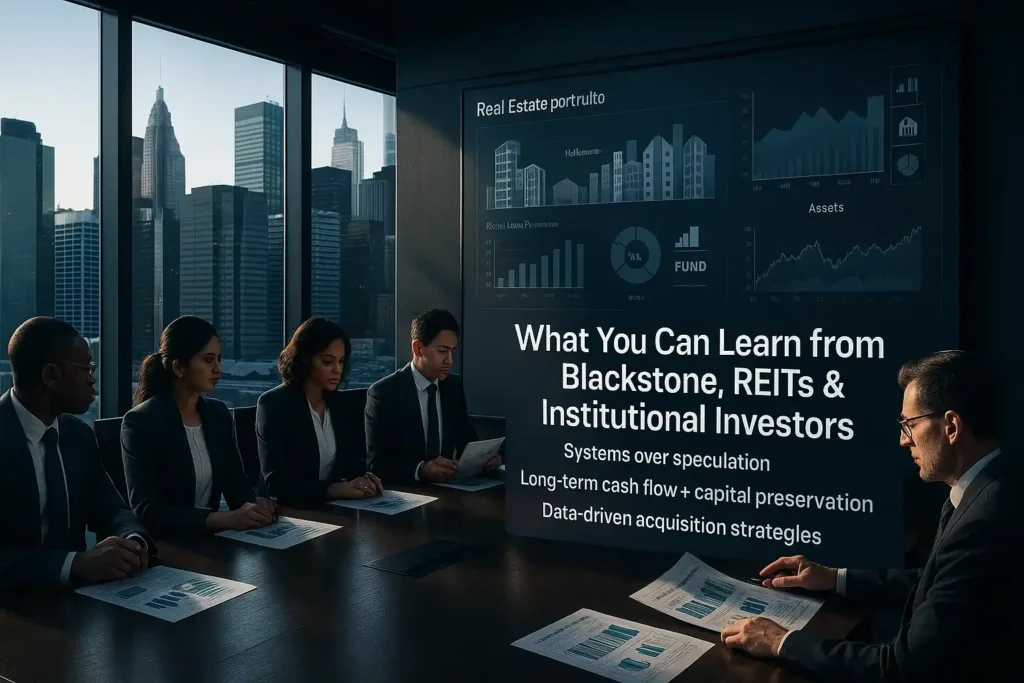
Understanding the Players
1. Blackstone
Established in 1985, Blackstone controls more than 1 trillion dollars (as of 2025), of which a sizeable percentage belongs to real estate. They buy logistics parks, rental housing, hotels and data centers. Their strategy is concentrated on a long term value development, operations performance as well as specialization in the industry.
2. REITs
REIT refers to any company which owns, operates or finances income-generating real estate. They enable small-scale investors to venture into thus allowing them to access large-scale real estates without acquiring property itself. Public publicly traded REITs are controlled, open and also tend to provide regular dividends.
3. Institutional Investors
Under this category, there are pension funds, insurance firms, sovereign wealth funds and the private equity firms. They usually invest in real estate as a way of portfolio diversification, a means of steady income and inflation hedge.
Key Lessons You Can Learn
1. Think Long-Term, Not Just Short-Term Gains
Blackstone and the majority of the institutional investors do not make investments with the hope of making a quick turn. Then they seek stable income and appreciation. Such a strategy can guide them through market cycles and be able to leverage growth on a decades long horizon rather than on a month to month basis.
Your takeaway: Focus on assets with sustainable demand and solid fundamentals rather than chasing speculative short-term spikes.
2. Diversification Is Non-Negotiable
REITs and institutional investors diversify their investments in the type of property, location and economic cycle. As one of the examples, they might have a combination of warehouses, offices and residential property across various countries.
Your takeaway: Even as a smaller investor, you can diversify—by owning properties in different markets or by mixing real estate with REIT investments in your portfolio.
3. Follow Demographic & Economic Trends
Blackstone doesn’t just buy properties; they invest where population growth, urbanization, and infrastructure are driving future demand. For instance, they’ve heavily invested in logistics centers to support the e-commerce boom.
Your takeaway: Watch where people and businesses are moving. Track government infrastructure plans, migration trends, and job market shifts.
4. Prioritize Cash Flow Over Speculation
Institutional investors value predictable rental income. Even if property prices stagnate temporarily, steady rental yields keep the investment profitable.
Your takeaway: Don’t buy solely hoping for price appreciation. Ensure the property generates consistent income to cover costs and deliver returns.
5. Use Professional Management
Professional asset management teams are invested in by large investors who take care of rentals and upgrading properties. This will provide satisfaction between tenants, efficiency in operations and an increased long-term value.
Your takeaway: If managing tenants and maintenance isn’t your strength, hire a reliable property manager to protect your investment.
6. Leverage Data & Research
Market players institutional looking at deep in the Market research — not hunger intuition. They source vacancy rates, rental trends, absorption rates and costs of capital before investing.
Your takeaway: Before buying, do your homework. Use government data, real estate reports, and financial modeling to assess risk and reward.
7. Embrace Alternative Asset Classes
Blackstone’s investments go beyond conventional housing and office buildings, including student housing, health care facilities, cold storage and data centers. Such niche markets tend to be more productive and have less competition.
Your takeaway: Explore non-traditional real estate segments that match your budget and risk appetite.
How to Apply These Lessons as an Individual Investor
- Start Small but Think Big – You don’t need billions to think like an institutional investor. Even a single well-researched property can follow the same principles.
- Mix Direct & Indirect Investing – Combine owning rental property with investing in REITs to spread risk and gain exposure to large-scale assets.
- Stay Educated – Read market reports, attend webinars, and follow global investment news. The best investors are always learning.
- Network with Professionals – Brokers, property managers, and legal advisors can help you access better deals and reduce costly mistakes.
You have no capital like Blackstone, and the size of a global REIT, but you can borrow their mindset. It is not only billion-dollar companies who can embrace long-term thinking, strict diversification, and evidence-based decision-making; these are all practices any serious investor can embrace.
When you think in the shoes of an institutional investor you increase your odds of successfully riding out market cycles, mitigating risk and developing cashflowing wealth in the form of real estate.
Conclusion
The experience of Blackstone, REITs and other institutional investors will provide a good roadmap to those who want to create sustainable wealth in real estate. Their approaches lay stress on data-driven decision-making, diversification, rigorous risk management, and long-term vision. Studying the way these giants manage to distribute capital, time market cycles and concentrate on sustainable cash flow instead of speculation, investors will be able to make smarter and resilient decisions. After it is all said and done, the moral of the story is this, invest as an institution, in a strategic, patient and fundamental manner.
FAQ,s Frequently asked questions
1. What makes Blackstone a leading name in real estate investing?
Blackstone’s success comes from its large-scale diversification, deep market research, and disciplined capital allocation. They focus on long-term value, buying undervalued assets during downturns and selling strategically in peak cycles.
2. What can individual investors learn from Blackstone’s strategies?
Individual investors can learn the importance of patience, risk management, and timing. Like Blackstone, they should research macroeconomic trends and focus on cash-flow-generating assets rather than short-term speculation.
3. How do REITs compare to institutional real estate investments?
REITs allow individual investors to gain exposure to real estate portfolios without directly owning property. Institutional investors, on the other hand, typically invest in large, private deals with higher capital requirements and control.
4. What are the key takeaways from institutional real estate strategies?
Key lessons include portfolio diversification, data-driven decision-making, and focusing on assets with strong fundamentals—such as location, demand, and yield potential.
5. What is the biggest lesson from Blackstone’s approach to real estate cycles?
Blackstone’s key lesson is to “buy when others are fearful.” They leverage downturns to acquire quality assets at discounts and profit when markets recover—showing the power of contrarian investing.