There have never been more opportunities to invest and an abundance of alternatives in the current financial markets makes it ever easier to invest. However, this is a question that divides investors on a single topic, should they utilise passive investing strategy or engage in active investing?
This is not a matter of choice. Quintessentially, it is a question of risk tolerance, the time horizon and the investment objective. Smart investing is the same scenario in India and the world over since companies that make the right decision are always winners in terms of long-term growth and this can be a costly affair.
So, in this article, we will discuss the main differences between the more active investing and passive investing, their risk profiles, and how one can make a decision in favor of one of these methods.
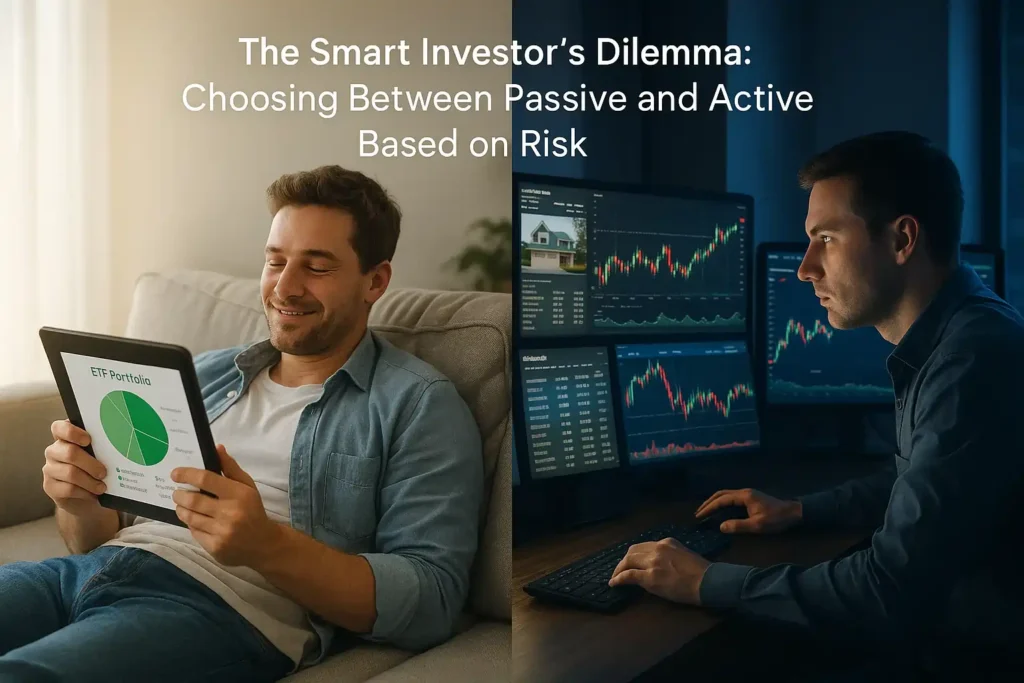
What Is Passive Investing?
Passive investing is an investment approach in which you buy market index or Exchange-Traded Funds (ETFs) and hold them. The concept is basic, you do not attempt to outsmart the market, you trace it.
- Example: Buying a Nifty 50 Index Fund or an S&P 500 ETF and holding it for 10–15 years.
- Key Feature: Minimal trading, lower costs, and long-term compounding.
Advantages of Passive Investing
- Low Costs: No need to pay hefty management or brokerage fees.
- Reduced Stress: Less monitoring and fewer emotional decisions.
- Long-Term Growth: Markets generally trend upward over time.
Risks in Passive Investing
- Market Risk: If the market crashes, your portfolio falls too.
- No Outperformance: You settle for average returns, even when opportunities to do better exist.
What Is Active Investing?
Active investing is a practice that consists of continuous purchases and sales of stocks, bonds, or funds in order to better achieve the market performance. Is it research, timing and, in certain cases, sheer intuition which is followed by the investors?
- Example: Selecting mid-cap stocks in sectors like IT, EV, or pharmaceuticals, and rotating them based on market cycles.
- Key Feature: Active portfolio management with higher engagement.
Advantages of Active Investing
- Potential to Outperform: Smart moves can beat the index.
- Flexibility: Adjust investments quickly to market conditions.
- Diversified Strategies: Can include value investing, growth investing, or sector-specific plays.
Risks in Active Investing
- High Costs: Brokerage fees, fund manager charges, and taxes reduce net returns.
- Requires Skill & Time: Wrong calls can erode wealth fast.
- Emotional Risk: Fear and greed often lead to poor decisions.
Also Read:
- Step-by-Step Guide to Successfully Navigate Real Estate Investing
- The Magic of Compound Growth in Real Estate How Time Multiplies Wealth
- How to Build an Investment Property Pipeline Without Burnout
Passive vs. Active Risk Profiles
| Factor | Passive Investing | Active Investing |
|---|---|---|
| Risk Level | Moderate, tied to market performance | High, depends on investor’s skill & timing |
| Cost | Low | High |
| Return Potential | Market average | Above average or below average |
| Time Commitment | Low | High |
| Best For | Long-term investors, retirement planners | Risk-takers, short to medium-term wealth creators |
The Smart Investor’s Dilemma
The dilemma is not choosing one over the other, but deciding which strategy aligns with your risk appetite and financial goals.
- If you want peace of mind, steady growth, and minimal involvement, passive investing is ideal.
- If you enjoy research, risk-taking, and active engagement, active investing may be more rewarding.
- Many smart investors use a hybrid approach:
- 80% passive in index funds or ETFs for stability.
- 20% active in individual stocks or sector plays for higher returns.
Risk-Based Decision Framework
Ask yourself:
- What is my risk tolerance?
- Low → Passive funds
- High → Active strategies
- What is my time horizon?
- Long-term (10+ years) → Passive investing compounds wealth better
- Short-term (1–5 years) → Active may capture faster gains
- How much time can I give to monitoring?
- Limited time → Passive
- Full engagement → Active
The fact is people should not expect a universal approach. Intelligent investors combine the two styles, allowing them passive investments to accumulate wealth in the long run and apply active strategies to exploit short-term prospects.
With the increased presence of retail in India and the increase in access to the global market investors are more flexible than ever before. The problem really is not which is the better but which fits my risk appetite and lifestyle.
Remember, wealth is not built by chasing every trend. It is built by consistent, disciplined choices aligned with your financial goals.
Final thoughts
The decision between passive and active investing is always up to the risk tolerance, time investment, and financial aim. The advantages of passive strategies are stability, reduced cost, and long-term consistency, which are suitable to investors willing to invest and have consistent growth but without much effort. Conversely, active investing is more likely to produce higher potential returns but it is more volatile and requires expertise and monitoring. The intelligent investor realizes that the solution could be in setting a balance between both, by using passive funds to achieve core stability and active investment to get to the targeted opportunities.
FAQ,s Frequently asked questions
1. What is the difference between passive and active investing?
Answer:
Passive investing involves tracking market indexes like the Nifty 50 or S&P 500 with minimal trading. Active investing, on the other hand, relies on frequent buying and selling decisions made by fund managers or investors aiming to outperform the market.
2. Which strategy is better for risk-averse investors?
Answer:
Passive investing is generally better for risk-averse investors since it offers diversification, lower costs, and stable long-term returns without the volatility of active decision-making.
3. Do active investors always earn higher returns?
Answer:
Not necessarily. While active investors aim to beat the market, research shows that most active funds underperform their benchmark indexes after fees and taxes are considered.
4. Can a combination of both strategies work?
Answer:
Yes, many investors adopt a hybrid approach—allocating part of their portfolio to passive index funds for stability and another part to active strategies for potential alpha or higher returns.
5. How does market volatility affect active vs passive strategies?
Answer:
During high volatility, active managers may exploit short-term opportunities, while passive investors ride out market swings. Over time, however, passive strategies tend to outperform due to lower costs and fewer emotional decisions.