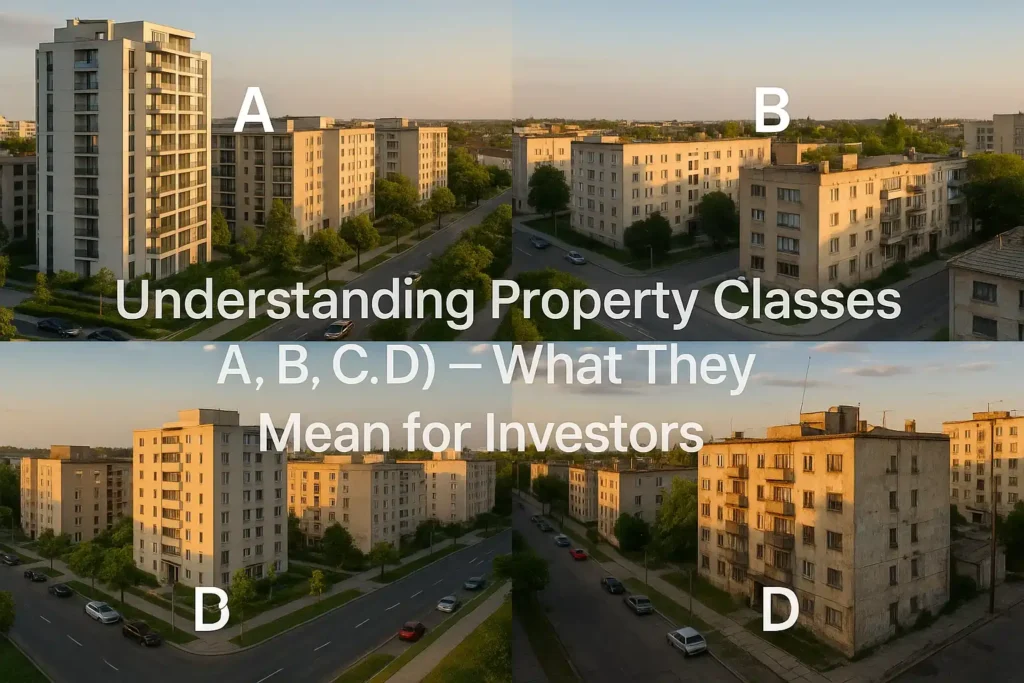
When property investors are going through the process of considering possible investment opportunities one of the first terms that they come across is the property class system. Personal properties are generally divided into Class A, B, C and D according to their similarities in terms of age, location, condition and tenant profile and risk-return profile.
Being familiar with such classes is of paramount importance since they are directly associated with entering the rental business and appreciation opportunities and maintenance issues. To understand them, it is important to simplify these property classes and offer some practical insights to the investors.
What Are Property Classes?
Property classification is an informal industry convention applied by brokers, consultants and institutional investors to assess and compare real estate. However, as compared to RERA guidelines or government circle rates, the property classes are subjective, and they assist the investors:
- Identify risk vs. reward balance.
- Decide which tenant base they want to serve.
- Compare cash flow stability vs. appreciation potential.
Class A Properties – Premium & Low-Risk Investments
Definition:
The Class A properties are latest, best constructed and most desirable by location. They mostly draw tenants with a high income and professionally managed.
Key Characteristics:
- Built within the last 10–15 years.
- Located in prime neighborhoods with strong infrastructure.
- High-end amenities such as gyms, concierge services, or premium interiors.
- Lower vacancy rates due to high demand.
Investment Outlook:
- Pros: Stable rental income, strong appreciation, minimal maintenance.
- Cons: Lower rental yields because purchase prices are high.
Example (India): Luxury apartments in Golf Course Road, Gurgaon or South Mumbai fall into Class A.
Class B Properties – Balanced Value with Moderate Risk
Definition:
Class B properties are a bit older and cheaper when compared to Class A, but in good locations with a consistent demand. They are attractive to middle-income tenants.
Key Characteristics:
- 15–30 years old but well-maintained.
- Located in established but not prime neighborhoods.
- May lack luxury amenities but still functional and livable.
- Moderate maintenance and repair costs.
Investment Outlook:
- Pros: Higher rental yields than Class A, affordable entry point.
- Cons: Slower appreciation compared to Class A, periodic renovations needed.
Example (India): Mid-segment housing projects in Dwarka, Delhi, or Noida Sector 50.
Class C Properties – High Yield, High Risk
Definition:
C properties are older and less desirable looking and located. They deal with lower-income tenants and tend to be run-down in need of substantial repairs.
Key Characteristics:
- Typically 30–50 years old.
- Infrastructure may be outdated.
- Higher tenant turnover and vacancy risk.
- Limited or no amenities.
Investment Outlook:
- Pros: Low acquisition cost, higher rental yield potential.
- Cons: High maintenance, risk of delayed rent payments, property depreciation.
Example (India): Old apartments in East Delhi or peripheral industrial areas of Tier-2 cities.
Class D Properties – Distressed or Very High Risk
Definition:
D properties are in damaged state or in the high-crime and underdeveloped areas. These are the most risky ones with the possibility of providing speculative opportunities to turnaround investors.
Key Characteristics:
- More than 50 years old or poorly maintained.
- Require major renovation or complete redevelopment.
- Very low tenant quality and unreliable rental income.
- May face legal disputes, encroachments, or regulatory issues.
Investment Outlook:
- Pros: Extremely low cost of acquisition, potential for high returns if area redevelops.
- Cons: Very high risk, uncertain demand, heavy legal and maintenance challenges.
Example (India): Abandoned mills in Mumbai (before redevelopment) or neglected housing clusters in old industrial towns.
How Investors Should Approach Property Classes
When choosing between Class A, B, C, and D, investors should align their choice with their risk appetite and investment goals:
- Class A → Best for long-term wealth preservation with steady appreciation.
- Class B → Balanced choice for rental yield + appreciation.
- Class C → Cash flow-focused investors willing to manage risks.
- Class D → Speculative, turnaround, or redevelopment investors.
Fact Check: Top Indian cities have experienced 8-10 percent per year appreciation in prime properties (Class A) with the older ones (class C and D) often lagging behind unless they are redeveloped, according to the CBRE Asia-Pacific Real Estate Market Outlook 2024.
The knowledge of the property classes is not merely theoretical – it gives a guide to an investment decision. Security is available in the Class A, but balance in Class B, and the Classes C and D have given greater chances of returns which also came with greater risks.
Smart investors often diversify across property classes to balance cash flow, appreciation, and risk.
If you are thinking to invest in Gurgaon, Noida, and NCR, find reliable consultancy that can lead you on property definition, due diligence, and long-term returns.
Ready to maximize your returns by choosing the right property class? At The Whitelisted Estate, we offer the best real estate consultation service in NCR, helping investors make informed, risk-free, and profitable decisions. Let us guide you through Class A to D properties with expert insights and market-backed strategies.