Numbers are the story in real estate investing. The hard part is which numbers are relevant in the evaluation of a deal. Three of the most popular metrics are Cash-on-Cash Return (CoC), Return on Investment (ROI), and Internal Rate of Return (IRR).
Each of them conveys something different about performance potential profitability to the investor. Not knowing them properly may result in poor choices and understanding them well is one of the ways that you could distinguish yourself among the rest as a shrewd investor.
In this article, we break down these metrics in simple terms, provide real-world examples, and explain when and why each should be used.
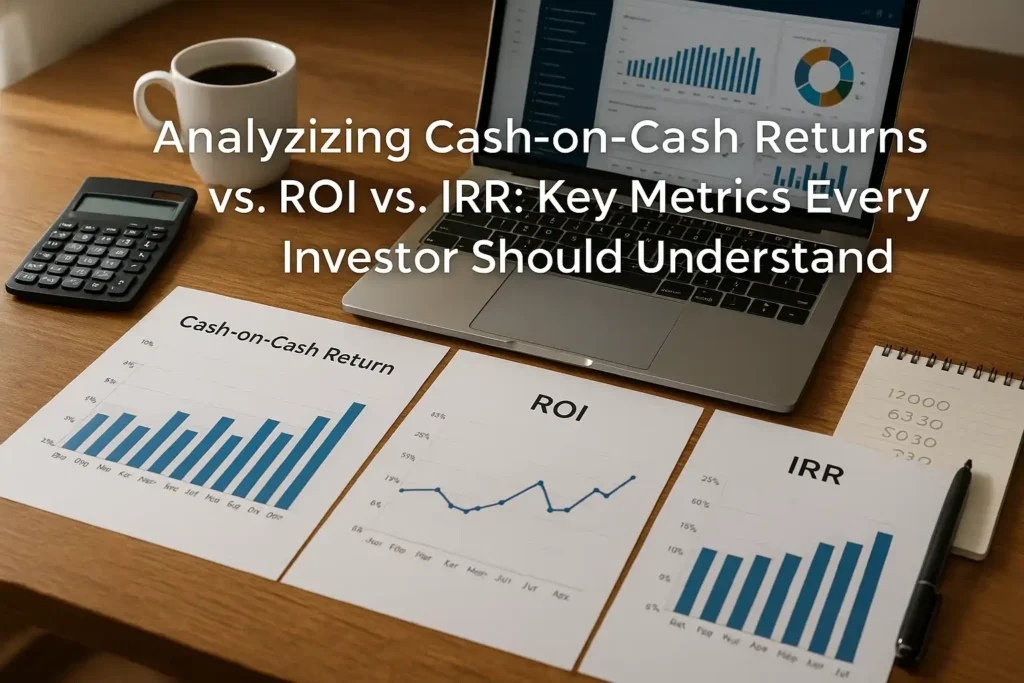
1. What is Cash-on-Cash Return (CoC)?
Definition:
Cash-on-Cash Return evaluates the amount of annual pre-tax money flow that an investment generates as compared to the amount of cash it was invested. It only concentrates on the real money you invest in the deal, not the sum of money that the property bodes in whole.
Example:
- You invest ₹50 lakh in a rental property.
- It generates ₹5 lakh in annual pre-tax cash flow.
- CoC = (₹5 lakh ÷ ₹50 lakh) × 100 = 10%
Use Case:
- Best for short-term investors or those focusing on immediate cash flow.
- Helps compare properties with similar financing structures.
Fact: Investors in India in emerging markets in real estate such as Dwarka Expressway and Sohna usually follow CoC returns, to help benchmark rental yields in the 7-10 percent range.
2. What is Return on Investment (ROI)?
Definition:
ROI is used to calculate overall profitability of an investment or the amount of investment profitability in relation to the amount spent on the investment.
Example:
- You bought a property for ₹80 lakh.
- After 5 years, you sell it for ₹1.2 crore and earned ₹20 lakh in rental income.
- Total Gain = ₹1.2 crore + ₹20 lakh – ₹80 lakh = ₹60 lakh.
- ROI = (₹60 lakh ÷ ₹80 lakh) × 100 = 75% over 5 years (15% annualized).
Use Case:
- Best for long-term investors to measure overall success.
- Useful when calculating profits from both cash flow and capital appreciation.
Fact: According to a Knight Frank India 2024 report, prime residential markets in Gurgaon have recorded 12-16 percent CAGR on returns in last five years, due to the high rate of urbanization.
3. What is Internal Rate of Return (IRR)?
Definition:
IRR is the rate of discount at which the present value of cash flows (rents, resale etc.) are summed to zero. In more basic words it represents the return per year, compounded over the period of the holding given the value of the money today.
Why It Matters:
- ₹1 today is worth more than ₹1 five years from now. IRR accounts for this by discounting future earnings.
Example:
- You invest ₹1 crore in a project.
- You earn ₹10 lakh yearly in rental income for 5 years.
- You sell the property in year 5 for ₹1.3 crore.
- Calculating IRR requires financial software or Excel, but in this case, the IRR would be around 12–13%.
Use Case:
- Best for complex projects with irregular cash flows.
- Common in commercial real estate, joint ventures, and development projects.
Fact: IRR is the metric commonly used by global investors as a yardstick A Deloitte survey in 2023 found that institutional investors seek to achieve an IRR of 12-15 per cent in Indian commercial property.
4. Comparing the Three Metrics
| Metric | Focus | Best For | Limitation |
|---|---|---|---|
| CoC Return | Annual cash income relative to cash invested | Rental income, short-term cash flow | Ignores appreciation & financing |
| ROI | Total profit vs. total investment | Long-term overall performance | Doesn’t account for time value of money |
| IRR | Annualized return considering time value | Large-scale or long-term projects | Complex to calculate, sensitive to assumptions |
5. Which Metric Should You Trust Most?
- If you’re a cash flow investor → Use CoC Return.
- If you want to measure long-term wealth creation → Use ROI.
- If you’re comparing multi-year projects with varying cash flows → Use IRR.
Smart investors don’t rely on just one metric. Instead, they look at all three in combination to get a complete financial picture.
The question is not only a matter of calculating Cash-on-Cash Return, ROI and IRR, it must be seen in light of informed and reliable investment choices as well. All these metrics perform various purposes, and combined, these tools can be used to estimate the old and the new in a fair manner to reduce risks and to maximize returns.
For new investors, starting with CoC and ROI is often sufficient. As you grow your portfolio, learning to calculate and interpret IRR will give you a professional edge.
Read Related Articles: