In India, the real estate market has been dominated by ownership demand, wherein home buying was considered as a symbol of financial stability and security. However, this narrative has been changing with demographic shifts, urban migration, and changing preferences in lifestyle. One such model that’s gaining popularity and is slowly getting a foothold in India is the Build-to-Rent (BTR).
But is the BTR model truly scalable in India’s diverse and dynamic housing market? Let’s explore.
What is the Build-to-Rent (BTR) Model?
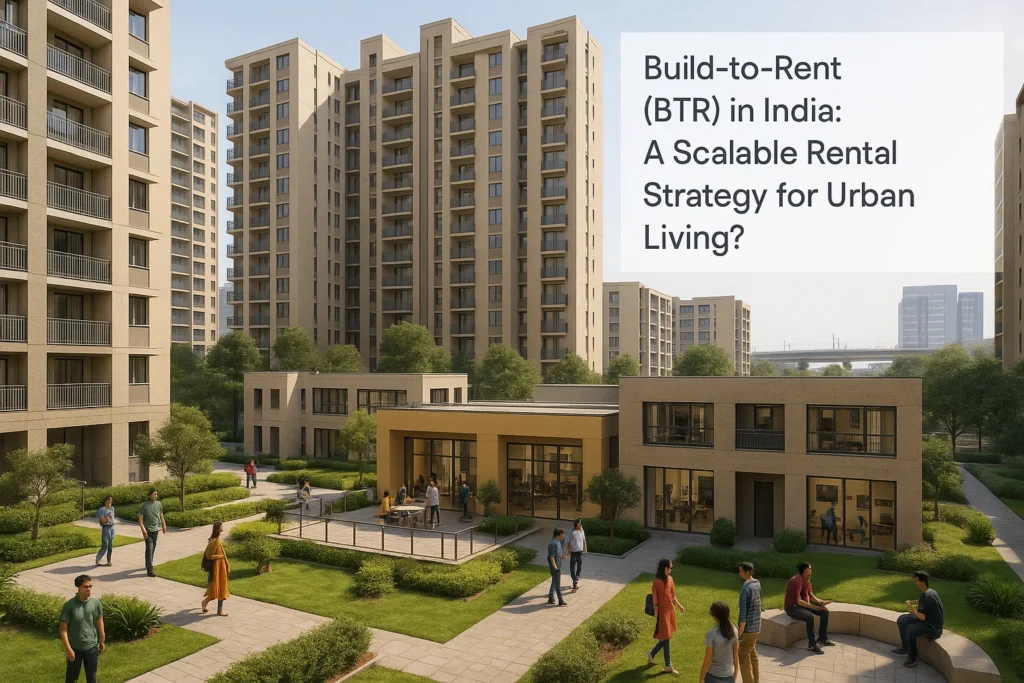
The Build-to-Rent (BTR) model refers to residential properties specifically developed and designed for long-term rental use, rather than for sale.
Unlike conventional real estate development, where apartments or houses are sold to individual purchasers, BTR projects are usually owned and operated by institutional investors, developers or private funds. These projects are built around providing quality rental housing with predictable rental returns and providing the tenants with managed services, amenities and flexibility of rental terms.
Globally, BTR has become a preferred housing solution in cities like London, New York, and Sydney, where affordability issues and rising rental demand have created an institutional rental market.
Why BTR is Relevant for India
India has historically been an ownership-driven market, but the dynamics are evolving:
- Urban Migration & Millennial Workforce
With more than 40% of India’s population predicted to live in urban areas by 2030, affordable rental housing with proper management is in high demand. Renting is in demand because it offers greater flexibility compared to buying to migrant professionals, students and gig-economy workers. - Rising Home Prices
Renting is seen as a viable option in urban areas such as Mumbai, Bengaluru, Delhi-NCR, and Pune, where property ownership is becoming less and less accessible to the younger generation. - Changing Attitudes Toward Homeownership
Millennials and Gen Z value mobility, lifestyle amenities, and financial flexibility over long-term ownership, creating a cultural shift toward renting. - Institutional Investor Interest
International players such as Blackstone, Brookfield and Hines have already expressed their interest in India’s residential rental market, indicating that organised rental housing might emerge as a significant asset class.
Also Read:
- Rise of Grade-A Office Spaces in Tier-2 Indian Cities
- Warehouse & Logistics Real Estate Booming Sector
- Transit-Oriented Development
- CapEx Planning in Commercial Real Estate What Savvy Investors
Benefits of the BTR Model in India
If implemented at scale, the Build-to-Rent model could bring multiple benefits to both tenants and investors:
- For Tenants:
- Better quality and managed housing compared to fragmented unorganized rentals.
- Access to amenities like gyms, coworking spaces, and community areas.
- Transparent leasing policies and tenant-friendly contracts.
- For Developers/Investors:
- Stable, recurring rental income instead of one-time sales.
- Long-term asset appreciation.
- Entry into a scalable asset class that aligns with India’s growing urban rental demand.
Challenges to Scaling BTR in India
Despite the potential, the BTR model faces challenges:
- Cultural Preference for Ownership
Owning a home is deeply embedded in India’s social fabric. Changing this mindset will take time. - Regulatory and Tax Framework
Current housing policies and tax incentives largely favor ownership. Rental housing policies are still evolving, with frameworks like the Model Tenancy Act, 2021 yet to see uniform implementation across states. - Profitability Concerns
Rental yields in India average around 2–3%, much lower than global BTR markets (5–7%). This makes the model less attractive unless backed by large-scale urban demand and efficient property management. - Operational Complexities
Managing large-scale rental housing requires expertise in tenant services, technology, and property maintenance—areas where India still lacks mature infrastructure.
Policy Support and Future Outlook
The Indian government has recognized the importance of rental housing:
- The Model Tenancy Act, 2021 aims to balance tenant-landlord relationships and attract institutional investors into the rental market.
- Some state governments are exploring affordable rental housing complexes (ARHCs) under the Pradhan Mantri Awas Yojana (PMAY-Urban), which could dovetail with private-sector BTR projects.
Globally, BTR grew rapidly when governments and investors worked together to build a structured rental ecosystem. If India moves in the same direction—offering tax incentives, regulatory clarity, and infrastructure support—the model could scale significantly.
Expert View Is BTR Scalable in India?
- Short-Term Outlook (3–5 years):
Adoption may remain limited to metro cities like Mumbai, Bengaluru, Delhi-NCR, Hyderabad, and Pune, where rental demand is strongest. - Long-Term Outlook (5–10 years):
With greater urbanization, institutional funding, and policy thrust, BTR can become an institutionalized asset class that offers a mix of affordable housing for tenants and stable returns for owners.
Build-to-Rent has tremendous potential in India but needs ecosystem level support to scale. While there are challenges related to affordability, cultural preferences, and regulatory gaps, the changing demographics and increasing demand for urban rentals set the stage for growth.
For investors and developers, BTR provides a way to diversify portfolios and access India’s rapidly expanding urban rental economy. For tenants, it guarantees a more organized, transparent, and lifestyle-focused rental experience.
India may not be at the same maturity level as Western markets, but the Build-to-Rent strategy could be the foundation of a scalable rental housing revolution in the years ahead.