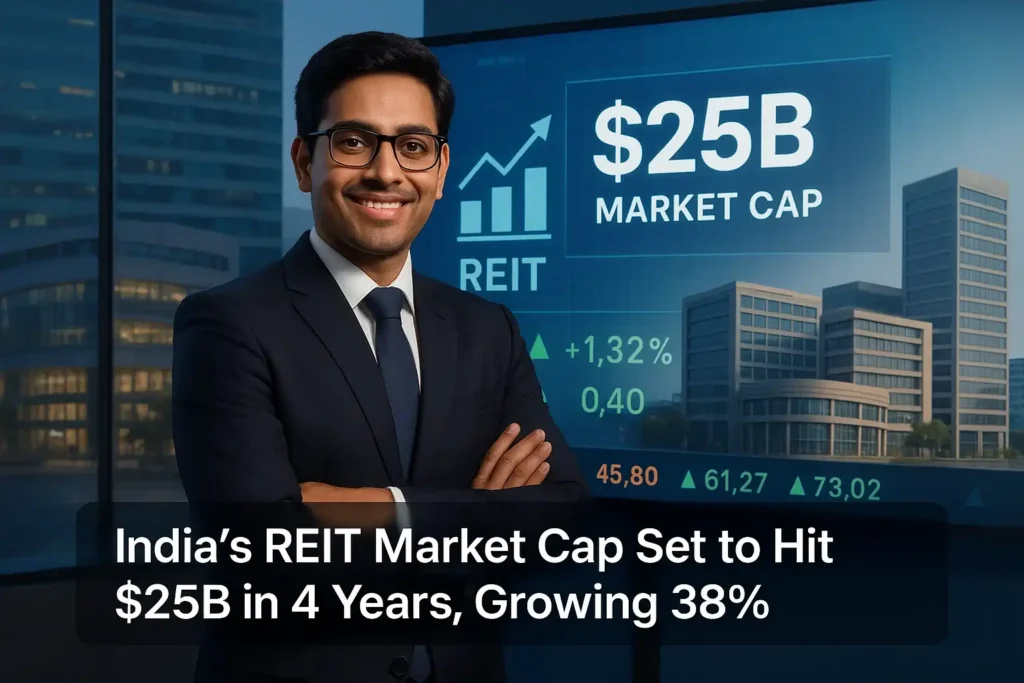
Quick take: India’s REIT sector — still young (first listing in 2019) — is maturing fast. Industry projections suggest the combined market capitalization of listed REITs will reach roughly US$25 billion within the next four years, driven by strong office leasing, yield attractiveness, regulatory clarity, and expansion into logistics, data centers, and other asset classes.
Why the Headline Number Matters
A projected jump to ~$25 billion from current levels implies steep growth in capitalisation and institutionalisation of India’s commercial real estate. This growth reflects more REIT listings, portfolio acquisitions, rising AUM, and higher investor appetite for stable income assets in India.
The Data Snapshot (What We Know Now)
- Current traction: As of mid-2025, the combined market cap of listed Indian REITs has crossed significant milestones, with aggregated AUM also on the rise.
- Yields: Indian REITs are delivering attractive running yields for unitholders — typically in the 6–7.5% range — which compares favourably with many mature REIT markets.
- Number & mix of REITs: Since 2019 several REITs have listed, mainly office-centric and retail-focused, and the market expects new entrants in logistics, warehousing, and data centres.
What’s Driving the ~38% Growth Outlook
- Strong office leasing recovery and demand — Grade A office stock in tech and corporate hubs has seen higher occupancy and rental stabilisation.
- Yield attractiveness relative to alternatives — steady distribution yields make REITs appealing to income investors.
- Regulatory and market deepening — reforms and greater transparency have boosted investor trust and encouraged more institutional capital.
- Asset class expansion — logistics parks, warehousing, and data centres are emerging as strong contenders for REIT structures.
- Institutional & foreign capital flows — global investors and domestic institutions continue to show strong appetite for Indian REITs.
Who Benefits — and How
- Long-term income investors: Gain steady yields and portfolio diversification.
- Developers / owners: Can monetise completed assets by transferring them into REITs and unlocking capital for new projects.
- Retail investors: Access institutional-grade real estate through listed units without having to buy property directly.
Main Risks & Caveats
- Macroeconomic and interest-rate risk: REIT valuations are sensitive to interest-rate moves.
- Concentration risk: The market is still concentrated in a few large office/retail portfolios.
- Execution risk for new asset classes: Logistics and data centers REITs need stable cashflows and investor acceptance, which could take time.
- Market liquidity: Liquidity remains limited compared to large global REIT markets.
What Investors Should Check Before Buying REIT Units
- Distribution history & payout policy — consistent distributions signal healthy cashflows.
- Lease profile & tenant mix — long-dated leases with high-quality tenants reduce risk.
- Leverage & covenants — higher leverage means higher vulnerability to shocks.
- Asset pipeline — growth depends on acquisitions, leasing, and developer asset transfers.
- Management track record — sponsor quality and management execution are critical.
Likely Timeline & What $25B Really Means
The $25B figure is a forward market cap projection that assumes continued listings, acquisitions, and rising investor demand. It is realistic if more REITs list, AUM expands, and markets remain receptive. However, timing could be delayed if rates rise or macroeconomic conditions weaken.
Bottom Line (EEAT Summary)
- Expertise: India’s REITs are projected to grow substantially, supported by stronger office leasing and competitive yields.
- Experience: The sector has matured since 2019, showing consistent distributions and wider investor participation.
- Authority: Projections are backed by reputed industry consultants and real estate associations.
- Trust: While the opportunity is real, investors should be mindful of risks like interest rates, concentration, and execution in new asset classes.
FAQ
Q: Is $25B guaranteed?
No — it’s a projection based on current trends. Outcomes depend on macroeconomic conditions, interest rates, and how quickly new asset classes scale.
Q: Are REITs taxed differently than stocks?
Yes. REIT distributions and capital gains follow specific tax rules in India. Investors should check the latest regulations and consult a tax adviser.
Q: Will logistics and data-centre REITs arrive soon?
Industry expectations suggest yes, but adoption will depend on standardisation, cashflow stability, and investor acceptance.
Q: Should retail investors buy now?
If you seek income and can tolerate market volatility, REITs provide access to institutional-grade real estate. However, due diligence on yields, tenant quality, and balance sheet strength is essential.