Buying farmland in India has become a popular investment choice, especially as urban areas expand and demand for residential housing rises. Many investors and landowners often ask: “Can farmland be converted into residential plots?” The answer is yes, but it involves a clear legal process, multiple approvals, and compliance with state-specific laws.
This article explains the legal steps, requirements, and challenges of farmland-to-residential conversion in India, so you can make an informed decision.
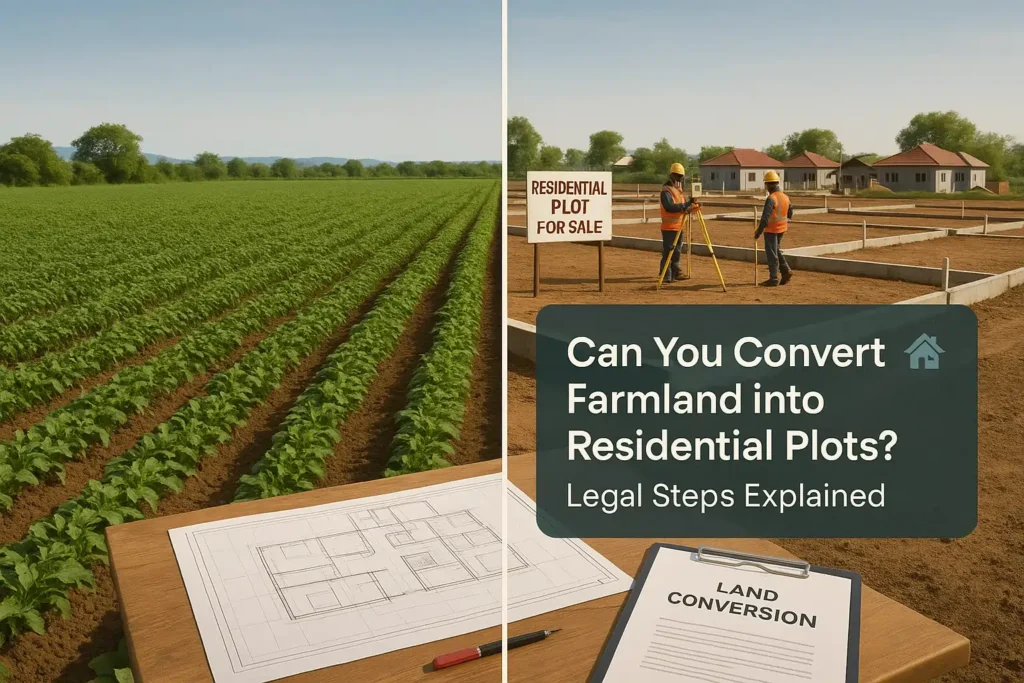
Why Convert Farmland into Residential Plots?
Farmland is often purchased for agricultural purposes, but as cities expand, its value as residential land grows significantly. Here’s why many landowners seek conversion:
- Higher Returns on Investment: Residential land usually fetches a higher market price than agricultural land.
- Urbanization Demand: Rapid city expansion increases demand for plotted developments.
- Commercial Development: Converting land allows construction of homes, apartments, and commercial spaces.
Legal Restrictions on Farmland
Before you begin, it’s important to know:
- Only agricultural use is permitted on farmland until it is legally converted.
- Some states have restrictions on who can purchase farmland (e.g., only farmers in certain states).
- Non-agricultural use of farmland without approval is illegal and may result in penalties or land seizure.
Legal Steps to Convert Farmland into Residential Plots
The process differs slightly across Indian states, but the general steps remain similar:
1. Check Land Zoning & Master Plan
- Verify if your farmland falls under an area zoned for future residential or mixed-use development in the city’s master plan.
- If it’s reserved strictly for agriculture or green belt, conversion may not be allowed.
2. Apply for Land Conversion (Change of Land Use – CLU)
- Submit an application to the District Collector / Tehsildar / Development Authority.
- The request is for Change of Land Use (CLU) from agricultural to residential.
3. Obtain No-Objection Certificates (NOCs)
Different departments need to grant approvals:
- Environment Department – to check ecological impact.
- Town Planning Authority – to ensure alignment with master plan.
- Revenue Department – to verify land title and ownership.
- Local Panchayat/Municipality – for infrastructure and civic approvals.
4. Pay Conversion Charges
- States levy a conversion fee, which can range widely depending on location and size of the land.
- Charges are usually calculated per square meter or acre.
5. Get Final Approval Order
- Once all conditions are met, the authority issues an order permitting non-agricultural (NA) use of the land.
- The land records are updated to reflect this new status.
6. Layout & Plotting Approval
- Before selling or developing residential plots, you must get layout approval from the development authority.
- This ensures roads, drainage, open spaces, and other civic amenities are planned as per law.
Challenges in Conversion
- Lengthy Process: Approvals can take months or even years in some states.
- High Conversion Fees: May increase project cost significantly.
- Title Disputes: Any ownership dispute delays the process.
- State-Specific Rules: Conversion rules vary across India (e.g., stricter in Maharashtra and Karnataka compared to some northern states).
Key Tips for Landowners and Investors
- Always verify title and zoning before purchase.
- Hire a property lawyer to assist with applications and compliance.
- Work with a town planner or architect for layout approval.
- Avoid shortcuts or unauthorized plotting – it can lead to demolition or cancellation of sale deeds.
Yes, you can convert farmland into residential plots, but it requires legal approvals, conversion charges, and compliance with state rules. Skipping the process can lead to serious legal trouble, so it’s better to follow the proper path.
If done correctly, farmland conversion can turn an agricultural asset into a highly profitable real estate investment.
FAQ on Farmland Conversion
Q1. Can any farmland be converted into residential plots?
Not always. It depends on the state laws, zoning regulations, and master plan of the area. Land in protected zones (forest, green belt, flood-prone areas) usually cannot be converted.
Q2. How long does the farmland conversion process take?
It varies by state and case complexity. On average, it can take 3 months to 2 years depending on approvals and clearances.
Q3. What is CLU permission?
CLU stands for Change of Land Use. It is the legal approval granted by the local authority to use agricultural land for non-agricultural purposes like residential or commercial.
Q4. What happens if farmland is used for residential purposes without conversion?
This is illegal. Authorities can impose heavy penalties, demolish constructions, or even confiscate the land.
Q5. Do all states in India allow farmland conversion?
Yes, most states allow conversion, but rules and charges differ. Some states also restrict farmland purchases to farmers only, making conversion more complicated for non-farmers.
Q6. Is farmland conversion expensive?
Yes. Conversion charges and taxes can be significant, especially in urbanizing areas. However, the increased land value after conversion usually offsets the cost.