Selling property in India involves large sums of money. Many buyers and sellers often wonder:
“Can I sell my property in cash to avoid taxes or simplify the transaction?”
The short answer is: You can receive cash, but only within strict limits. Exceeding those limits could trigger severe penalties under the Income Tax Act, 1961.
This article explains the rules, consequences, and best practices around cash transactions in real estate, so you don’t land in legal trouble.
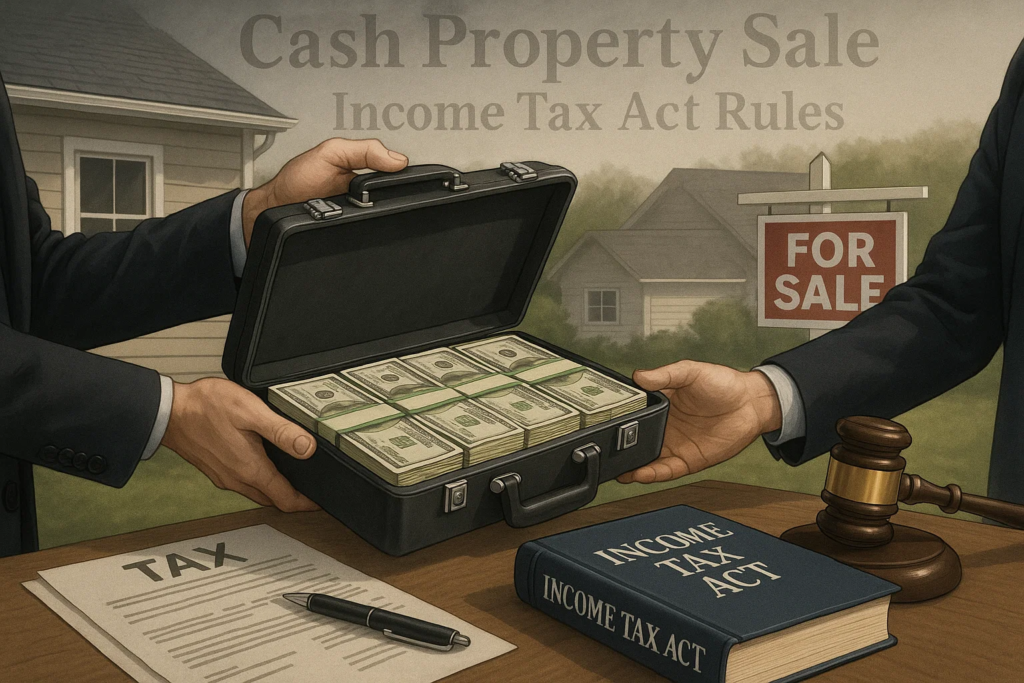
Can You Legally Sell a Property in Cash?
Yes, you can accept cash for selling a property, but only up to a certain limit and under very strict guidelines.
As per the Income Tax Act, any cash transaction of ₹2 lakh or more in a single event is not allowed. This is covered under Section 269ST of the Income Tax Act, 1961.
What is Section 269ST of the Income Tax Act?
Section 269ST prohibits any person from receiving an amount of ₹2,00,000 or more:
- In a single transaction, or
- From a single person in a day, or
- In respect of one event or occasion
in cash.
So, if you’re selling a house worth ₹50 lakh, and someone wants to pay ₹20 lakh in cash and ₹30 lakh via bank, it is illegal under this law.
Also Read:
Penalty for Accepting Cash Over ₹2 Lakh
If you violate Section 269ST:
- The entire cash amount received becomes liable to a 100% penalty.
- So, if you received ₹10 lakh in cash, the penalty is also ₹10 lakh.
- This penalty is imposed under Section 271DA of the Income Tax Act.
The buyer and the seller both may come under scrutiny.
Why Are Cash Transactions in Real Estate Regulated?
The government enforces strict rules around cash transactions in real estate to:
- Prevent black money generation
- Track unaccounted income
- Reduce tax evasion
- Promote digital and transparent payments
Since real estate is a high-value sector, it’s often misused for hiding income. Therefore, authorities have tightened compliance norms.
Acceptable Modes of Property Payment
To stay on the right side of the law, always use these acceptable payment modes:
- Cheque (account payee)
- Demand Draft
- NEFT/RTGS/IMPS
- UPI (for smaller amounts)
- Bank transfer
These modes leave a clear money trail and are considered valid proof during property registration and income tax assessment.
Registration Rules and Payment Disclosure
During property registration:
- Both buyer and seller must declare the sale value in the sale deed
- The Sub-Registrar may refuse registration if the declared payment is suspicious
- Stamp duty and circle rates must also be factored in
Paying part in cash and part via bank may raise red flags and attract tax raids.
TDS Applicability on Property Sale
For property sales over ₹50 lakh:
- The buyer must deduct 1% TDS (Tax Deducted at Source) under Section 194-IA
- TDS is deducted on the entire sale amount, not just the bank-transferred portion
- Form 26QB must be filled, and TDS deposited with the government
If a part of the payment is in cash, this TDS compliance becomes difficult, which could trigger income tax scrutiny.
Reporting Property Sales in ITR
If you’re a seller:
- You must report the capital gains (short or long term) in your Income Tax Return (ITR)
- If you received any part of the sale amount in cash, it becomes hard to prove or claim benefits like indexation or Section 54 exemption
- If caught, you may face interest, penalty, and prosecution
Real Case Example
Illegal Transaction:
Mr. A sells his plot for ₹35 lakh.
- Receives ₹10 lakh in cash, ₹25 lakh via bank.
- Does not declare the ₹10 lakh in his ITR.
Consequences:
- Violates Section 269ST
- ₹10 lakh cash is unaccounted → Penalty = ₹10 lakh
- Faces notice and potential raid by IT department
Can You Show Cash as Advance?
Some people try to bypass the rule by taking cash as “advance”.
This is still illegal if the total cash received across the entire transaction exceeds ₹2 lakh. The law considers it part of one single transaction.
How to Legally Sell Property and Minimize Tax?
Here are legal ways to minimize tax without accepting cash:
- Invest capital gains in specified assets (under Section 54, 54F)
- Use joint ownership for tax planning
- Invest in Capital Gains Bonds (Section 54EC)
- Consult a chartered accountant (CA) before the transaction
Cash Transaction Rules for Property in India
| Aspect | Rule/Limit | Legal Section |
|---|---|---|
| Max. Cash Allowed in Sale | ₹1,99,999 | Section 269ST |
| Penalty for Violation | 100% of cash received | Section 271DA |
| TDS Applicability | 1% on sale value > ₹50 lakh | Section 194-IA |
| Report in Income Tax Return | Mandatory for seller | Capital Gains Head |
| Allowed Payment Modes | Cheque, Bank Transfer, DD, UPI | RBI/Income Tax Norms |
Key Takeaways
- You can’t legally sell or buy a property with more than ₹2 lakh in cash.
- Violation of this law may lead to 100% penalty.
- Always use traceable bank channels for real estate payments.
- Declare property sale in your income tax return and deduct TDS if applicable.
- Consult a financial advisor before finalizing high-value deals.
Selling a property in cash might seem convenient, but it can land you in serious legal and financial trouble. With stricter regulations under the Income Tax Act, transparency is the best policy.
If you are planning to sell or buy property, do it legally and smartly.
Frequently Asked Questions
1.Can property be sold entirely in cash in India?
Technically, property can be sold in cash, but the Income Tax Act and government regulations restrict cash transactions above certain limits to prevent tax evasion and ensure transparency.
2.What is the cash transaction limit under the Income Tax Act?
The Income Tax Act prohibits cash transactions of ₹2 lakh or more for property purchases, and buyers and sellers are required to use traceable banking channels for larger amounts.
3.Why is selling property in cash discouraged?
Large cash transactions raise concerns of tax evasion, black money, and lack of accountability, which is why government authorities encourage bank transfers and documented payments.
4.What are the penalties for selling property in cash?
If authorities find violations, penalties can include fines, inquiries under the Income Tax Act, and potential prosecution for tax evasion or money laundering.
5.Can part of the property price be paid in cash?
Yes, a minor portion may be paid in cash depending on the transaction size, but it should not exceed the prescribed limits and must be declared to tax authorities.
6.Does paying in cash affect property registration?
Yes, during registration, authorities require proof of payment, and undisclosed cash transactions can lead to rejection or legal complications.
7.How can property buyers ensure compliance with tax rules?
Buyers should conduct transactions through banking channels, maintain proper documentation, declare the total transaction value, and consult tax professionals for guidance.
8.Is it legal to show part of the payment as a loan or adjustment to bypass cash rules?
No, structuring payments deceptively to avoid tax compliance can be treated as tax fraud and attract penalties under the Income Tax Act and anti-money laundering laws.
9.Where can property buyers and sellers find more information on tax compliance?
Information can be obtained from the official Income Tax Department website, certified tax advisors, registered real estate professionals, and government guidelines on property transactions.