IIn rural areas of India, land holdings have been very fragmented, which has been a hindrance to agricultural output and slowed progress. To respond to this, the government put forward Chakbandi, or the consolidation of land, which rearranges small plots into larger and continuous plots. In so doing, farmers can manage land effectively, enhance productivity, and get improved infrastructure.This paper examines Chakbandi kya hai, its application, its advantages, and difficulties, and how it has impacted rural India.
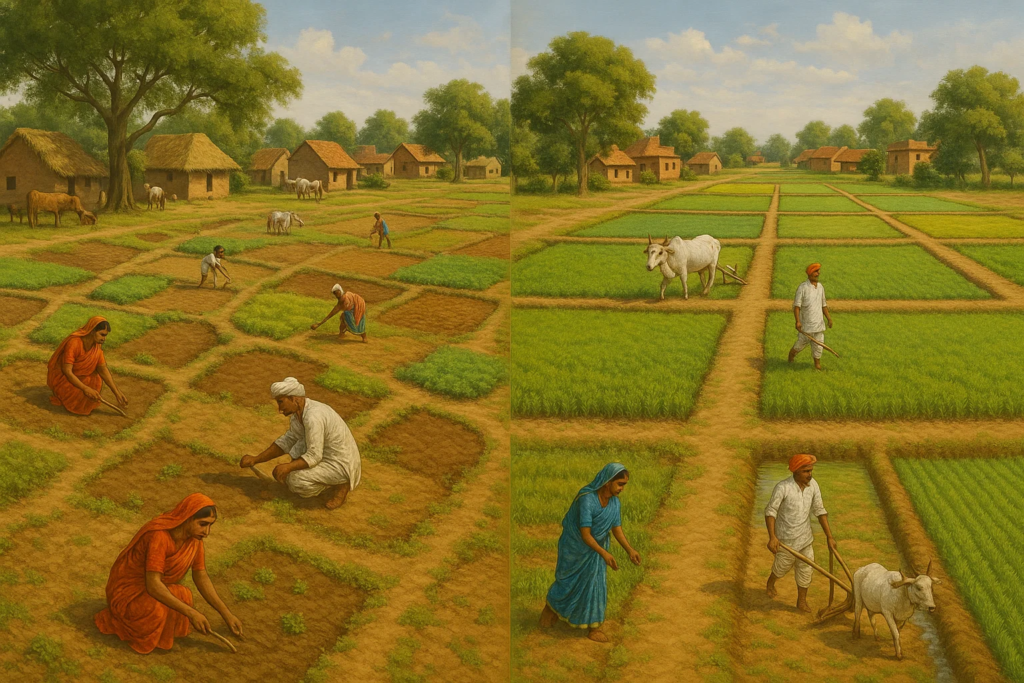
What is Chakbandi? (Chakbandi Meaning)
The meaning of Chakbandi is quite straightforward: it is a process of uniting the small pieces of agricultural land belonging to one owner into unified places. This system is used to make sure that the farmers do not have many small plots, but they have large plots that are irregular.
This system is commonly used in states such as Uttar Pradesh, Haryana, Punjab, Bihar, and Madhya Pradesh in order to enhance the efficiency of farming and to minimize conflicts. Through land consolidation, improved roads, irrigation systems, and an organized infrastructure can also be enjoyed by the villages.
Key Objectives of Chakbandi
- Abolish scattered land parcels: The farmers are given greater and continuous plots.
- Increase productivity: With effective land use, contemporary agricultural practices are available.
- Enhance rural infrastructure: Simpler road, waterway, and drainage planning.
- Minimize conflicts: Well-defined boundaries reduce conflict among the villagers.
- Favor mechanized agriculture: Bigger areas can be used by a tractor and irrigation.
What was the Reason behind the introduction of Chakbandi?
1. Fragmented Land Holdings
The division of land by the generations results in small and scattered land, which lowers the productivity of agriculture and raises boundary conflict.
2. Low Productivity
Spatial plots waste labor, water, and fertilizer, which complicates contemporary farming.
3. Infrastructure Inadequacy in Rural Areas.
Fragmentation affects the planning of the villages as roads, canals, and drainage systems are not built in good time.
Through these problems, Chakbandi in UP and other questions encourage the practice of productive and sustainable farming.
How Does Chakbandi Work?
The state authorities implement Chakbandi according to the laws of land consolidation. The general steps of the process are these:
Step 1: Notification
The government gives a notice of the onset of consolidation in a village.
Step 2: appointment of the officials.
It is supervised by a Consolidation Officer (CO) and personnel.
Step 3: Checking of the Land Records.
All records are checked. Ownership and rights are confirmed, and objection is sought and overcome.
Step 4: Valuation of Land
Each plot is evaluated on:
- Soil quality
- Irrigation access
- Location
- Productivity
To facilitate fairness, authorities tend to have point-based scoring.
5: Consolidation Plan Preparation.
- Scattered plots are combined into fewer, larger parcels of equal value.
- Roads, ponds, schools, and other infrastructure of the community are given out on the land.
6: Publication of Draft and Final Plan.
- The villagers are provided with draft maps.
- Discontents are solved, and a conclusive strategy is adopted.
7: Possession and Mutation.
New consolidated parcels are given to the farmers, and land records are officially.
Chakbandi Case Status
The status of the Chakbandi case is required to be monitored to ensure transparency. Through the state land record portals or regional offices, farmers are able to access the objections, allocations, and final records. This is to make sure that there is proper resolution of disputes and implementation of programs to consolidate promptly.
Constitution: Chakbandi in Uttar Pradesh.
Uttar Pradesh has been a frontrunner in the area of land consolidation: since the 1950s, chakbandi has been introduced in the state of UP on a larger scale of thousands of villages. The results include:
- Better irrigation due to better access to canals.
- Increased plots to increase crop yields.
- Fewer lawsuits and litigations on land.
- In UP, over 65 percent of the agricultural land has been successfully consolidated.
These findings depict the success of Chakbandi in the rural transformation of economies.
Benefits of Chakbandi
- Enhanced Productivity: Larger plots can be used to conduct mechanized farming.
- Efficient Land Use: The roads, canals, schools, and marketplaces can be easier to plan.
- Less Conflict on land: With boundaries and records, there is no conflict.
- Enhanced Access to Loans: The consolidated and updated records have been used to obtain loans, insurance, and subsidies.
Improved infrastructure: Villages are better organized and are likely to get development initiatives.
Challenges in Chakbandi
Though it works, there are obstacles to implementation:
- Opposition of landlords: Emotional attachment or fear of losing arable land.
- Corruption and favouritism: Claims of unequal distribution.
- Delays: Objections to the law and lack of record keeping slows down.
Incomplete consolidation: Villages are left incomplete with lapses by the administration or resistance to consolidation.
Chakbandi Digital Tools in the Modern Era.
Through Digital India programs, governments are currently relying on technology to enhance transparency:
GIS mapping: Prepares precise land maps.
Drone Surveys: Survey the land and topography effectively.
Online Objection Handling: Enhances the communication with farmers.
Digital Land Records: Provides non-interceptable ownership records.
These tools make the process smoother, faster, and more just.
Future of Chakbandi in India
Due to the rising value of rural land and increased modern agriculture, Chakbandi will be instrumental in land reform. Future efforts include:
Combining Chakbandi with PM Kisan, Digital Land Records, and Swamitva Yojana.
Encouraging the involvement of the community.
Providing incentives among early adopters in the villages.
Key Takeaways
| Aspect | Details |
|---|---|
| Full Form | Chakbandi = Land Consolidation |
| Purpose | Merge scattered plots into fewer, larger ones |
| Benefit | Better productivity, fewer disputes, rural infra development |
| States | UP, Bihar, Haryana, Punjab, Madhya Pradesh |
| Challenges | Resistance, delay, record issues |
| Modern Tools | GIS, drones, digital records |
Conclusion
Chakbandi is not merely land consolidation, but a springboard of rural development. It enhances the lives of farmers by bringing together fragmented plots, boosting productivity, minimizing conflict, and ensuring infrastructure development, thus empowering the rural economic systems. Constant monitoring of the Chakbandi case Status has proven to be transparent, and the modern tools have made the process efficient and reliable.
In the case of villages in India, particularly Chakbandi in UP, this reform still changes the face of agriculture in India, creating a sustainable development and productive rural areas, which are modern and safe.
FAQs
1. What is Chakbandi?
Chakbandi involves the consolidation of small farmland into large pieces of land. This assists farmers in utilizing land effectively and increases productivity.
2. Why was Chakbandi introduced in India?
Chakbandi was initiated by the government in a bid to help in the reduction of fragmented lands, enhance farming efficiency, and aid in the rural infrastructure.
3. How does Chakbandi work?
The government surveys, appraises, and consolidates land. They settle disputes, allot bigger plots to proprietors, and officially revise land register records.
4. What are the advantages of Chakbandi?
Chakbandi is the one who boosts agricultural productivity, decreases conflicts, facilitates borrowing, and improves the village infrastructure. The farmers obtain bigger plots and can have easier access to the government schemes.
5. What is the way to check my Chakbandi case status?
Being able to monitor your Chakbandi case Status through state land record portals or local land offices is a guarantee of transparency and information in time.