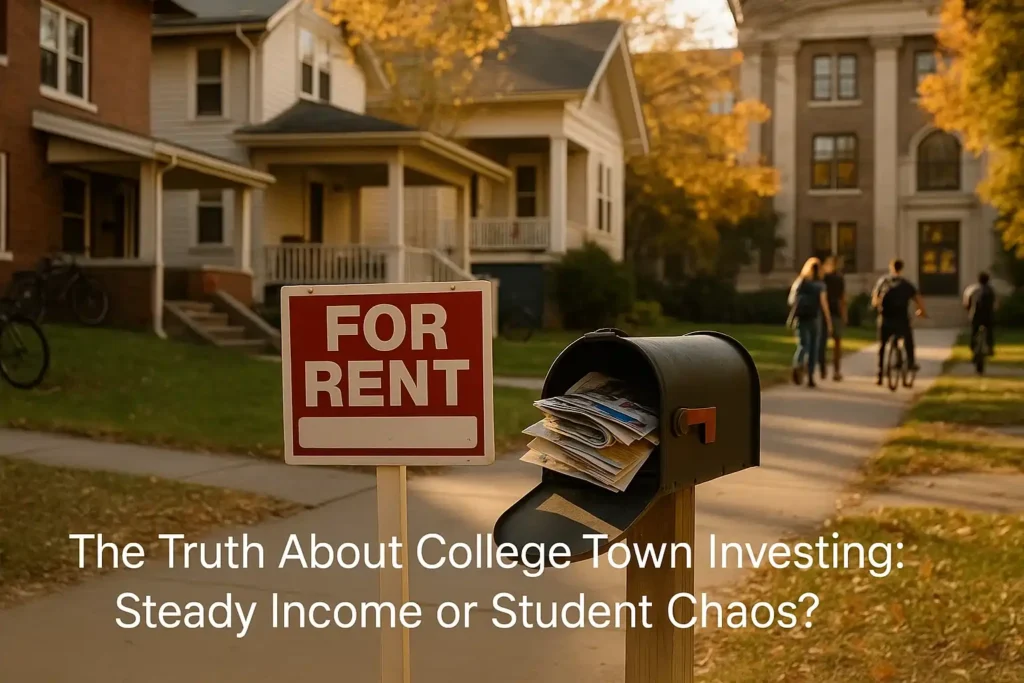
Investors in real estate never miss an opportunity to seek steady income and rent ready markets. College towns are one of such markets that people tend to pay attention to. As universities continue to receive consistent number of students, staff and faculty, investing in properties around universities appears to be a sure bet. The reality is a bit more complicated however college town investing can be a gold mine of a stable flow of rental income and a nightmare of student induced mayhem.
This article will discuss the actual advantages and disadvantages of investing in college towns properties with the help of professional opinions and real-life examples to make the decision on your own.
Why College Towns Attract Investors
- Consistent Demand
Every year universities contribute thousands of students in need of accommodation. A college maintains a steady need of accommodation unlike the rental markets where fluctuations occur depending on the local job scenario. - Low Vacancy Risk
Rental cycle is not surprising as a result of student turnover; semesters and college schedules make the visceral level. A home near campus does not stay vacant very long. - Premium Rent Potential
Houses, apartments and other kinds of properties near walking distance of a university usually attract high rents when compared to those in other areas. Parents and students do not mind paying a higher price as long as they would be more convenient and safe. - Diverse Tenant Base
It’s not just students—faculty, administrative staff, and even medical professionals (if the campus has a hospital) contribute to a varied rental pool.
The Flip Side Student Chaos and Challenges
While the income potential looks attractive, investing in college towns comes with its own set of risks:
- Property Wear and Tear
College students are not reputed to be the best tenants. Repair expenses can increase by undergoing parties, late-night parties, and even poor maintenance. - Frequent Turnover
Students have a tendency to rent out only during a single academic term unlike long-term renters. That equates to additional leasing business, advertising expenses and paperwork. - Noise and Community Conflicts
College towns have neighbors who occasionally conflict with their student tenants regarding noise, parties and parking problems- which may cause tension and complaints. - Market Dependence on University
The demand can easily decrease in case the university experiences decrease in enrollments, moves away, or changes to online-based programs, which affects property values and rental income.
Also Read:
- What You Can Learn from Blackstone, REITs & Institutional Investors
- The Magic of Compound Growth in Real Estate How Time Multiplies Wealth
- How to Build an Investment Property Pipeline Without Burnout
- Should You Invest for Cash Flow or Appreciation?
Strategies for Successful College Town Investing
If you’re considering this market, here are some practical tips to balance steady income with the challenges of student rentals:
- Choose the Right Location
- Properties within 1–2 km of campus tend to have the highest demand.
- Look for areas with strong infrastructure—cafes, transport, libraries, and student-friendly amenities.
- Invest in Durable Furnishings and Finishes
- Use easy-to-clean flooring, sturdy appliances, and replaceable furniture.
- This reduces long-term repair and maintenance costs.
- Offer Group Leasing or Co-Signer Options
- Parents often co-sign leases, which minimizes default risk.
- Group leases (one lease signed by multiple students) ensure that even if one tenant leaves, the rent is covered.
- Work with a Property Manager
- Professional property managers experienced with student rentals can handle tenant screening, rent collection, and maintenance—saving you from daily headaches.
- Diversify Your Tenant Base
- Don’t rely only on students. Target faculty, visiting researchers, and staff housing to stabilize your portfolio.
Example
Consider Gainesville, Florida, where there is the University of Florida. Houses near campus have been known to attract high rental values, yet those who do not consider the added expenses of higher turnover are usually losing out in profits. Conversely, those investors that went into the purchase of housing properties with high quality materials, contracted tight lease terms, and presented housing property to the graduate student or faculty population enjoyed stable rental income and slightly better than average returns in appreciation.
This example shows that success depends on strategy, not just location.
Is College Town Investing Right for You?
- Best For: Investors seeking steady rental income, who can handle or delegate active property management.
- Risky For: Investors expecting hands-off, low-maintenance rental properties.
To sum up, there are, on the one hand, attractive and on the other hand, demanding aspects of college town real estate. When carefully planned, with long term installations and with the correct combination of tenants, it produces steady returns. In their absence, landlords will be overwhelmed by student havoc and not rental profits.
There is nothing as cookie-cutter about college town investing. It also needs a thorough knowledge of the market, active management of properties and a long-range strategy. When it is done correctly, it could secure consistent cash flow and good appreciation. When not done right you can find yourself going broke and losing energy.
As with any investment, success depends on research, preparation, and execution.