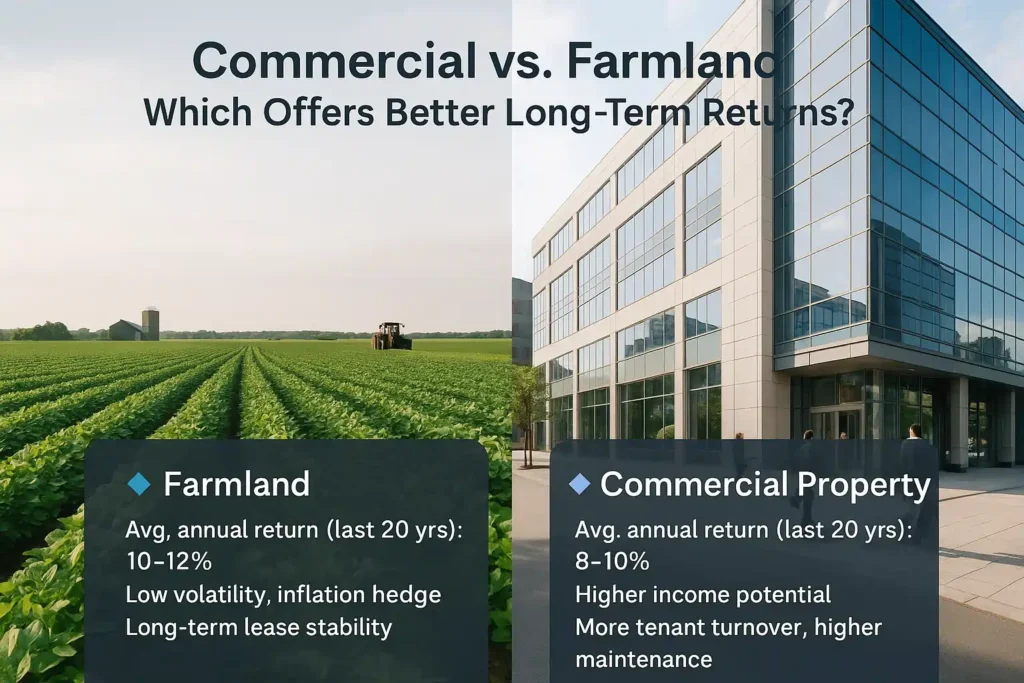
A farmland and commercial real estate are among the alternatives that an investor chooses to go with. Each kind of asset has special benefits and long-term profitability prospects, and the proper replacement would depend on the diverse factors, including risk tolerance, source of capital, location, economic indicators, and investment objectives to an individual. In this blog we will compare the investment in commercial property and farmland along with many aspects such as the rental yield, the appreciation, tax benefits, risks involved and the continuity in the income and you can easily make your decision based on this.
What Is a Commercial Property Investment?
Commercial properties are: office, retail store, warehouse and service outlog. The investors may prefer renting such places to business or even sell such places later at a better price. It is a favorite possession of high-net-worth users, NRIs and institutional investors because of steady inflow of incomes.
Key Features:
- High rental yield (6%–12%)
- Professional tenants
- Higher upfront cost
- Location-sensitive returns
What Is Farmland Investment?
Farmland refers to agricultural land used for cultivation, leasing, or even agri-tourism. It has gained attention for being a tangible, inflation-hedged asset, especially in peri-urban zones like Naugaon, Sohna, and parts of Rajasthan near the Delhi-Mumbai Expressway.
Key Features:
- Lower entry cost
- Long-term capital appreciation
- Legal restrictions on ownership in some states
- Increasing demand for organic and sustainable farming
Rental Income Comparison
Commercial Property:
- Offers steady monthly rental income
- Lease periods range from 3 to 9 years
- Escalation clauses of 5–10% every 3 years
- Professional management companies available
Farmland:
- Rental income depends on crop cycles or leasing to farmers
- Income can be seasonal and uncertain
- Some returns come from timber, fruit orchards, or agri-tourism
Pro Tip: If your goal is monthly passive income, commercial property outperforms farmland.
Capital Appreciation Potential
Commercial Property:
- Capital appreciation linked to infrastructure and economic growth
- Prime commercial hubs (like Gurugram, Noida, Bengaluru) show 8%–10% YoY growth historically
- Value may fluctuate during economic downturns
Farmland:
- Prices steadily rise in urbanizing regions
- Regions like Naugaon have seen 3x–5x appreciation in 5–8 years
- Less affected by economic cycles; more by local demand and infrastructure
Pro Tip: Farmland in strategic corridors (like DMIC, expressways) can outperform commercial real estate in appreciation over 7–10 years.
Entry Barriers and Costs
| Factor | Commercial Property | Farmland |
|---|---|---|
| Minimum Investment | ₹50 lakh to ₹5 crore | ₹20 lakh to ₹1 crore |
| Legal Complexity | Moderate | High in some states |
| Stamp Duty | 6%–8% | 5%–7% (varies by state) |
| Loan Availability | Easier through banks | Limited financing options |
Note: Commercial property is more accessible through REITs, while farmland often requires outright purchase.
Tax Implications
Commercial Property:
- Rental income taxable under ‘Income from House Property’
- Depreciation benefits available
- GST applicable on under-construction property
- Capital gains tax applies on sale
Farmland:
- Income from agricultural activity is tax-free (under Section 10(1))
- No capital gains tax if agricultural land is in rural area
- No GST applicable
Pro Tip: Farmland can be a great tax-planning tool if structured correctly.
Risk Analysis
| Risk Factor | Commercial Property | Farmland |
|---|---|---|
| Market Fluctuation | Medium–High | Low–Medium |
| Tenant Risk | Yes | No (if self-used or leased to farmers) |
| Regulatory Risk | Zoning, RERA norms | Land ceiling, ownership laws |
| Liquidity | Moderate | Low |
Diversification and Use Cases
- Commercial Property suits urban investors looking for high rental yield, professional asset management, and quick resale potential.
- Farmland is better for wealth preservation, long-term inflation hedging, and alternative income sources like organic farming, solar leasing, or weekend home development.
Also Read:
- Commercial vs Residential Which Is Better for Investment?
- The Future of Commercial Real Estate in Gurgaon
- What’s Best for You Residential or Commercial
- Tax Benefits Showdown What You Gain from Farmland vs SCO Ownership
Who Should Invest in What?
| Investor Type | Best Fit |
|---|---|
| NRIs | Commercial property (easy to lease, manage remotely) |
| HNIs | Mix of both for diversification |
| Risk-Averse | Farmland in emerging locations |
| Passive Income Seekers | Commercial assets like SCOs or REITs |
| Visionary Investors | Farmland near expressways or planned townships |
Real-World Example
- Commercial Property: A 500 sq. ft. retail shop in Dwarka Expressway leased at ₹120/sq.ft. gives a monthly rental of ₹60,000 (~9% rental yield) with long-term appreciation as the area matures.
- Farmland: A 1-acre plot in Naugaon bought at ₹35 lakh in 2019 is now valued at ₹1.1 crore due to expressway access and upcoming organized farmhouse clusters.
Which Offers Better Long-Term Returns?
If your priority is income stability plus liquidity: Choose commercial property.
If your priority is long-term appreciation and tax efficiency: Choose farmland, especially in peri-urban growth zones.
Smart investors often create a balanced portfolio with a mix of both asset classes to hedge risks and optimize returns.
Farm and commercial real estate are good bets when it comes to wealth creation over the long term. Commercial spaces have the advantage of providing routine income and liquidity but on the other side, there is farmland which saves taxes, preserves capital and also enhances appreciating value in high potential corridors.
At The Whitelisted Estate, we specialize in strategic farmland and high-ROI commercial property investments across NCR. Whether you’re looking for passive income, capital growth, or tax-saving opportunities, our experts can guide you through every step.
Book your free consultation today: +91-7428812398
Locations: Gurgaon | Sohna | Naugaon | Dwarka Expressway