Using agricultural land to build houses or business premises may be a good strategic decision and business move of land owners as well as real estate investors. Nevertheless, it deals with legal, regulatory, and procedural measures, which need to be adhered to accurately. This blog will discuss the means of transforming arable land into usable residential/ commercial land in India
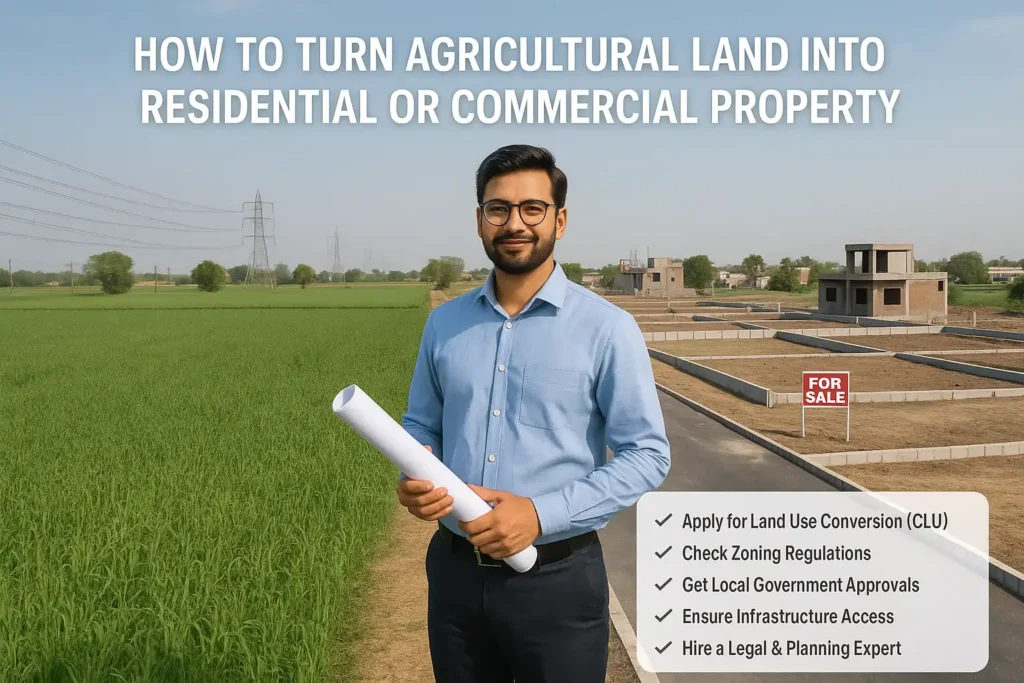
Understanding the Basics What Is Land Use Conversion?
The agricultural land is legally defined to be used only for farming purposes, and it therefore cannot be converted into a business center or housing project unless the conversion is done through the official legal process. Moreover, the conversion of land to non-agricultural use is a formal procedure through which land that was previously restricted to agricultural activities is legally changed for other purposes. Consequently, once converted, the land becomes eligible for lawful development or construction. Thus, following the prescribed procedure ensures compliance with state regulations and prevents potential legal disputes.
Why Convert Agricultural Land?
- Higher ROI: Residential or commercial property has higher market value than agricultural land.
- Urban Development: As cities expand, peripheral agricultural zones become suitable for housing, schools, malls, or offices.
- Diversification: Landowners can diversify income sources by leasing or selling developed property.
Step-by-Step Guide to Convert Agricultural Land
1. Check Local Zoning Regulations
Before proceeding, it is crucial to verify the land use rules under the Master Plan or Zoning Plan of the area. Moreover, this verification helps ensure that the proposed development aligns with the region’s designated land use policies. In most cases, these details can easily be accessed through the local Municipal Corporation, Town Planning Office, or District Collectorate. Therefore, conducting this step early can save time, prevent legal issues, and ultimately streamline the conversion process.
Tip: Some regions may be designated as “green zones” where conversion is prohibited.
2. Apply for Land Conversion at the Revenue Department
Submit a formal application to the Tehsildar or District Collector’s office. This application is often made under the local State Land Revenue Act.
Required Documents:
- Land title deed
- Latest 7/12 extract or Record of Rights (RoR)
- Property tax receipts
- Soil test report (sometimes required)
- No Objection Certificate (NOC) from local authorities
3. Pay the Conversion Charges
You’ll be required to pay a conversion fee and/or betterment charges, which vary from state to state. These fees are calculated based on land area and proposed land use.
For example:
- In Karnataka: Approx ₹200 per sq. meter
- In Maharashtra: 10% of the land’s market value as per the Ready Reckoner
Also Read:
- Tax Benefits Showdown What You Gain from Farmland vs SCO Ownership
- Income Potential Compared Leasing Out Farmland vs SCO Units
- Commercial vs. Farmland Which Offers Better Long-Term Returns?
- Landlords, Are You Paying Too Much? Master Advance Tax Rules and Avoid Costly Penalties
4. Obtain Necessary Approvals and NOCs
In many cases, you’ll need additional NOCs from:
- Pollution Control Board
- Forest Department (if land falls under any green cover)
- Local Municipal Body or Panchayat
- Electricity and Water Supply Board
Expert Tip: Engage with a licensed town planner or consultant who can streamline the documentation and approvals.
5. Update Land Records After Conversion
Once the conversion is approved:
- The new land use type must be reflected in official Record of Rights (RoR).
- Update property tax records with the new classification.
6. Comply with Building By-Laws
If your goal is to construct, then you must carefully follow the municipal building by-laws. Moreover, it is essential to obtain all the necessary approvals before beginning any construction activity. Additionally, ensure that your building plans comply with local zoning regulations, since any violation can lead to penalties or project delays. Therefore, adhering to these by-laws not only ensures legal compliance but also promotes a smoother construction process.
- FAR (Floor Area Ratio) restrictions
- Building height limits
- Parking regulations
- Fire safety norms
Only after these compliances, you can apply for a Building Plan Approval.
Conversion Rules Across Key Indian States
| State | Conversion Authority | Time Taken | Approx Cost (per acre) |
|---|---|---|---|
| Maharashtra | Collector / Tahsildar | 3–6 months | ₹2–5 lakh |
| Haryana | Department of Town & Country Planning | 6–12 months | ₹5–10 lakh (sector-specific) |
| Karnataka | Deputy Commissioner | 2–6 months | ₹1–3 lakh |
| Tamil Nadu | CMDA / DTCP | 3–6 months | ₹2–4 lakh |
| Uttar Pradesh | District Magistrate | 3–9 months | ₹3–6 lakh |
Risks and Legal Considerations
– Encroachment or Land Disputes
Ensure your title is clear and land is free from legal disputes.
– Land Ceiling Acts
In some states, landholding limits exist. Exceeding them requires special permissions.
– Environmental Clearances
Mandatory for large-scale commercial or industrial conversion.
– Master Plan Conflicts
Some agricultural lands may be earmarked for public infrastructure in the future.
Professional Help to Consider
- Land Use Consultants: Experts in planning and legal compliance.
- Real Estate Lawyers: To verify title and handle disputes.
- Chartered Engineers or Architects: For preparing building plans post-conversion.
Using farmlands that are converted into residential or commercial spaces may result in good earnings. However, such interventions must therefore always be carried out carefully and within the boundaries of the legal framework. Moreover, landowners should consequently ensure compliance with all applicable laws and regulations before proceeding with any development activities. Additionally, seeking professional guidance can help avoid legal complications and thus ensure a smooth conversion process
Moreover, since land conversion policies vary significantly across different states of India, it is therefore imperative to hire loyal and experienced professionals who understand the regional regulations. Additionally, property owners must adhere to all legal procedures and approvals to avoid penalties or disputes. Consequently, they should also be prepared for delays, as the conversion process can be time-consuming and may involve several administrative steps.
By approaching the process with legal clarity, proper documentation, and expert guidance, you can unlock the full potential of your agricultural land.
Disclaimer: This blog is for informational purposes only. Please consult legal or real estate professionals for advice specific to your region and case.
FAQ,s Frequently asked questions
1. What does converting agricultural land mean?
Converting agricultural land means legally changing its land-use classification from “agricultural” to “residential,” “commercial,” or “industrial” under local zoning and land revenue laws. It allows for non-agricultural development and construction.
2. Why do landowners convert agricultural land?
Landowners often convert land to increase its market value, enable construction, or use it for business or housing projects. Converted land can generate higher income through sales, leases, or development.
3. What documents are needed for conversion?
Typically, the following documents are required:
- Proof of land ownership (sale deed or title deed)
- Latest land tax receipts
- Encumbrance certificate
- Land sketch and survey map
- No Objection Certificates (NOCs) from local authorities
4. What is the process for converting agricultural land to non-agricultural use?
- Submit a formal application to the District Collector or local revenue office.
- Attach required documents and pay conversion fees.
- Authorities inspect the land and verify its location and zoning.
- Once approved, an official Conversion Certificate or Order is issued.
5. What are the conversion charges or fees?
Conversion fees vary by state and land type. Typically, they range between 2% to 10% of the land’s market value or as per the local government’s fixed rate per square meter/acre.
6. What are the benefits of converting agricultural land to residential or commercial use?
- Higher resale and rental value
- Eligibility for loans and development approvals
- Increased investment potential
- Opportunity to build residential complexes or commercial spaces
7. Are there state-wise differences in land conversion rules?
Each Indian state has its own Land Revenue Act and specific rules for land conversion. For instance, Karnataka follows Section 95 of the Karnataka Land Revenue Act, while similarly, Maharashtra operates under the Maharashtra Land Revenue Code. Moreover, these regional differences mean that landowners must carefully review state-specific regulations before initiating the conversion process. Therefore, understanding the legal framework in your respective state is essential to ensure compliance and avoid future disputes.