This is a question that every investor, developer, or property buyer faces at some point. Both strategies can deliver strong returns, but they come with different risks, timelines, and financial commitments. Let’s break down what each option means, when it makes sense, and how to decide which is right for you.
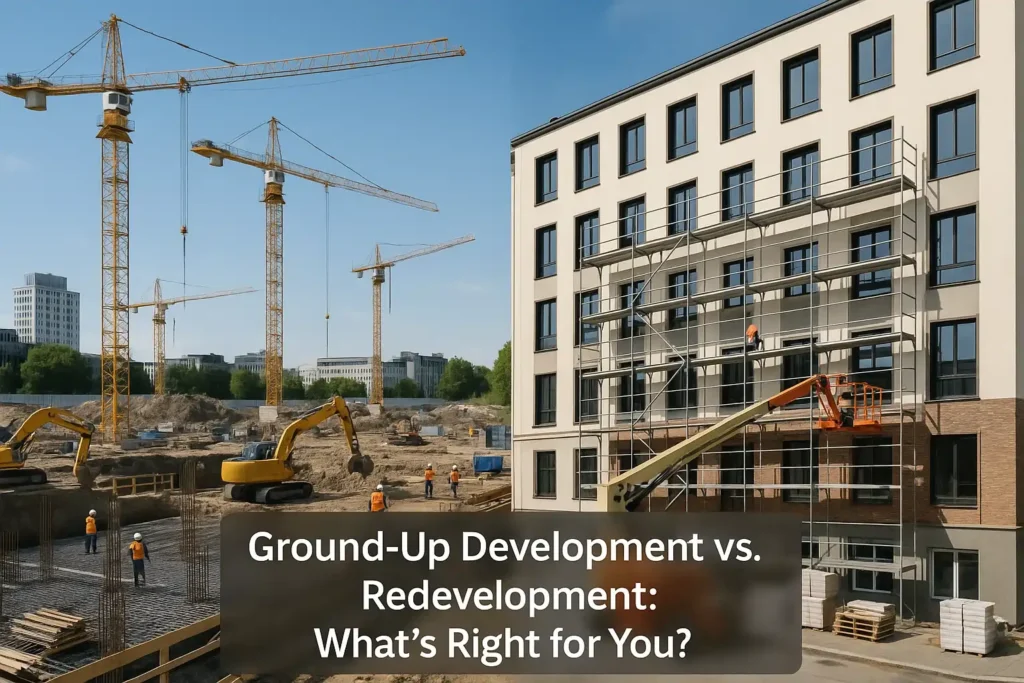
What Is Ground-Up Development?
Ground-up development means constructing a property from scratch on vacant land. It involves:
- Acquiring raw land or a cleared plot
- Securing zoning approvals and permits
- Designing and building entirely new structures
- Managing infrastructure (roads, utilities, drainage, etc.)
Pros of Ground-Up Development
- Full creative control: You design the property layout, architecture, and amenities.
- Higher long-term value: New buildings command premium rents and sale prices.
- Efficient design: Modern construction techniques make buildings energy-efficient and compliant with updated regulations.
Cons of Ground-Up Development
- High initial cost: Land acquisition + construction can be capital-intensive.
- Longer timelines: From construction approvals, projects may take years.
- Regulatory hurdles: Zoning, environmental clearances, and RERA compliance may cause delays.
What Is Redevelopment?
Redevelopment means taking an existing property or structure and upgrading, demolishing, or reconstructing it for better use. This can range from modernizing old residential complexes to converting warehouses into commercial hubs.
Pros of Redevelopment
- Faster execution: You already have existing infrastructure and approvals.
- Lower upfront cost: Buying an old property for redevelopment can be cheaper than raw land.
- Location advantage: Many redevelopment projects are in established, high-demand areas.
Cons of Redevelopment
- Legal and tenant issues: Vacating tenants or handling disputes can delay work.
- Hidden costs: Old building demolition, structural defects, or compliance upgrades may increase expenses.
- Limited flexibility: Pre-existing layouts and location constraints may restrict your design.
Ground-Up Development vs. Redevelopment Key Differences
| Factor | Ground-Up Development | Redevelopment |
|---|---|---|
| Initial Cost | High (land + construction) | Moderate (property purchase + renovation/demolition) |
| Timeline | Long (2–5 years) | Short to medium (1–3 years) |
| Risk Level | Higher (market cycles, regulatory hurdles) | Moderate (legal/tenant risks) |
| Design Flexibility | Full creative freedom | Restricted by site/location |
| Location Advantage | Often in emerging markets or the outskirts | Usually in prime, developed areas |
| ROI Potential | High in the long run | Steady, faster payback |
Which Option Is Right for You?
Your choice depends on your investment goals, budget, and risk appetite:
- Choose Ground-Up Development if:
- You want a landmark project with long-term appreciation.
- You have access to larger capital and patience for longer timelines.
- You are targeting new, growing markets with available land.
- Choose Redevelopment if:
- You want quicker turnaround with lower upfront costs.
- You prefer established neighborhoods with proven demand.
- You are comfortable handling legal, structural, or tenant-related challenges.
Expert Tip: Many seasoned developers balance both strategies—using redevelopment in prime city centers for stable returns while betting on ground-up projects in emerging markets for future growth.
Both ground-up development and redevelopment can create wealth in real estate, but the right choice depends on where you invest, your financial strength, and your long-term vision. Redevelopment offers speed and location advantage, while ground-up development gives you full creative freedom and long-term value creation.
FAQs on Ground-Up Development vs. Redevelopment
Q1. Which is more profitable: ground-up development or redevelopment?
Both can be profitable. Ground-up projects often generate higher returns in the long run, while redevelopment provides faster returns due to location and lower upfront costs.
Q2. What are the biggest risks in redevelopment?
Tenant disputes, hidden structural issues, and compliance delays are the biggest risks.
Q3. Is ground-up development only for large developers?
Not necessarily. Smaller developers and investors can also pursue ground-up projects, especially in Tier-2 and Tier-3 cities where land is more affordable.
Q4. Which option is better for first-time investors?
Redevelopment is usually more beginner-friendly because of lower capital requirements and quicker turnaround.
Q5. How does RERA impact redevelopment and ground-up projects?
Both must comply with RERA, ensuring transparency. Redevelopment projects may require additional approvals related to tenant agreements and demolition permits.