The announcement and early construction of Gurgaon’s new metro corridor is already changing investor and home-buyer calculations across the city. A 28.5 km elevated metro that links Millennium City Centre / Huda City Centre with Cyber City — with a 1.85 km spur to the Dwarka Expressway — promises to knit Old Gurugram and the new business districts together. That connectivity will have measurable effects on prices, demand, and development patterns in both Dwarka Expressway and Old Gurgaon.
Essential Paperwork for Buying Rural Property
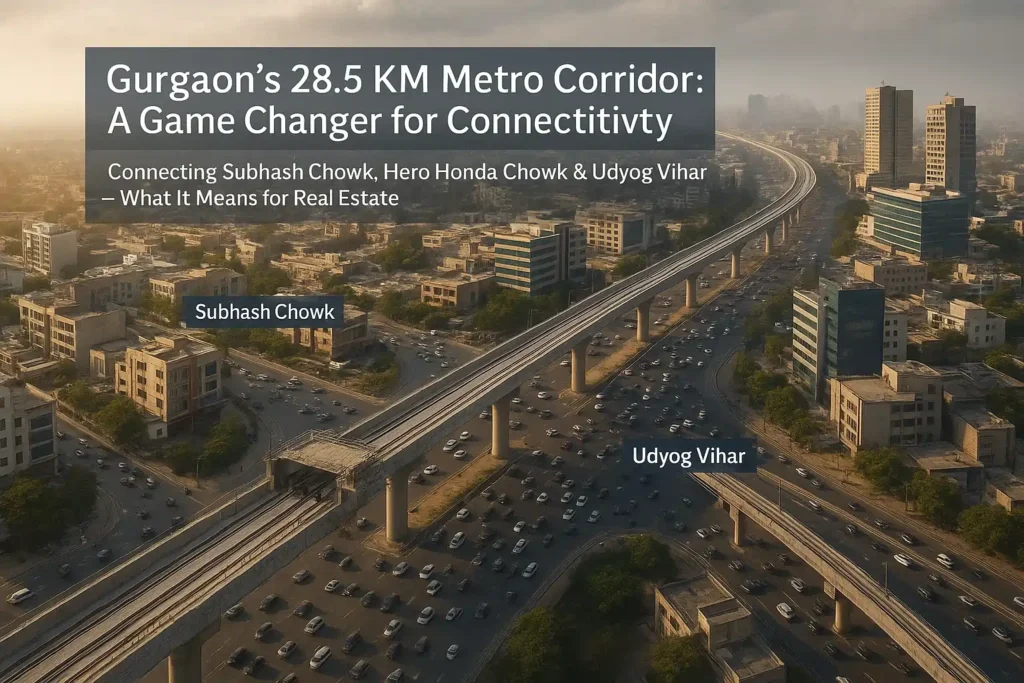
- Length & shape: ~28.5 km elevated corridor connecting Old Gurugram with Cyber City, plus a short spur toward Dwarka Expressway.
- Stations: ~27 stations planned to serve residential, institutional, and commercial pockets—designed to improve last-mile access to IT/office hubs (Udyog Vihar, Cyber City) and transit nodes.
- Cost & timeline signals: Construction activity has accelerated in 2025; the project has multi-hundred-crore approvals and piling/works are underway on early stretches. Ground-breaking has already taken place on initial nodes.
Why a Metro Line Usually Lifts Nearby Property Values — The Economics in Plain English
- Faster commutes = larger effective neighbourhood. Households and renters are willing to pay a premium to cut daily travel time.
- Institutional and commercial re-weighting. Offices, retail, and services follow transit, increasing local jobs and daytime footfall.
- Lower transport friction raises willingness to pay. Areas that were marginal because of congestion become attractive to buyers and developers.
- Perception and developer interest. Metro corridors attract new launches, higher-quality finishes, and “transit-oriented development” marketing.
Ground-breaking has already taken place on initial nodes
How Dwarka Expressway Stands to Gain
Dwarka Expressway has already been a top performer in the past few years due to expressway completion, new supply, and investor interest. The metro spur will accelerate this trend:
- Commuter reach to Cyber City and Udyog Vihar will be much quicker, turning Dwarka Expressway addresses into viable daily-commute homes for IT and finance professionals.
- Price elasticity already visible: Dwarka Expressway prices have approximately doubled in the last 3–4 years in many pockets. Analysts expect that the metro will accelerate growth further, with localized uplifts of 15–25% once stations become operational.
Practical implication: Inventory near planned stations on the expressway will enjoy better liquidity and stronger rental demand once the line is operational.
What Old Gurgaon Will Experience
Old Gurgaon — the older, more established residential spine with dense neighbourhoods and markets — will benefit differently:
- Reduced central-to-periphery pressure. Commuters will save significant time reaching Cyber City and Udyog Vihar.
- Infill redevelopment potential. Older plots and low-rise areas near stations become candidates for redevelopment, attracting institutional developers.
- Commercial resilience. Local retail, dining, and last-mile services typically see higher footfall where stations land.
Bottom line: Old Gurgaon’s established stock will see improved liquidity and selective price gains, but the strongest percentage rises will likely appear in undervalued peripheral pockets.
Numbers & Realistic Upside
- Dwarka Expressway has already seen property values double in the last four years.
- Market estimates suggest short- to mid-term uplifts of 15–30% in station micro-markets over a 2–4 year window once metro operations begin.
- “Areas that were marginal because of congestion become attractive to buyers.”
Who Benefits Most — Buyers, Owners, or Speculators?
- End-users / owner-occupiers: Win from better commute, quality of life, and resale options.
- Buy-to-let investors: Can expect improved rental yields and lower vacancy.
- Developers / flippers: Gain from early land acquisitions and transit-oriented projects, though they carry higher risk.
Risks and What Can Go Wrong
- Timing risk: Delays in construction can postpone benefits.
- Microlocation matters: A property within 500–800 metres of a station sees far greater impact than one 2–3 km away.
- Overpaying on hype: Markets sometimes price in future value too early.
- Short-term disruption: Construction can cause temporary congestion and local inconvenience.
Practical Checklist for Buyers and Investors
- Map exact station locations: Buy within a 10–15 minute walk.
- Prefer ready or near-completion projects: These assets capture early rental demand.
- Check developer track record: Quality and timely delivery will matter more in metro-influenced markets.
- Look at interchange nodes: These hubs often command the strongest premiums.
- Be conservative on expected gains: Use 15–25% uplift as a realistic benchmark.
An Opportunity, Not a Guarantee
The new Gurugram metro corridor that links Old Gurgaon to Cyber City — with a spur to Dwarka Expressway — will materially reshape the city’s transit map. While some of the value is already priced in, the metro will still bring durable, location-specific gains: higher rental demand, improved resale liquidity, and renewed developer activity in transit-adjacent areas. For buyers and investors, success will depend on choosing the right microlocation, project stage, and developer, rather than banking on hype alone.
FAQ , S
1. How will the new Gurgaon metro line impact property prices on Dwarka Expressway?
The metro spur connecting to Dwarka Expressway is expected to raise property values by 15–25% in micro-markets near stations over the next few years. Improved connectivity to Cyber City and Udyog Vihar will attract more end-users and tenants, boosting both resale and rental demand.
2. Will Old Gurgaon also benefit from the new metro line?
Yes, Old Gurgaon will see benefits such as reduced travel time, better connectivity to job hubs, and redevelopment opportunities. While price appreciation may be lower compared to Dwarka Expressway, liquidity and rental demand in Old Gurgaon are expected to improve significantly.
3. What type of properties will gain the most from the metro project?
Properties located within walking distance (up to 800 meters) from planned metro stations and those near interchange hubs will gain the most. Ready-to-move and near-possession projects are likely to capture the first wave of appreciation and higher rental yields.
4. When will the new metro line be completed?
The metro corridor has already begun early construction in 2025. While official timelines may shift, large-scale operations are typically expected within 4–5 years of such ground-breaking, subject to no major delays.
5. Is it a good idea to invest in under-construction projects near the new metro?
Investing in under-construction projects can yield strong returns if the developer has a good track record of delivery. However, buyers must factor in risks like construction delays and ensure they are not overpaying for “future metro value” that is already priced in.
6. Will the metro also improve rental demand in Gurgaon?
Yes, rental demand is expected to rise, especially along Dwarka Expressway and Old Gurgaon areas close to metro stations. Professionals working in Cyber City, Udyog Vihar, and nearby office hubs will find metro-linked homes more attractive, reducing vacancy rates for landlords.