India’s urban population is expected to reach 600 million by 2036, creating immense pressure on housing, infrastructure, and transport systems. To address these challenges, cities need innovative urban planning models that balance growth with sustainability. One such model is Transit-Oriented Development (TOD)—a planning approach that integrates residential, commercial, and recreational spaces within walking distance of mass transit hubs.
TOD is not just about infrastructure; it is about reshaping how people live, commute, and interact in urban spaces. This blog explores what TOD means, why it is crucial for India, its benefits, challenges, and real-world examples.
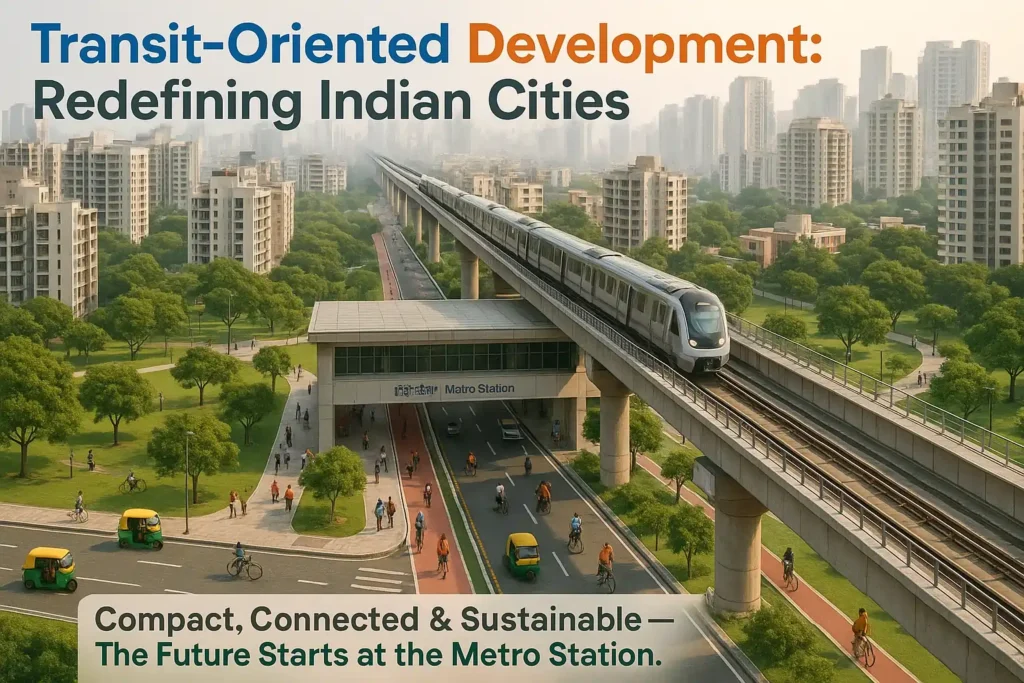
What is Transit-Oriented Development (TOD)?
Transit-Oriented Development (TOD) is an urban development strategy that creates high-density, mixed-use communities centered around public transport systems such as metro stations, bus rapid transit (BRT), or suburban railway networks.
Key Features of TOD
- High-Density Development: Concentrating housing, offices, and retail near transit hubs.
- Mixed-Use Planning: Combining residential, commercial, recreational, and institutional spaces.
- Walkability: Designing pedestrian-friendly streets with safe sidewalks and bicycle lanes.
- Reduced Car Dependency: Encouraging people to use public transport over private vehicles.
- Sustainable Living: Lower carbon emissions, efficient land use, and reduced congestion.
Why India Needs TOD
India’s cities are already grappling with traffic congestion, pollution, and housing shortages. According to a World Bank report, traffic delays cost Indian cities billions annually. With urban migration accelerating, TOD presents a sustainable alternative to uncontrolled sprawl.
Key Reasons TOD is Crucial for India
- Rising Urbanization: Over 40% of India’s population will live in urban areas by 2030.
- Infrastructure Investments: The Indian government is investing heavily in metro rail, regional rapid transit systems (RRTS), and high-speed rail projects.
- Sustainability Goals: TOD aligns with India’s commitment to reduce carbon emissions under the Paris Agreement.
- Affordable Housing Demand: TOD can integrate affordable housing policies near transit hubs, making cities more inclusive.
Benefits of Transit-Oriented Development
1. Improved Connectivity
TOD ensures seamless access to metro stations, bus stops, and cycle tracks, reducing travel times and making cities more commuter-friendly.
2. Economic Growth
Businesses thrive around TOD hubs due to higher footfall. Retail outlets, offices, and co-working spaces near transit systems attract steady customer bases.
3. Affordable Housing Opportunities
Government schemes like PMAY (Pradhan Mantri Awas Yojana) can be integrated into TOD policies, ensuring affordable housing near transit hubs.
4. Environmental Sustainability
By reducing car dependency, TOD cuts down on vehicular emissions, lowers air pollution, and contributes to greener urban living.
5. Enhanced Quality of Life
Residents enjoy walkable neighborhoods, reduced commute stress, better air quality, and access to essential services without relying heavily on private vehicles.
Challenges in Implementing TOD in India
While TOD has immense potential, its execution faces hurdles:
- Land Acquisition Issues: Acquiring land near transit hubs for large-scale development can be difficult.
- High Costs: Building high-density, mixed-use developments requires heavy investment.
- Policy & Governance: Lack of coordination between municipal bodies, urban development authorities, and transport agencies.
- Socio-Economic Divide: If not planned well, TOD could lead to gentrification, pushing low-income groups away from city centers.
- Awareness & Acceptance: Developers and citizens need to adapt to new urban living concepts beyond traditional layouts.
Examples of TOD in India
1. Delhi Metro TOD Policy
The Delhi Development Authority (DDA) has adopted a TOD policy that encourages high-density development around metro corridors, with a focus on mixed-use projects.
2. Ahmedabad Janmarg BRTS
Ahmedabad’s Bus Rapid Transit System (BRTS) is one of the earliest attempts to integrate land use with transit, encouraging compact development around bus corridors.
3. Gurgaon Rapid Metro Corridor
Gurgaon has seen multiple mixed-use developments along the Rapid Metro line, promoting office spaces, malls, and housing within walkable distances.
4. Mumbai Metro Expansion
As Mumbai expands its metro network, real estate development is increasingly shifting around metro corridors, offering high rental yields and connectivity benefits.
The Road Ahead TOD and Smart Cities
The Government of India’s Smart Cities Mission has emphasized the role of TOD in creating sustainable and livable urban centers. The future of Indian cities lies in integrating technology, mobility, and sustainability. With ongoing investments in RRTS corridors (Delhi-Meerut, Delhi-Alwar, Delhi-Panipat) and metro expansions, TOD will redefine real estate and urban living.
Transit-Oriented Development (TOD) is more than a planning concept—it is the blueprint for the future of Indian cities. By encouraging walkability, sustainable transport, affordable housing, and economic growth, TOD can transform India’s chaotic urban expansion into well-planned, people-centric communities.
For policymakers, developers, and investors, TOD represents both a challenge and an opportunity. Cities that adopt TOD today will be the ones leading India into a more sustainable and livable tomorrow.