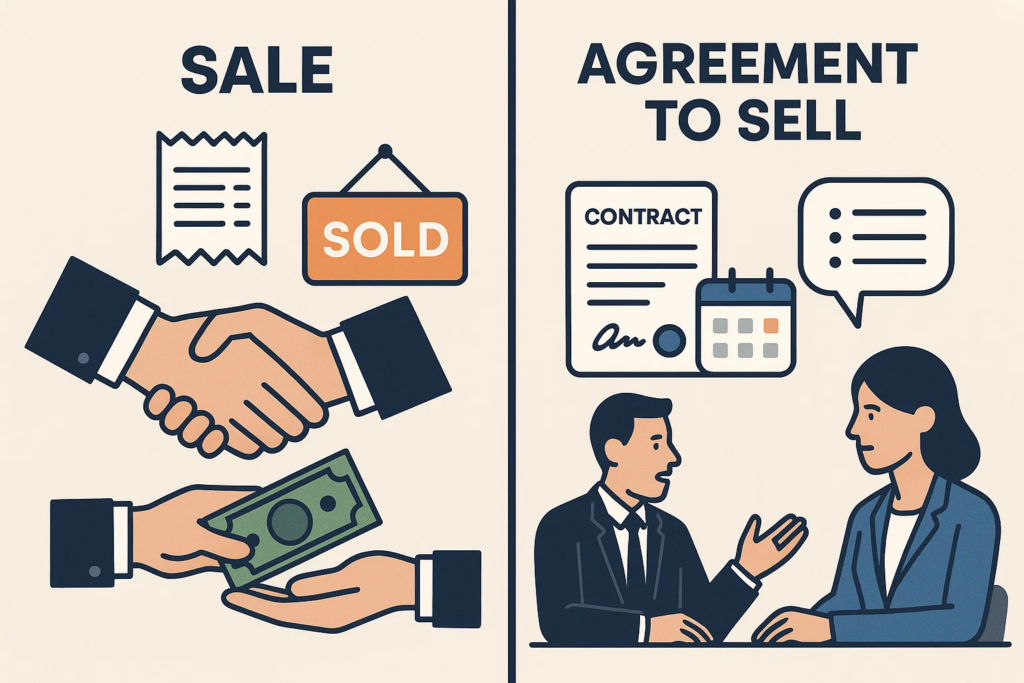
A sale creates ownership of the property immediately upon execution of a sale deed which is properly stamped and registered. An agreement to sell, on the other hand, is a mere promise to make the transfer subject to fulfillment of conditions at a future date and till then the buyer shall merely have a contractual right. This article compares the difference between sale and agreement to sell, their distinguishing features, legal provisions, things to watch out for in agreements, etc.
Many property disputes in India erupt due to one fundamental misunderstanding. The buyer, after paying a hefty amount of token money, executes an “agreement” and assumes ownership of the flat or the plot. In legal terms, he does not!
This article explains the key differences between sale and agreement to sell in plain language, the differences with regard to their comparison to the sale deed, the applicable law and points to consider before signing any agreement. You would often find ‘agreement to sale’ while browsing online or in documents. It refers to the same as an agreement to sell.
What is a Sale?
According to the section 54 Transfer of Property Act, 1882, a sale is a transfer of ownership for a price paid, payable or promised. The distinguishing factor is the word ‘transfer’ and in a sale, it takes place immediately. As regards to tangible immovable property of the value of one hundred rupees and above, according to the same section, the transfer should happen by a registered instrument (sale deed) and till then, the buyer shall have merely the contractual right.
On a complete sale:
- Ownership transfers to the buyer immediately.
- The buyer can move to get the mutation done in the revenue or municipal records.
- The seller cannot deal further with the property nor can he assign or pledge the property again.
Here’s an example to understand the sale. Ritu buys a flat in Gurugram for Rs 80 lakh. She pays the entire amount and both parties execute the sale deed in the office of the Sub-Registrar, stamp duty is paid and the deed is registered. From this point onwards, Ritu becomes the owner of the flat.
What is an Agreement to Sell?
Again, according to Section 54, a contract for the sale of property is a contract that a sale of the property will take place on certain terms between the parties to the contract. There is a rider in this subsection which the buyer often misses. Such a contract “does not, of itself, create any interest in or charge on such property”.
Thus, in layman’s language, by agreeing to sell, the buyer does not become the owner of the property.
However, he becomes a buyer-in-waiting till such time as the sale deed is executed and registered.
A good agreement to sell usually incorporates:
- The consideration (price), earnest money and the schedule for the balance.
- The timeline for the execution of the sale deed, for example, within 90 days from the date of agreement.
- The conditions which have to be fulfilled first such as sanction of loan, clearance of existing mortgage or obtaining approvals.
- What happens when either party defaults including refund or forfeiture terms.
For example: Arjun agrees to buy a plot for Rs 45 lakh and pays Rs 4.5 lakh as earnest money. The agreement to sell incorporates that the sale deed will be executed within 90 days from the date of agreement, subject to the seller clearing a bank charge on the plot.
Till then, the plot belongs to the seller. If the seller backs out, Arjun can not come and claim the property by right. He will have to go to the court of law (Specific Performance) to get the seller to execute the sale deed and if the seller is not amenable, claim compensation for his losses.
Key Differences Between Sale and Agreement to Sell
Here’s a detailed comparison of sale vs agreement to sell across various factors:
| Basis | Sale | Agreement to Sell |
|---|---|---|
| Ownership Transfer | Immediate | Future, after conditions are met |
| Legal Nature | Executed Contract | Executory Contract |
| Registration | Mandatory | Optional but recommended |
| Risk Transfer | Immediately to buyer | Remains with seller until sale |
| Remedy for Breach | Buyer can sue for possession | Only compensation can be claimed |
| Document | Sale Deed | Agreement to Sell |
| Legal Enforceability | Legally binding and complete | Legally binding but not complete |
| Applicable Law | Transfer of Property Act, 1882 | Indian Contract Act, 1872 |
Agreement to Sell vs Sale Deed: Side-by-Side Comparison
If you are looking for the quick difference between agreement to sell and the sale deed in India, here’s a comparison.
| Factor | Agreement to Sell | Sale / Sale Deed |
| Nature | A promise to transfer ownership in the future | A completed transfer of ownership |
| Ownership | Stays with the seller | Moves to the buyer at once |
| Right created | A right to enforce the contract | Full title and possession |
| Registration | Not always compulsory, but needed in some cases | Compulsory for immovable property worth ₹100 or more |
| Stamp duty | Set by each state; often lower, but can be charged like a conveyance if possession is handed over | Full state duty on the higher of price or circle rate |
| If the seller defaults | Buyer can sue for specific performance or damages | Seller no longer holds the property; disputes turn on title or defects |
| Can it be undone? | Yes, as per its terms or by law | Hard to reverse; usually needs a court order or a fresh registered deed |
| Proof of ownership | None | Primary title document |
Sale Agreement and Sale Deed: What the Documents Contain
In India, many confuse “sale deed vs sale agreement” and “sale agreement vs sale deed” as the same. They are not. The differences are as mentioned above. Here’s what each document contains.
The Sale Agreement:
It is the rule book for the deal. The Sales agreement contains the price, payment terms, schedule, conditions and defaults with appropriate riders. It does not create ownership of the property for any of the parties.
The Sale Deed:
This marks the end of the deal. It states that the seller has transferred ownership for the agreed price and describes the property and its boundaries as well as possession. It needs to be executed in the presence of the sub-registrar with witnesses and shall be required by the banks and buyers for years to come.
The Laws Behind the Difference
There are various Acts which touch upon these topics. The most relevant ones are:
- Section 54, Transfer of Property Act, 1882: defines a sale and also says that a contract for sale does not create any interest in the property.
- Section 53A, Transfer of Property Act: provides limited protection to a buyer in possession of the property upon proper registration of the agreement.
- Sections 17 and 49, Registration Act, 1908: a sale deed must be registered and as per 17(1A), an agreement relied upon for part-performance must be registered as well. An unregistered document does not affect the property, but can prove the contract in a suit for specific performance.
- Specific Relief Act, 1963: post-2018, courts are mandated to enforce a valid contract by default.
- Limitation Act, 1963: suit for specific performance is generally barred three years after the date fixed for completion or the refusal of the seller.
- RERA, Section 13: developer cannot take more than 10% of cost as advance without signing a registered agreement for sale.
The Supreme Court has laid down the practical difference between the three in Suraj Lamp & Industries v. State of Haryana (decided on 11 October 2011). It held that agreement to sell, general power of attorney and will arrangements do not transfer title. Only a registered conveyance deed does. That bundle of documents holds out papers but not ownership.
How to Verify an Agreement to Sell?
1. Verify title: check the chain of ownership documents, encumbrance certificate, tax receipts and approvals.
2. Sign the agreement to sell and pay the earnest money through traceable channels.
3. Fulfill conditions: this may involve loan sanction, obtaining a no-objection certificate, or clearance of an old mortgage.
4. Pay the balance as per the schedule, and keep the receipts.
5. Execute sale deed: pay the stamp duty and register it before the sub-registrar.
6. Complete mutation and shift utility connections to your name.
The change of ownership happens only in step 5. Before that, it is all preparation.
Importance in Real Estate Transactions
Buyers
- Knowing whether the document is a sale deed or an agreement to sell helps in understanding your rights.
- Always ensure that you transfer the property title through a registered sale deed, because doing so protects your ownership rights and, moreover, helps avoid legal disputes in the future.
- Avoid paying the full amount merely based on an agreement to sell without safeguards.
Sellers
- Helps in securing your interest before full payment is received.
- Agreement to sell allows you to set clear terms before parting with ownership.
Investors
- Many under-construction projects are sold via an agreement to sell, which makes it essential to know the risk exposure.
- It’s important to ensure the agreement is well-drafted and includes timelines and exit clauses.
Why Registration Matters?
Sale Deed Registration
- Mandatory under law.
- Without registration, the buyer doesn’t get legal ownership.
- Subject to stamp duty based on property value.
Agreement to Sell Registration
- Not mandatory but helps protect the buyer’s interest.
- Registered agreement can act as proof in court cases.
Common Mistakes by Buyers to Avoid
- Treating the agreement or even a token receipt as proof of ownership.
- Leaving the timelines vague. “Within a reasonable time” is a recipe for disputes. Give a definite date and a grace period.
- Skipping the default clause. Specify what is to be refunded, forfeited or payable as compensation if someone walks away.
- Paying large amounts in cash. Transfer via banks so that everything is traceable.
- Relying on a power of attorney or will to complete the deal. After Suraj Lamp, that does not work.
- Ignoring the encumbrance certificate. An unpaid loan or litigation can follow the property to you.
Conclusion
The difference between the two agreements, that is the Agreement to Sell and the Sale Deed, is that there is a lot to be learned about both agreements as far as making sure that one differentiates a binding proposal to sell from a transfer of ownership rights. Agreement to Sell serves as the legal obligation of the buyer and seller, whereas the Sale Deed is executed when the sale agreement becomes legal through registration as per the Indian Registration Act.
By going through the differences between sale and agreement to sell, the buyer must ensure the seller has the complete title to the property, ascertain all terms and conditions of the agreement and also confirm the documents needed for registration.
For high-value properties, buyers should consider hiring a lawyer to do due diligence on the ownership of the property as it helps in disclosing many issues and makes the deal transparent. One must understand that an agreement to sell is not a legal document to transfer ownership; thus, a sale deed cannot be used to correct a defective agreement.
Difference Between Sale and Agreement to Sell: FAQs
An agreement to sell provides the terms and conditions for future sale while a sale deed when executed and registered to the satisfaction of the law becomes the legal document which transfers the ownership of the property.
No, it is not, as per Section 54 of the Transfer of Property Act, an agreement could be binding but does not create any interest in the property.
Yes, an agreement to sell in India is legally binding and enforceable but does not transfer the ownership of the property.
Yes, the buyer could claim compensation through the law of contract for the breach which occurred either through an act or omission by the seller of his duty to deliver the property.
No, the registration of an agreement to sell is not mandatory but some agreements as per Section 17(1A) of the Registration Act 1908 and state laws are compulsorily registered.