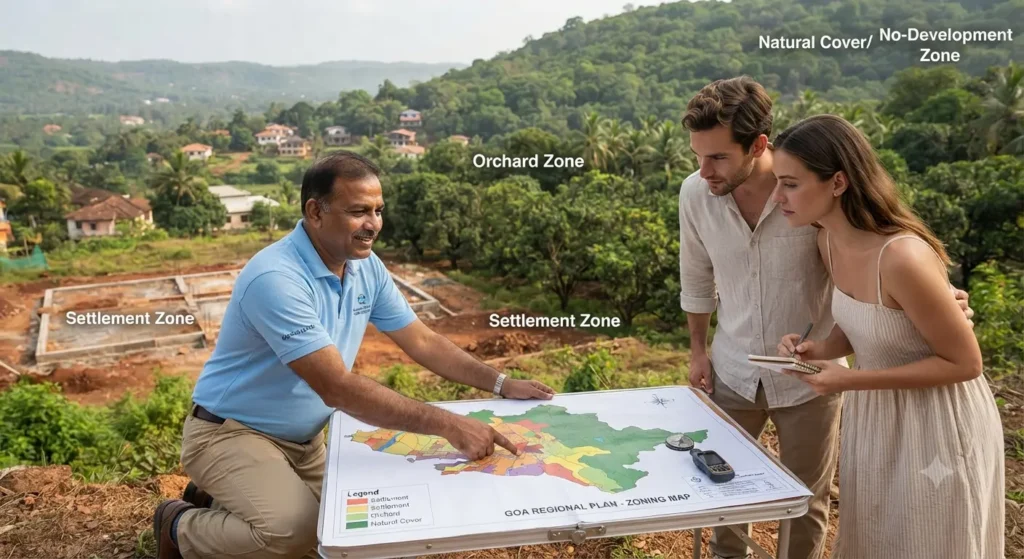
Purchasing land in Goa can be thrilling, particularly if a piece of land is seen encircled by trees, fruit orchards or expansive open spaces. Whereas a picturesque site, does not equate to being suited for a specific buyer’s development.
Without having a clear understanding of what is contained in the Goa’s Regional Plan before you buy land, you cannot assess how the land will be developed. It gives a more detailed context of land use and development and may be used to inform purchasers about the suitability of a parcel for being located within a settlement area, orchard related zone, a zone of natural cover or other category.
Anyone interested in buying property in Goa should learn how to read the Regional Plan as it will help minimize the chance of making assumptions based on the property’s location or based on what the seller promises.
What Is Goa’s Regional Plan?
A Regional Plan is a land-use and development planning document that provides general land-use and development principles for a region. It identifies different areas according to their intended use and planning characteristics.
Basically, the plan is used to answer the question:
What is the development planned for this land within the planning framework?
What it might look like to a buyer on the ground and what it really is can be vastly different.
A large green parcel might appear perfect for a villa, farmhouse, resort or any other development. However, the buyer should not assume that construction is allowed, even if the applicable planning designation does not allow development.
Settlement Areas
Settlement designation typically refers to a region that is tied to a present or anticipated human settlement and use.
When selling or investing in a property, settlement areas can be considered to be a good choice due to the development potential that they offer as compared to some environmentally sensitive areas or agricultural areas. But the designation of a settlement in itself does not imply that anything can and should be built on the land.
There may be other factors as well, such as:
- Zoning and development regulations that apply to the project.
- Minimum plot requirements
- Road access
- Setbacks
- Building permissions
- The legal aspects of title and ownership.
- Cultural, coastal or environmental limitations
- Heritage-related restrictions
- Needs to receive approvals from relevant authorities
So, it is advisable for a buyer to check the entire planning status, not just by the word “settlement.
Orchard Areas
Goa is famous for its plantations, farms, greenery, orchards, coconut trees and other green scapes.
If you’re looking for a quiet second home or weekend getaway, a property that’s listed as an orchard might appeal to you the most. However, from a planning point of view, it is also a characteristic of agriculture.
Buyers should determine:
- The official land use designation of the parcel.
- The planning designation (where relevant).
- Whether the proposed use would be authorized.
- Whether a conversion or other permissions are required.
- If there are any restrictions as a result of existing trees or further agricultural use.
The mere existence of an existing building does not guarantee that a purchaser will have the right to build a new structure or to add to an existing structure without first obtaining permission.
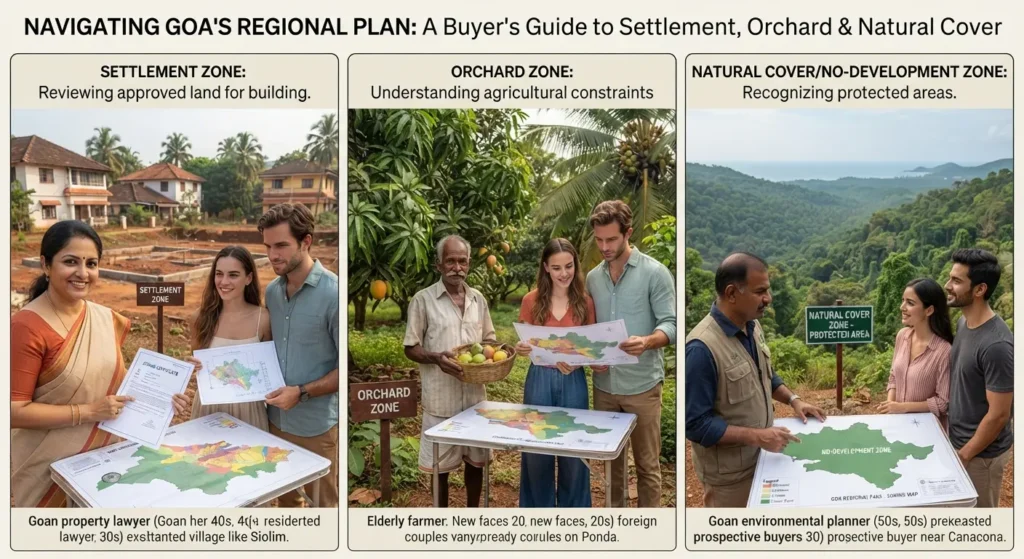
The area of natural cover and environmentally sensitive areas.
Natural-cover areas are important to focus on in due diligence.
Forests, wetlands, water bodies, hills, agricultural area and other ecologically important features are all present in Goa’s landscape. Environmental concerns can affect the permitting of development in a certain area.
If a customer is buying a house because of the greenery or secluded location, he or she should be wary.
Limited development in a particular area might be part of the charming appeal of a natural look property.
Prior to paying a token amount, buyers need to determine if the property is subject to any environmental, forest, coastal, heritage or other planning constraints.
For those considering purchasing property in the region, here are some reasons why the Regional Plan is important:
A common misconception that many people fall for when purchasing land is that they think the land will be theirs to develop.Many property deals are unsuccessful because the right to ownership is confused with the development rights.
Not all land-use changes and construction are allowed.
The Regional Plan is thus part of an overall due-diligence process. It should be considered along with revenue documents, title documents, survey data, related zoning ordinances and permits for proposed development.
Therefore, if a buyer is going to construct a villa, they shouldn’t end their checking process after they establish that the seller has registered title. The buyer should also check to see if the proposed construction is allowed for that specific premises.
Don’t only use maps from the internet!
Digital maps and property portals may also be useful for preliminary investigations, but cannot be used as a definitive means of establishing development rights.
A listing of real estate can refer to land as:
- Residential
- Orchard
- Farm land
- Settlement
- Investment land
- Villa plot
The marketing descriptions are not necessarily a full legal and planning picture.
Before committing a financial investment, the buyer should obtain verification from the official records as well as planning documents.
Use a paper copy of the survey to verify the number.
The most crucial part is the actual survey number and subdivision information of the property.
Rather than asking the question “Is this a residence,” ask:
What is the Plan designation of the survey number in question?
This separation is very important.
Various land use categories may be present in a broad locality. Planning classification can vary significantly between two Development Appropriateness Plans that are only a short distance apart.
That’s why assumptions about location can be dangerous.
The Regional Plan is one part of the Due Diligence process.The Regional Plan is just one component of Due Diligence.
It is normally recommended that a comprehensive property investigation be conducted that extends beyond the Regional Plan.
Buyers are advised to consider:
- Previously registered deed and previous title papers
- Survey records
- Mutation records
- Land-use classification
- Encumbrances
- Access and right of way.
- Development permissions
- Conversion requirements
- Applicability of Coastal Regulation Zone, if applicable
- Environmental restrictions
- Existing structures and their approvals.
- Local planning rules that apply
Legal and planning counsel can be especially useful where the intended acquisition project is large, complicated or involves construction.
Before purchasing, consider these questions:
When buying land in Goa, ask yourself:
What is the exact Regional Plan designation?
Does the property fall under a ‘settlement area’, ‘orchard related area’, ‘natural-cover area’, or another area?
Is the use in accordance with the relevant planning designation?
Are there any other restrictions that impact construction?
Has the current building been deemed suitable for operation under the law?
Do any changes in land use need to be made?
Is there legal access to the property by road?
Do there exist environmental or coastal limitations?
Being able to have these questions answered and answered clearly can help buyers differentiate between an eye-catching home and a home that is right for them.
Final Thoughts
There are a number of things that make a property desirable in Goa, but the very same nature that makes it desirable can affect what is allowed to be built on the lot.
It is therefore important for property due diligence to establish if land is within a settlement, orchard, natural-cover or other planning category.
The best way is to ensure survey particulars and check planning documents, title and revenue documents and seek professional advice before investing funds.
So, do not just ask “Where is the property?” when purchasing land in Goa.
Ask a more relevant question:
What can I do with it in the context of the relevant planning framework?
The answer can have a huge impact on the utility of the home as well as your future plans.
Frequently Asked Questions: Reading Goa’s Regional Plan Before You Buy
Goa’s Regional Plan (such as RP 2021) is a statutory land-use blueprint that designates specific zones for development, agriculture, and environmental conservation. Checking it before buying ensures the land is legally buildable and not restricted.
A Settlement Zone indicates that the land is legally approved for residential or commercial construction. It is the safest zone for buyers looking to build immediately without extensive land-use conversion processes.
Generally, strict regulations protect orchards from commercial or residential real estate development. While limited farmhouse construction might be permitted under specific agricultural exemptions, full-scale residential development usually requires a tedious zone conversion process.
Land designated as Natural Cover (often comprising hillsides, forests, or ecologically sensitive areas) is heavily restricted. Development is tightly controlled or outright prohibited to preserve Goa’s topography, meaning you typically cannot build permanent structures here.
You can verify the land zone by inspecting the official Regional Plan maps available at the Town and Country Planning (TCP) Department office in Goa or by consulting a local licensed surveyor who can overlay survey numbers onto the digital maps.
Zone conversions are legally complex, heavily scrutinized, and often restricted or frozen by government policies and judicial orders aimed at curbing indiscriminate real estate expansion. Buyers should never purchase agricultural land assuming conversion is guaranteed.
Purchasing blind risks acquiring non-buildable land, facing heavy penalties for illegal construction, enduring demolition notices, or buying property stuck in eco-sensitive zones where utility connections (water and electricity) will be denied.
Regional Plan zoning dictates land use (Settlement, Orchard, etc.), whereas Comunidade land refers to traditional community-owned land governed by the Code of Comunidades. Comunidade land involves complex leasehold or auction rights and requires special clearances in addition to regional zoning checks.
Yes. If a property falls under CRZ regulations near water bodies or Eco-Sensitive Zones (ESZ) around wildlife sanctuaries, those central and state environmental rules supersede standard Regional Plan allowances, introducing stricter height and distance limits.
It is highly recommended to hire a local Goan property lawyer specializing in land revenue laws, coupled with a professional architect or town planner who can cross-verify survey numbers against current TCP maps and land records (Form I & XIV).