Introduction
Have you ever heard the term “repo rate” in financial news but weren’t sure how it affects your home buying decision? The repo rate, set by the Reserve Bank of India (RBI), plays a crucial role in shaping the broader economy—including real estate prices.
This blog will break down what the repo rate is, why it matters, and how it directly impacts property prices, home loan EMIs, and investment trends in the Indian real estate market.
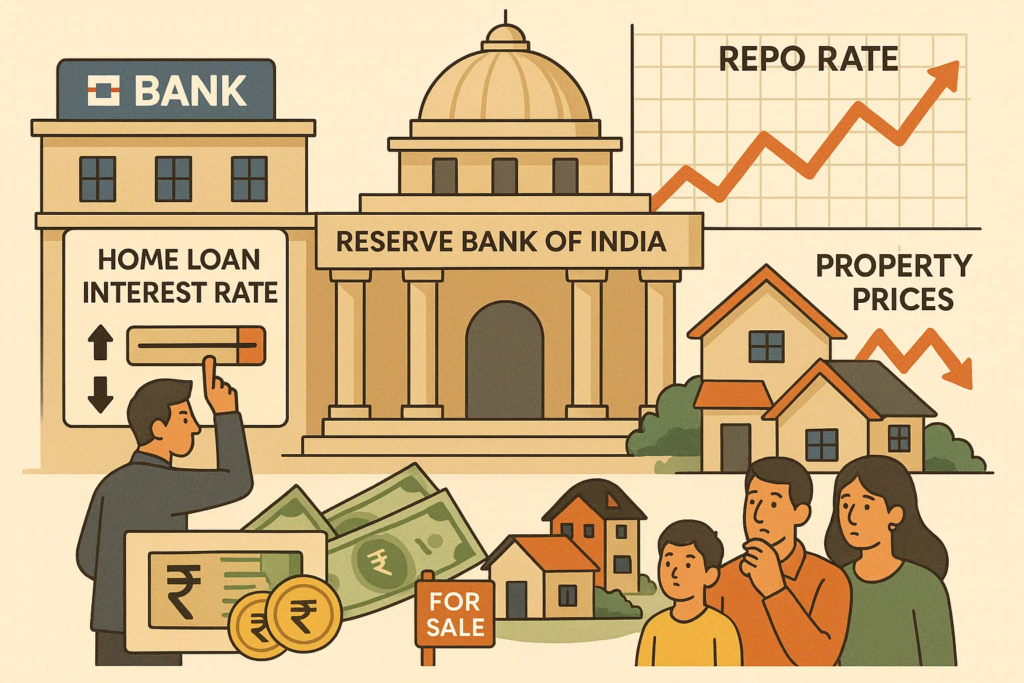
What Is the Repo Rate?
Definition
The repo rate is the interest rate at which the Reserve Bank of India (RBI) lends money to commercial banks for short-term needs. When banks face a shortage of funds, they borrow from the RBI at this specified rate.
Objective of Repo Rate
The RBI adjusts the repo rate to:
- Control inflation
- Stimulate economic growth
- Maintain liquidity in the banking system
How Does the Repo Rate Work?
Here’s a simplified explanation:
| Repo Rate | What Happens |
|---|---|
| Increased | Loans become expensive → Demand drops → Inflation is controlled |
| Decreased | Loans become cheaper → Spending and borrowing increase → Growth is stimulated |
Repo rate acts as a benchmark for banks when setting interest rates on loans and deposits, especially home loans.
How the Repo Rate Affects Real Estate Prices
1. Impact on Home Loan Interest Rates
When the repo rate changes, banks adjust their floating interest rates on home loans accordingly.
If Repo Rate is Cut:
- Home loan interest rates fall
- EMIs reduce
- More people are motivated to buy property
- Increased demand can lead to rising real estate prices
If Repo Rate is Increased:
- Home loan interest rates rise
- EMIs become costlier
- Fewer people opt for home loans
- Demand drops, stabilizing or reducing property prices
2. Impact on Housing Demand
A lower repo rate generally boosts:
- First-time homebuyers’ confidence
- Investor activity in affordable and mid-segment properties
- Construction activity as developers expect higher sales
Conversely, a higher repo rate makes borrowing costlier, which can:
- Delay buying decisions
- Slow down project sales
- Discourage speculative investment
3. Impact on Real Estate Investment Sentiment
Repo rate cuts signal a pro-growth approach by the RBI. This often translates to:
- Increased liquidity in the market
- Better returns in real estate over traditional savings instruments
- Boost in demand for residential and commercial spaces
High repo rates do the opposite—money becomes tighter, and investors may prefer fixed-income securities over real estate.
Recent Examples in India
Example 1: Post-COVID Rate Cuts (2020–2022)
- RBI slashed repo rates from 5.15% to a historic low of 4%
- Home loans dropped below 7% interest
- Property sales surged across metros like Gurgaon, Pune, Bangalore
- Developers launched affordable housing projects to meet demand
Example 2: Rate Hikes in 2023–2024
- To control inflation, the RBI hiked repo rates back up to 6.5%
- Home loans crossed 9% in many banks
- There was a slowdown in luxury housing sales
- Buyers postponed decisions waiting for rates to ease
Impact on Different Real Estate Segments
| Segment | Repo Rate Cut Impact | Repo Rate Hike Impact |
|---|---|---|
| Affordable Housing | Higher demand and sales | Slower sales, EMI burden |
| Luxury Housing | Limited impact | Investors may hold off |
| Commercial Property | More leasing activity | Reduced capital expenditure by companies |
| Plot Investments | Increased demand in Tier-2/3 cities | Price corrections or stagnation |
Long-Term vs Short-Term Effects
- Short-Term: Immediate effect on home loan rates, EMIs, and sales volume.
- Long-Term: Influences developers’ project planning, investor behavior, and urban expansion.
What Should Homebuyers and Investors Do?
If Repo Rate is Low:
- Lock in long-term home loans
- Consider buying under-construction projects
- Explore high-growth locations like Dwarka Expressway, New Gurgaon, Sohna, Naugaon
If Repo Rate is High:
- Compare floating vs fixed loan rates
- Look for developer discounts and offers
- Invest in rental yield properties where ROI justifies cost
The repo rate isn’t just a technical financial term—it directly affects your home affordability, investment planning, and market dynamics in Indian real estate. Whether you’re a homebuyer or an investor, keeping an eye on RBI’s repo rate decisions can help you make smarter property choices.
Frequently Asked Questions
1.What is the repo rate in India?
The repo rate is the interest rate at which the Reserve Bank of India (RBI) lends money to commercial banks, influencing the cost of borrowing in the economy.
2.How is the repo rate connected to real estate prices?
A lower repo rate reduces borrowing costs for banks, making loans cheaper and increasing demand for property, which can drive real estate prices higher.
3.When does the RBI change the repo rate?
The RBI adjusts the repo rate based on inflation, economic growth, and financial stability to control liquidity and encourage or slow down borrowing.
4.Does a high repo rate decrease property demand?
Yes, a higher repo rate makes loans expensive, which can reduce borrowing and slow down property purchases, leading to a potential decrease in real estate prices.
5.How quickly do real estate prices respond to repo rate changes?
Price adjustments may take a few months, as banks revise lending rates and buyers adjust their purchasing decisions based on new loan affordability.
6.Are home loans directly affected by changes in the repo rate?
Yes, home loans linked to floating interest rates are directly impacted by repo rate changes, which can lead to lower or higher EMIs for borrowers.
7.Does the repo rate influence both residential and commercial properties?
Yes, the repo rate affects borrowing costs across all sectors, influencing demand for residential homes, commercial spaces, and investment properties.
8.Can investors use repo rate trends to plan property investments?
Yes, monitoring repo rate changes helps investors predict market conditions and decide the best time to invest or sell properties for maximum returns.
9.Where can I track repo rate changes and understand their impact on real estate?
Repo rate updates are available on the RBI’s official website, financial news platforms, and by consulting real estate experts or banking professionals for market insights.