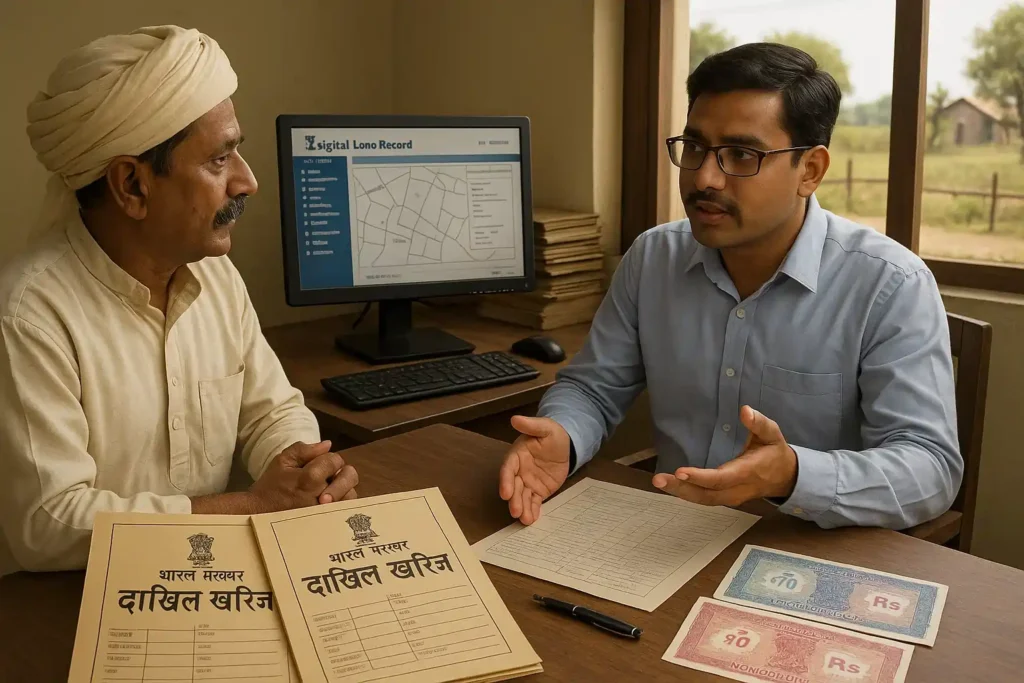
Acquisition or inheritance of a property does not mean just filling out forms, post-acquisition, there may also be an update in the revenue or municipality records with regard to the newly acquired owner’s details. In some states in India, this procedure is referred to as dakhil kharij or property mutation.
The process, the documentation, fees, etc. depend on the state and also on the nature of the property. In Bihar, Uttar Pradesh, and other states, there may be unique revenue processes and online processes. Knowing about the process may ensure that one doesn’t face any problem when acquiring the property.
Here you will learn what is meant by the term, its significance, how it is done, the required documents, and how to check the online status for property mutation in India.
What Is Dakhil Kharij in Property?
Dakhil kharij is a procedure to update revenue records about a change in the owner of a property. This is commonly done for land and agricultural property, although the specific procedure depends on the property and location.
In simple terms, what is dakhil kharij in property? It is the process of adding the name of the new buyer, heir, donee or eligible claimant to the relevant land records after verifying the documents. Dakhil kharij consists of two words with separate meanings.
Dakhil means entering the details of the new owner into the record. Kharij means removing the previous entry if necessary, based on the procedure applicable to that property and state.
Dakhil Kharij in English
Dakhil kharij in English is also referred to as mutation of property or land records. It may be known by different names in different states. RoR (Record of Rights), khata or khatauni, jamabandi or similar terms may also be used. The procedure and documents for property mutation vary for rural, urban and municipal property. Contact your local revenue office to clarify the applicable process and documents.
Dakhil Kharij Meaning: An Example
For example, if you buy a plot of land, the sale deed is executed and filed with the seller. You may also need to apply to mutate the property in your name with the revenue or municipal authority, depending on the location. After your application is accepted, your name can be entered in the land records. This is what we mean by (Dakhil Kharij) mutation. Note that mutation does not create a right in a property. Only the documents implemented when you buy, inherit, gift or receive a property through a will create rights.
Importance of Dakhil Kharij in Property
Updating land records ensures that the records reflect the right person as the owner of the land. It also allows the authorities to identify the person responsible for land revenue or other applicable taxes.
The main advantages of completing the mutation process are:
1. Updated revenue records after sale, inheritance, gift, partition or other events.
2. To help the authorities trace the person responsible for land revenue or other applicable taxes.
3. Maintain land records about changes in ownership as applicable.
4. Future transactions: Purchasers, lenders, and attorneys are likely to look at the mutations when performing their due diligence procedures. They will, however, have to verify whether there are any irregularities in the titles and other records too.
5. Irregularities: The mutation and verification procedure can detect any problems with respect to names, plot numbers, area calculations, or any other information that needs correction.
It is indeed beneficial to complete a mutation; however, mutation should never be considered as a replacement for looking at the title and other legal aspects of the property.
What Is the Dakhil Kharij Process?
The process for property mutation is slightly different in every state. Here is a generic procedure.
Step 1: Correct Revenue Office
First, you need to identify the office responsible for the property record. It may be the circle office, tehsil, revenue office or local body, depending on the property and the location. You can also visit the website of the state government to know if you can apply online for property mutation.
Step 2: Required Documents
Apply at the office concerned with the relevant documents. In case of a purchase, you may need to present a sale deed. In case of inheritance, you may need to provide a will or death certificate, along with other documents. The documents required depend on the reason for mutation.
Step 3: Submitting the Application Form
Fill the application form either electronically or at the office. Provide all the details about the property, including the area (where the property is situated), tehsil/circle, village, plot/survey number and so on.
In case of online submission of application form, submit scanned copies of your documents and keep the acknowledgement and application number for future purposes.
Step 4: Verification by the Authority
The authority may verify the documents and records and conduct a field verification, as applicable. Notice may also be sent to persons interested in the property to participate in the process.
Step 5: Clarification of Documents and Objections
In case of any objections raised by the authority regarding incomplete or other documents, clarification may be provided. In case of any objections raised by the authority, a response should be given within the stipulated time limit. For instance, in case of disputes regarding inheritance, mutation cannot be done until the dispute is sorted out.
Step 6: Approval and Record
If the application is accepted, you will receive a notice about the approval. The records in the revenue office will also be updated. Ensure that the entries about the name, area and plot number are correct.
Note that simply submitting an application does not mean that the mutation is approved. You must double-check the entry independently.
Types of Dakhil Kharij in Property
You may need to apply for mutation for different reasons, such as buying, inheriting, gifting or partition of a property.
1. Mutation After Sale:
You may apply for mutation after buying a property. This involves submitting a sale deed and other documents.
2. Mutation Through Inheritance:
If you inherit a property after the death of the owner, you may apply for mutation based on succession laws. This may involve submitting a will, death certificate and other documents. If there are disputes about inheritance, you may not be able to complete the process.
3. Mutation Through Gift:
If you receive a property through a gift, you may apply for mutation with a gift deed and other documents.
4. Mutation Through Will:
You may apply for mutation after receiving a property through a will.
5. Mutation Through Partition:
If you partition a property, you may apply for mutation with the documents about the partition. This may vary based on the documents applicable in your state.
6. Correction or Other:
Sometimes, you may need to make changes to the record of a property, such as correcting a spelling mistake, based on an order from the authority. It may not always be possible to apply for mutation in such cases.
Read More: Difference Between Sale and Agreement to Sell
What Are the Required Documents for Dakhil Kharij?
The documents required to update property records vary based on the reason and the state. However, the following documents are commonly accepted:
- Registered sale deed or other documents to prove the transfer of property.
- Previous Record – Jamabandi, Khatauni or Record of Rights (RoR).
- Plot or survey number and village.
- Identity and address proof, as applicable.
- Application form and acknowledgement, if already submitted.
- Latest receipt of land revenue or property tax, if applicable.
- Death certificate and other documents to prove inheritance.
- Registered gift deed, if the property is gifted.
- Will, partition deed, court order or any other documents, if applicable.
- Declaration, affidavit or any other documents, as applicable.
Make sure that you do not assume that you need all documents listed above. You must consult the documents required for mutation in your state. You can also confirm if a property is mutation-proof before you apply for mutation.
How to Do Property Mutation in India?
To complete the process, you must understand the procedure and documents required in your state and for the type of property. The procedure may vary for agricultural land and a flat or house in a city.
Here is a simple procedure to help you with property mutation:
1. Confirm that you understand the basis for mutation (sale, inheritance, gift, partition or correction).
2. View the records and find the property identifier, such as the name of the owner and the plot number.
3. Prepare the documents that support your application (use the checklist of documents described above).
4. Apply through the appropriate office (online, if available).
5. Ensure that you save the acknowledgment and note the application number.
6. Follow up on the application and respond to notices, if applicable.
7. Collect the updated record after the application is approved.
Note that there is no single application form for property mutation across India. You must apply according to the procedure of the state where your property is located. It is also possible that the process or timelines may vary in different offices. If your application for mutation is pending beyond the stipulated time, you may contact the office mentioned in the acknowledgment or use the state’s grievance-redressal mechanism.
Read More: What Is CLU in Property in India?
How to Check Dakhil Kharij Status Online?
You can check the status of mutation online for certain states. You may need to provide details, such as the district, circle or tehsil, financial year, case number, deed number, village or plot number.
Here is a simple procedure to help you with checking the status of mutation:
1. Visit the official website of the revenue or land records department of the state.
2. Use the link for application status or case status.
3. Select the district and local office (circle or tehsil) that handles the application.
4. Enter the details that the website asks for, such as the application or case number.
5. Complete the security check and submit the request.
6. View the status of your application and the instructions, if any.
Ensure that you use the link provided by the state government rather than a third-party website that collects personal information or payment.
How to Check Dakhil Kharij Status Offline?
However, if you are unable to check the progress online or there is no such information available on the progress of the application, then visit the office dealing with the application.
Take along with you the acknowledgment or case number, property details and copies of the documents submitted. Ask the subordinate who is dealing with the dispute whether any notice has been issued by him to you, and whether there is anything that needs to be done further from your side.
In case your application is pending for too long a time, then send a written application for the same. Get a copy of the stamp of the acknowledgment or proof of submission of the application. If there has been an order in the matter, ask for its copy and see how one can appeal or object to that order if he is not satisfied with it.
The Supreme Court has frequently held that mutations in revenue records are primarily for fiscal and administrative purposes and that they neither create nor destroy ownership. A title dispute may need to be resolved by a competent court.
Therefore, buyers cannot take for granted that the listing of a mutation entry or the deed of registration will be enough to prove the title. The process of property due diligence should include investigating the title chain, encumbrances, approvals, and pending litigation.
How to Know the Status of Mutation of Property in Bihar?
BiharBhumi services can be availed by the applicants of Bihar.
- One needs to visit the BiharBhumi website.
- One needs to find the option for Mutation Application or Application status.
- The appropriate service will need to be chosen along with filling in the property/case details.
- Instructions on the website will have to be followed to see the status.
In case the application is rejected or needs more information, the cause should be noted down and the circle office could be contacted if necessary.
The Bihar Revenue and Land Reforms Department also provides a special page for mutation status. It needs details such as district, circle, financial year and case number.
Process to Check Status of Dakhil Kharij in UP
In the state of Uttar Pradesh, the process varies depending on the type of property record and the revenue process prevailing in the region.
- Navigate the official website of the revenue or land records of the state of Uttar Pradesh.
- Choose the particular mutation or revenue case services provided. Do not mix up the land record and mutation application status services.
- Pick up the required district and tehsil as per the instructions.
- Input the case number as asked by the portal.
View the last order/status. If you don’t get any response from the portal regarding your application, please contact the tehsil or revenue department with your acknowledgment.
Difference Between Dakhil Kharij and Property Registration
Property registration and mutation serve different purposes. Registration records a transaction or instrument through the appropriate registration authority. Mutation updates the relevant revenue or municipal records to reflect a change.
| Basis | Property Registration | Property Mutation |
| Main purpose | Records a registrable instrument or transaction | Updates relevant revenue or municipal records |
| Authority | Sub-Registrar or other registration authority, as applicable | Revenue, land-record or municipal authority |
| Common supporting document | Sale deed, gift deed or other registrable instrument | Transfer document, inheritance evidence or other prescribed proof |
| Typical timing | At the time the registrable document is executed and presented, as required by law | Usually after the transfer or succession event, following the applicable process |
| Result | Registration of the instrument | Updated entry in the relevant record |
| Does it alone settle ownership? | Registration is important but does not guarantee that the transferor had good title | No; mutation does not by itself create or extinguish title |
In this regard, it is important to note that according to past decisions of the Supreme Court, an entry in the revenue books relating to mutations shall normally be a matter related to financial and administrative considerations and not that of creation of any rights or extinguishing any rights.
Thus, it can be said that purchasers of property cannot merely depend upon an entry made in the revenue books or a registered deed for their purchase. They must conduct a due-diligence survey.
Benefits of Dakhil Kharij Property
There are several advantages to mutation where applicable:
- Better Records: To ensure that the record of the government matches the recognised conveyance.
- Improved Revenue Administration: To ensure that the person who owns the property as reflected in the records is liable for applicable land revenue.
- Record-keeping: For systematic maintenance of property records.
- Documentation for Due Diligence: As an addition to documentation required for verification on the next sale of the property.
- Error Correction: The chance to correct an error made at the first stage of the application process.
- Facilitation of the Process: To make it easier to process next applications because the records have been updated.
Still, there is no guarantee that there will be no hidden disagreements, mortgages, restrictions, or other peculiarities of the title in the mutation record. Always conduct a review of the supporting documents yourself.
Conclusion
Dakhil kharij is a necessary step in the process of updating property revenue records after a sale, inheritance, gift or other mode of acquisition of ownership that is recognised by law.
The application procedures may take place on the official website or via the department dealing directly with the kind of property concerned, depending on the state and land type.
Make sure to obtain the exact authority, the documents to be submitted beforehand, and the application number. Check the status regularly and verify the entries. Above all, understand that mutation is only part of the process of establishing ownership. Do consult a property lawyer for contentious inheritance, disputes over ownership and rejected mutation applications, familiar with the laws in your state.
Dakhil Kharij: FAQs
Logon to the portal of BiharBhumi or website of the respective department and click on the option for checking mutation. Fill the required details for selecting district and circle or case number. Your acknowledgement number should be ready.
Logon to the website of UP revenue/land records and select the option of checking the status of revenue/mutation cases. Enter district, tehsil along with the application number or other particulars provided by you and then click submit. If your status report is not available, then get in touch with tehsil/revenue office for the status and your application number.
Select the required district along with the details of your property and applicant, then upload the required documents as per the instructions. You must save the reference number for future use as the guidelines regarding portals keep on changing.
It depends on the laws, rules and procedures applicable to the particular property in your state, the documents produced and any disputes that may arise. The mutation process is affected by the verification procedures for the documents, issuance of notice to parties and objections, if raised, and the workload of the department processing the application. You must refer to the guidelines issued by the department and get in touch with them if your application takes longer than mentioned in the guidelines.
While a mutation of records reflects that a conveyance has taken place, an entry in the revenue records concerning the change in ownership does not create or establish ownership. Ownership needs to be determined by examining the documents of title and other relevant papers. In cases of dispute in ownership, the matter can be devoted to a competent court for adjudication.