You do not merely purchase four walls when you purchase an apartment in India but you also purchase rights to the land upon which the building is located. Such ownership is referred to as Undivided Share (UDS) of land. Regrettably, there is a significant number of homebuyers who do not really know how UDS works, and this ignorance is used against them by builders. We can distill the actual deal behind UDS, why it matters, and the tricks you need to be aware of.
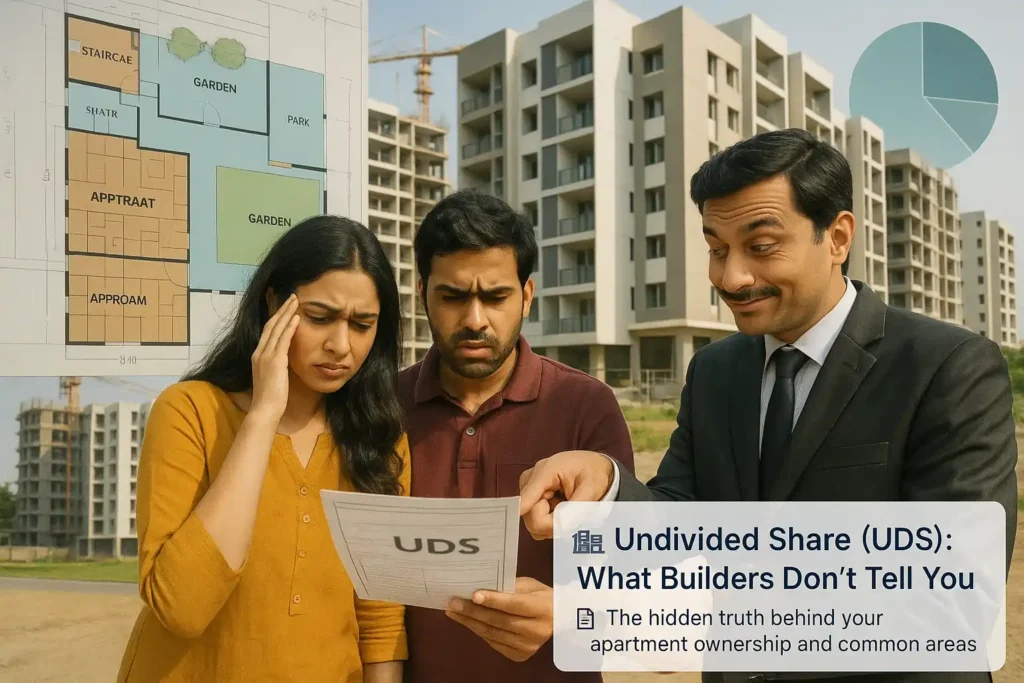
What is Undivided Share (UDS)?
To put it bluntly, UDS is the piece of land that accompanies your apartment. To put it in perspective, should a builder convert a 20,000 sq. ft. piece into 20 apartments, every customer must receive an equal share of the land.
Formula for UDS:
UDS = (Flat Area ÷ Total Built-up Area) × Total Land Area
This means, even if your apartment is on the 10th floor, you still own a part of the land. This UDS becomes crucial if the building is redeveloped or demolished.
Why UDS is Important
- Permanent Ownership of Land – Buildings may deteriorate, but land remains valuable. UDS ensures you own a slice of it.
- Redevelopment Rights – In case of redevelopment, your UDS decides your bargaining power with builders.
- Market Value & Resale – Apartments with higher UDS have better appreciation potential.
- Loan & Legal Security – Banks check UDS while approving home loans; a very low or unclear UDS can raise red flags.
Common Tricks Builders Play with UDS
Unfortunately, many builders in India manipulate UDS to their advantage. Here’s how:
1. Selling More Apartments than Permitted Land Share
Constructors at times develop more flats than the land is allowed to sustain. This waters down the UDS of every purchaser. In the case of a plot which only has 12 flats, but the builder constructs 16, the UDS of everyone goes down.
2. Not Disclosing the Exact UDS in Sale Deeds
To the shock of many buyers, their sale deed does not even specifically note the UDS. Rather, builders refer to the super built-up area only. You have a weak right to ownership without UDS mentioned.
3. Retaining UDS for Future Exploitation
Other builders are very smart and keep some share of the land to themselves. They re-build this later (when redeveloping or adding more Floor Area Ratio-FAR) without compensating those who already have purchased the property.
4. Clubbing Common Areas as UDS
Unscrupulous developers may inflate UDS by wrongly including open spaces, parking, or amenities. Remember: car parking is not part of UDS—it’s either common or stilt parking.
5. Mismatch Between Carpet Area and UDS
A smaller flat may sometimes have disproportionately less UDS than fair calculation. Builders manipulate ratios to give themselves more leeway during redevelopment.
Real Also:
- Smart Contracts in Property Transactions
- Choosing the Right Entity for Short-Term Rentals Legal & Tax
- Real Estate and Estate Planning How to Legally Pass Wealth
- Maximize Profits, Minimize Taxes 5 Legal Loopholes
Legal Perspective on UDS in India
- RERA (Real Estate Regulation and Development Act, 2016) makes it mandatory for builders to disclose land ownership and UDS details.
- Supreme Court of India has clarified in multiple judgments that UDS is inseparable from apartment ownership. You cannot sell a flat without transferring UDS.
- State laws (like Tamil Nadu Apartment Ownership Act, 1994, or Karnataka Apartment Ownership Act, 1972) also define UDS and protect buyers’ rights.
How to Safeguard Yourself as a Buyer
- Check Your Sale Deed – Ensure that UDS is clearly mentioned in square feet, not just as a percentage.
- Verify Land Title – Confirm that the builder has clear ownership of the land before selling UDS.
- Ask for Approved Plans – Cross-check number of units vs. land area to avoid dilution of UDS.
- Compare UDS Across Projects – Don’t just look at flat size; check how much land share you’re getting.
- Consult a Lawyer – A small investment in legal advice can save you from big property disputes later.
Real-World Example
In Chennai, a 10,000 sq. ft. plot was used to construct 10 flats of equal size. Each buyer got 1,000 sq. ft. as UDS. When the building was redeveloped after 25 years, each owner’s substantial land share gave them strong negotiation power.
Contrast this with Bengaluru cases where builders sold more flats than sanctioned. Each buyer’s UDS shrank, and during redevelopment, owners struggled to secure fair compensation.
The fact that you own an apartment as an undivided share (UDS), is not merely a technicality. Constructors can be deceitful and weaken or conceal UDS, a smart buyer can guard his rights. Invariably insist on understanding UDS prior to putting down the dotted line.
Final Advice: If you’re planning to buy an apartment, don’t just focus on location, amenities, and flat size. Always ask: “How much UDS am I getting?” That one number can decide your property’s long-term worth.
conclusion
1. What is Undivided Share (UDS) in an apartment?
Undivided Share (UDS) refers to the portion of land that is legally owned by an apartment buyer in proportion to their flat’s size. It represents the buyer’s ownership in the total land on which the apartment complex is built.
2. Why is UDS important for apartment buyers?
UDS determines your actual ownership in the property’s land. Even if the building is demolished, your UDS remains legally yours, giving you rights to rebuild or receive compensation.
3. How is UDS calculated?
UDS = (Individual Apartment Built-up Area ÷ Total Built-up Area of All Apartments) × Total Land Area.
This calculation helps determine your share of the land in square feet.
4. What are common tricks builders use with UDS?
Builders sometimes:
- Reduce UDS allocation while inflating built-up area.
- Sell terrace or parking areas illegally.
- Avoid mentioning exact UDS in the sale deed.
These tactics confuse buyers and weaken ownership rights.
5. What happens to UDS if the apartment is redeveloped?
During redevelopment, the UDS determines your eligibility for compensation or the size of your new apartment. Owners with higher UDS often receive better terms from developers.
6. How can homebuyers protect themselves from UDS fraud?
To stay safe:
- Verify the project’s RERA registration.
- Cross-check land title documents and layout approvals.
- Get the UDS details in writing in your sale deed.
- Consult a legal property expert before finalizing the deal.