Purchasing real estate in India is usually assumed to be the final financial goal. But as location, price, and reputation of the builder are taken into consideration by most buyers, there is one important thing overlooked, and that is property registration. Sadly, some of the most dangerous scams occur there as well. Such scams are not much talked about, yet they may make buyers lose money, these cases may take a long time in court and even ownership is possible.
In this blog, we will uncover property registration scams in India, explain how they work, and provide you with practical tips to safeguard your investment.
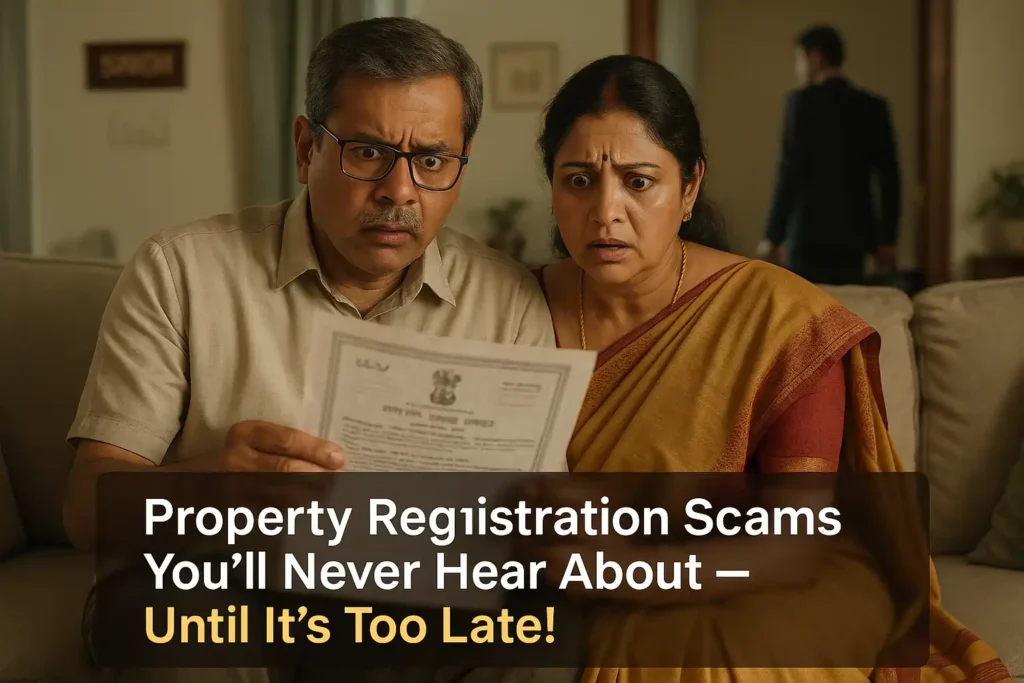
Why Property Registration Matters in India
Registration of property is a legal provision as required by the registration act, 1908. It makes ownership a legal document at the office of the local sub-registrar. The property is registered and is a subject of public record, which minimizes the chances of conflict.
However, because the process involves multiple stakeholders — from property dealers to sub-registrar office staff — it creates opportunities for fraudsters to exploit loopholes.
Common Property Registration Scams in India
1. Duplicate or Forged Sale Deeds
Sometimes fraudsters make counterfeit sale examples in a way that they appear entirely real. They then sell the property to unwary people. Before anyone notices the fraud, the scammer has disappeared and the victim is left in court.
Real Case Example: In 2022, the Delhi Police uncovered a racket where fraudsters used forged Aadhaar cards and fake deeds to sell the same flat to multiple buyers.
2. Multiple Registrations of the Same Property
Due to the assistance of corrupt insiders at sub-registrar offices, some properties are sold to more than one individual. Because a digitization of property records has not occurred in most states yet this scam occurs more in semi-urban and rural regions.
Fact Check: According to a report by the Ministry of Rural Development, lack of updated land records contributes to nearly 66% of civil cases in India.
3. Under-Registration and Black Money Trap
The sellers even coerce buyers to base the property on a lower circle rate to avoid paying stamp duty. Although it appears to be a bargain, it exposes the shopper to the risk of IT notices, penalties, and even cancellation of the transaction in the event of any disagreements.
Example: In Gurgaon, buyers registering properties below actual market value have faced scrutiny from the Income Tax Department, leading to legal complications.
4. Impersonation Fraud
The actual owner is impersonated by the fraudsters using counterfeit identity and witnesses and a sale deed is executed in the presence of the actual owner. This normally occurs when the owner is living in a foreign country or has vacated the premises many years ago.
Proof: In Mumbai, the police registered several cases where NRIs lost crores because their flats were sold off by imposters using fake documents.
5. Fake Power of Attorney (PoA) Sales
Fraudulent sellers sell properties and in particular land parcels with forged PoAs. Because PoAs are typically used in India (at least prior to the reforms that took place because of RERA), buyers do not bother to check their validity.
Fact: In 2011, the Supreme Court ruled that property sales through PoA are invalid unless executed as part of a genuine development agreement. Yet, misuse continues in many states.
6. Manipulation of Encumbrance Certificates (ECs)
The Encumbrance Certificate should indicate whether the property has been loaned or not. Other times, the fraudsters bribe the officials to conceal the current mortgages and deceive the buyers that the property is free.
Reality Check: The Comptroller and Auditor General (CAG) has flagged irregularities in property registration data in several states, pointing to a systemic problem.
How to Protect Yourself from Property Registration Scams
1. Verify Land and Property Records Online
Most states now have digital land records portals — such as Bhoomi (Karnataka), Bhulekh (UP), Jamabandi (Haryana). Always check the latest mutation records and ownership details.
2. Get Legal Due Diligence Done
Hire a real estate lawyer to verify title deeds, encumbrance certificates, and prior ownership records for at least the last 30 years.
3. Use Government-Approved Circle Rates
Avoid registering below circle rate values. It may save money in the short term, but it exposes you to legal and financial risks later.
4. Authenticate the Seller’s Identity
Insist on cross-checking Aadhaar, PAN, and photographs with the original owner in person. If it’s a PoA sale, verify the PoA at the sub-registrar’s office.
5. Demand Certified Copies
After registration, always collect certified copies of the registered deed and keep digital backups.
6. Stay Updated on RERA and Court Rulings
RERA has made property transactions more transparent, but registration fraud still exists outside RERA’s scope. Keep track of new rules in your state.
In India, property registration scams do not headline on any given day, but they can destroy lives and fortunes quietly. Consumers and particularly first-time homeowners should be informed that due diligence is not a voluntary measure but an obligatory protection against fraud.
If you’re investing in property, work with experienced real estate consultants and lawyers who understand the local ecosystem. A little extra effort today can save you years of courtroom battles tomorrow.
Frequently Asked Questions – Property Registration Scams in India
Common property registration scams include forged sale deeds, double-selling (selling the same plot to multiple buyers), owner impersonation at the Sub-Registrar’s office, selling government or prohibited land, and misusing General Power of Attorney (GPA) documents.
Fraudsters create counterfeit ownership documents using fake stamps, forged signatures, and counterfeit notarization. They often obtain a certified copy of a legitimate deed from the Sub-Registrar’s office and doctor the details to display a fake chain of ownership.
In a double-selling fraud, a dishonest seller enters into agreements and collects advances from multiple buyers for the same property within a short window, exploiting delays in official registration before disappearing.
You can independently verify property documents directly through your state’s official land records and registration portals (such as Kaveri in Karnataka, TNREGINET in Tamil Nadu, or online Bhulekh portals) by cross-checking unique registration numbers, dates, and survey numbers.
Sellers often hand over doctored or outdated Encumbrance Certificates to hide recent encumbrances or secret mortgages. Buyers must always pull a fresh 15-to-30 year EC directly from the Sub-Registrar’s office or state portal.
Scammers sometimes use forged, expired, or revoked General Power of Attorney documents to sell properties—frequently targeting NRI or absentee owners—without the actual owner’s knowledge or proper legal authorization.
In identity fraud, an imposter uses fake PAN cards, Aadhaar cards, and manipulated photographs to mimic the true landowner at the Sub-Registrar’s office during biometric and identity checks, often aided by corrupt insiders.
Essential safeguards include conducting thorough title searches via a legal expert, tracing a 30-year ownership chain, inspecting original physical documents, verifying tax receipts, checking revenue records (RTC/Khata), and ensuring immediate registration.
Mutation updates the government’s revenue records (such as Patta or Tehsil registers) with the new owner’s name. Failing to complete mutation leaves a loophole where the previous owner or fraudsters can attempt secondary transactions.
If defrauded, victims can immediately file an FIR for cheating and forgery under the Bharatiya Nyaya Sanhita (BNS), approach the civil court for a title declaration suit, and report the case to cybercrime or economic offense wings if digital document forgery is involved.