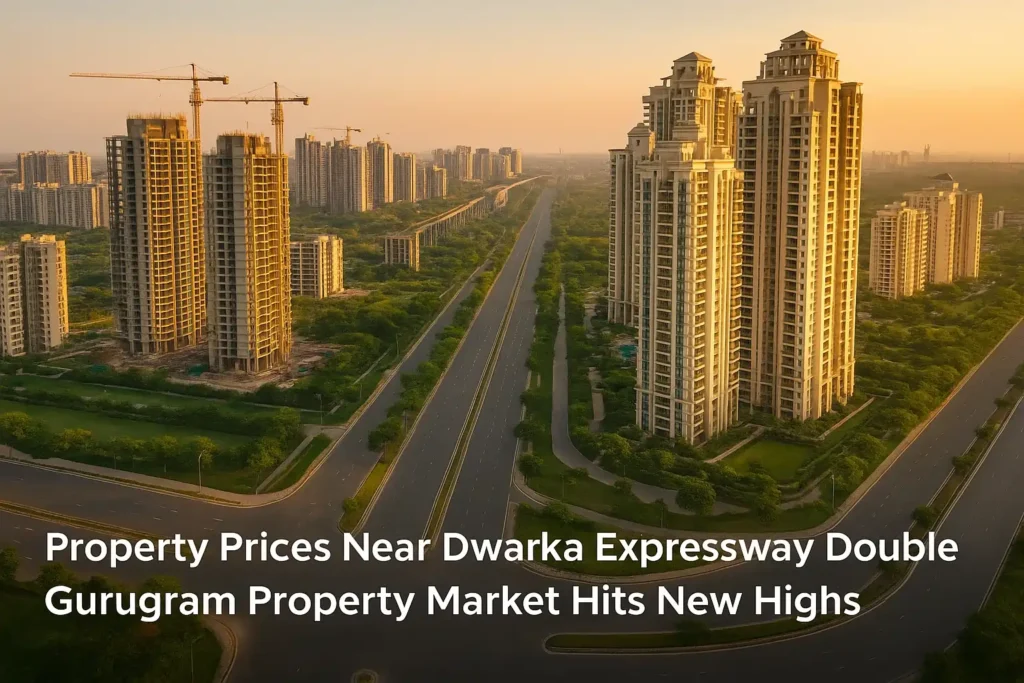
When large infrastructure projects deliver on promise, real estate markets follow fast. The Dwarka Expressway — long planned, then completed in stages and connected to new arterial links — has become the single biggest growth catalyst for the western Gurugram micro-market. Multiple industry reports show property rates along the corridor have nearly doubled in the last four years, with more upside expected as connectivity and last-mile amenities come online.
The numbers how much did prices rise?
Prices along Dwarka Expressway rose from roughly ₹9,400–₹9,500 per sq ft in 2020 to around ₹18,500–₹19,000 per sq ft by 2024–25 — effectively a near 100% increase in about four years. Specific project pockets and ready-to-move inventories saw even sharper gains, with some completed projects more than doubling from earlier pre-completion levels.
Analysts point out that launches and absorptions across the corridor have been strong: thousands of units were launched and absorbed between 2020–2024, showing both developer confidence and buyer appetite.
Why Dwarka Expressway triggered this boom
A mix of hard infrastructure and market dynamics explains the surge:
1. Faster, safer connectivity to Delhi & IGI Airport. The opening of key stretches and links such as Urban Extension Road-II reduced travel times and traffic bottlenecks, making the corridor attractive for airport-linked professionals and companies.
2. New commercial and corporate pull. Developers and occupiers have eyed the corridor as an affordable alternative to central Gurgaon and MG Road, bringing new office and retail demand that supports residential premiums.
3. Project completions and delivery. Several previously stalled projects were completed, unlocking supply and creating real transaction data that re-rated values. Ready inventories and OC (occupancy certificate) status materially lift realizable prices.
4. Limited comparable supply and investor momentum. As more buyers chased a corridor with improving infra and a rising narrative, demand outpaced fresh affordable supply, accelerating price appreciation.
Add Related Article:
- Comparing Dwarka Expressway with Noida Expressway Which Has Better ROI Potential?
- How Central Park Is Influencing Land Appreciation on the Dwarka Expressway
- How Proximity to IGI Airport Benefits Dwarka Expressway Residents
- Affordable vs. Luxury Housing on Dwarka Expressway – What’s Available?
- Top 5 Sectors to Invest Along Dwarka Expressway in 2025
- Why Dwarka Expressway Is the New Hub for Luxury Living in NCR
- Dwarka Expressway: Accelerating Real Estate Demand & Growth
What experts are forecasting (and why to be cautious)
Market commentary suggests further upside but with caveats:
- Property experts project another 15–40% rise over the next 2–5 years in certain pockets — driven by metro plans, added linkages and commercial absorption.
- At the same time, analysts warn of affordability pressures: fast rises could push mid-income buyers out unless developers supply more targeted mid-segment inventory. Rising construction/land costs and interest-rate sensitivity could moderate momentum.
Bottom line: upside exists, but it depends on continued delivery of transport links, commercial demand, and a balanced supply response from developers.
What parts of Gurugram benefited most?
Sectors immediately adjacent to the expressway (Sectors 100–113 band and nearby nodes like 102–106, 108–112) captured the bulk of investor interest. Premium projects from top developers set price benchmarks, while smaller/ready projects recorded the sharpest percentage gains as they moved to completion and handover.
Investment playbook — practical guidance
Invest For homebuyers (end-users):
- Prioritize completed/OC-granted projects if your goal is occupancy and stability.
- Evaluate commute patterns — check travel times at peak hours, not just off-peak estimates.
For investors (short-to-medium term):
- Target ready-to-move inventory for lower execution risk and quicker liquidity.
- Look for sectors where new commercial/office leases or metro stations are confirmed; those micro-markets typically re-rate faster.
iInvestors For long-term investors (5+ years):
- Prefer projects backed by strong developers with delivery track records.
- Diversify: consider nearby sub-micro markets (e.g., nodes linking to Manesar/IMT) to balance cyclic exposure.
Risks and red flags
- Infrastructure timing risk: Planned metro lines, tunnels or flyovers materially affect values — delays reduce near-term returns.
- Supply glut risk: Unchecked launches in one corridor could temporarily depress rental yields and resale liquidity.
- Regulatory and title risk: Always verify clear title, approvals and RERA registration; completed projects mitigate these risks but don’t remove them entirely.
- Macro interest-rate environment: Higher home loan rates reduce affordability and can slow price growth.
Case study snapshot: ATS Marigold
A useful micro example: a previously stalled ATS project near the corridor (revived with government-backed support) saw per-sqft prices rise significantly post-completion (from ~₹6,000–6,500 to ₹13,500–15,000), illustrating how project completion plus locality re-rating can sharply increase realizable price.
Conclusion — outlook and final checklist
The Dwarka Expressway has re-shaped Gurugram’s western corridor: prices doubled in roughly four years in many pockets, driven by connectivity, project completions and commercial interest. Further gains are possible, especially where transport projects and metro links proceed on schedule — but gains are not automatic.
Quick buyer checklist
- Is the project OC/handover ready?
- Are transport links confirmed and on schedule?
- Is the developer delivery record strong?
- Do price comparable show sustainable demand (absorption data)?