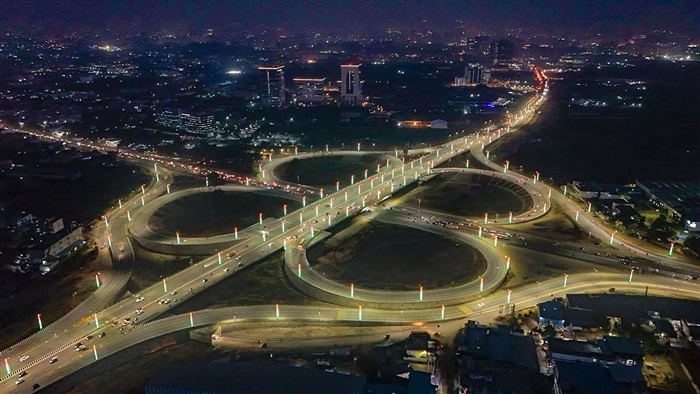
The Dwarka Expressway real estate growth story has changed significantly by 2026. A few years ago, much of the discussion around this corridor focused on what might happen after the expressway became operational. That question has now changed.
The Haryana section of Dwarka Expressway was inaugurated in March 2024, giving Delhi and Gurugram a new 19 km grade-separated connection. Since then, the corridor has seen a substantial increase in residential launches, higher property prices, premium housing demand and continued infrastructure investment.
But there is another side to the story.
Property prices have risen sharply, while developers are continuing to add new housing supply. That means the 2026 market cannot be understood simply by saying that infrastructure has improved and prices have gone up. Buyers also need to look at inventory, absorption, project quality, sector-level differences, rental demand and the amount of future supply entering the market.
A September 2026 report cited by the Hindustan Times said residential prices along Dwarka Expressway had increased 135% between 2021 and H1 2026, while 38,680 residential units were launched during the period and 10,770 units remained available.
That combination of strong historical price growth and substantial new supply is what makes the Dwarka Expressway real estate growth story more interesting in 2026.
What is driving Dwarka Expressway real estate growth in 2026?

The corridor’s growth comes from several factors working together rather than from the expressway alone.
The first is improved road connectivity. NHAI describes the 19 km Haryana section as a grade-separated corridor connecting the Delhi-Haryana border with Kherki Daula and improving movement between Delhi and Gurugram. The project was designed to reduce pressure on NH-48 and improve access toward IGI Airport and Gurugram’s wider road network.
The second factor is Gurugram’s employment base. Housing demand becomes stronger when people have practical reasons to live near employment centres. Gurugram already has a large commercial and corporate ecosystem, and the expansion of residential development along the northern and western parts of the city has created new housing demand.
The third factor is the scale of new residential development. The corridor has moved beyond a small collection of future projects. It now has a large project pipeline covering multiple sectors and price segments.
The fourth is changing buyer preference. Premium apartments and larger homes have become increasingly important in the corridor. A September 2026 report said 4 BHK and larger homes accounted for 28% of supply between 2021 and H1 2026.
So the story is no longer simply about affordability. It is increasingly about connectivity, larger homes, premium projects and access to the wider Gurugram and Delhi market.
Also Read. Rajasthan Property Tax 2026
What does the Dwarka Expressway property market 2026 look like?
The Dwarka Expressway property market 2026 is considerably larger and more mature than the market that existed before the expressway became operational.
According to data reported by Hindustan Times, the corridor recorded 38,680 residential launches between 2021 and H1 2026. The same report said 10,770 units were still available.
According to reported in May 2026 that prices on the corridor had reached around ₹12,000 to ₹14,000 per sq ft, while some new branded developments were priced above that benchmark. It also reported that annual supply had increased substantially after the pandemic compared with the pre-pandemic period.
These figures should not be treated as one universal price for every property.
A new luxury development, an older resale apartment and a project under construction can have very different effective prices. Even two apartments in the same sector can differ because of floor, view, configuration, possession status, developer, size and additional charges.
This is why anyone researching the Dwarka Expressway property market 2026 should compare like-for-like properties rather than relying on a single corridor-wide average.
How much have Dwarka Expressway property prices increased?
The answer depends on the dataset being used.
A September 2026 report based on ANAROCK data put the price increase at 135% over five years, with average prices rising from ₹6,032 per sq ft in 2021 to ₹14,180 per sq ft in H1 2026.
Reported a different price range in May 2026, placing the corridor at roughly ₹12,000 to ₹14,000 per sq ft while noting that several branded projects were above that level.
These numbers are not necessarily contradictory. Real estate reports can measure different things, including listed prices, launch prices, average project prices or specific property categories.
For a buyer researching Dwarka Expressway property prices, the more useful comparison is:
| Factor | Why it matters |
|---|---|
| Sector | Prices vary significantly between micro-markets |
| Project | Developer positioning affects pricing |
| New launch or resale | New launches can carry a premium |
| Apartment size | Larger configurations have different ticket sizes |
| Floor and view | Premium floors can command higher rates |
| Possession status | Ready or near-ready homes may price differently |
| Saleable or carpet area | ₹/sq ft comparisons can become misleading |
| Additional charges | Headline prices don’t always represent the final acquisition cost |
The important point is that the corridor has experienced substantial appreciation, but historical appreciation should not be converted into an automatic forecast for the next five years.
Why is Dwarka Expressway real estate demand increasing?
The Dwarka Expressway real estate demand story is closely connected to how people use Gurugram.
The expressway improves road access between Delhi and Gurugram, while the airport connection adds value for frequent travellers and professionals. In May 2025, NHAI started trial operations of tunnels and underpasses on the Delhi section. The infrastructure was designed to improve connections between Dwarka, Yashobhoomi, IGI Airport and Gurugram.
This matters for residential demand because buyers increasingly evaluate a property based on its total commute network rather than just its distance from a highway.
A household may consider:
- daily office travel
- Delhi connectivity
- airport access
- schools
- hospitals
- shopping
- public transport
- road access to other parts of Gurugram
The Dwarka Expressway real estate demand has also benefited from the growing number of residential communities along the corridor. As more projects reach occupancy, the area can develop stronger supporting retail and social infrastructure.
However, demand should not be measured only by the number of launches. A market can record strong launches without every project selling at the same pace.
That is why absorption, available inventory and project-level sales activity deserve equal attention.
Is the property growth coming only from infrastructure?
No, Infrastructure is one of the major drivers, but it does not explain the entire Dwarka Expressway Property growth story.
The corridor has also benefited from Gurugram’s broader expansion.
Residential development is moving into areas where land availability is greater than in older premium locations. Developers can create large communities with modern amenities, larger apartment configurations and extensive open spaces.
At the same time, buyers who may have previously considered established Gurugram locations can now compare newer developments with better planned layouts and newer building stock.
This has created a different type of competition.
The question is no longer only:
“How close is this property to the expressway?”
It is increasingly:
“What does this project offer compared with other premium housing options available in Gurugram?”
That distinction will become more important as prices rise.
Which sectors are seeing residential development?
Dwarka Expressway is not one uniform residential market.
Important sectors around the corridor include 103, 104, 105, 106, 109, 111 and other adjoining development zones. HRERA records show active registered projects in several of these locations.
For example, HRERA records show projects in Sector 105 near the Daulatabad Flyover, including Sanctuary 105 and Sanctuary 105 Phase-2.
Sector 111 also has multiple registered developments. HRERA records include Puri Aerosphere, registered in August 2026, as well as established projects such as Manor One.
Sector 104 also has registered residential development, including Hero Homes Tower 8.
Sector 106 has established projects such as Paras Dews in the HRERA database.
This matters because buyers should not treat a “Dwarka Expressway” address as sufficient evidence of value.
The exact sector, approach road, project location and surrounding development can make a meaningful difference.
How is the corridor shifting toward premium housing?
One of the clearest changes in the Dwarka Expressway Property growth story is the rise of larger and higher-ticket homes.
The September 2026 report cited by Hindustan Times said 4 BHK and larger units represented 28% of residential supply launched between 2021 and H1 2026.
That tells us the corridor is increasingly attracting buyers looking for larger homes rather than only entry-level apartments.
The shift also changes the economics of the market.
A ₹1 crore property and a ₹4 crore property may sit in the same broad corridor, but their buyer pools are different. The more expensive the inventory becomes, the more important income levels, financing capacity and end-user demand become.
This is one reason why premiumisation should not automatically be interpreted as unlimited future appreciation.
Premium demand can be strong, but it needs a sufficiently large buyer base.
What does the supply pipeline mean for the market?
Supply is one of the most important parts of the Dwarka Expressway property market 2026 that many promotional articles underplay.
A September 2026 report put residential launches between 2021 and H1 2026 at 38,680 units and available inventory at 10,770 units.
This does not mean the market is weak.
It means buyers have more choices.
When several projects compete for the same buyer, differences in:
- developer reputation
- possession timeline
- location
- amenities
- apartment planning
- construction quality
- maintenance
- price
- financing
- resale potential
become more important.
For investors, this creates a useful distinction.
Dwarka Expressway Property growth at the corridor level does not mean every project will appreciate at the same rate.
Project selection matters.
What does inventory overhang tell buyers?
Inventory is worth watching because it provides context to price growth.
If prices are increasing while new supply is also entering the market, the next question is whether buyers continue absorbing that supply.
Moneycontrol’s 2026 coverage highlighted approximately 18 months of inventory along the corridor and discussed whether the premium pricing could continue to be absorbed by demand.
An inventory figure should not be interpreted in isolation.
A moderate level of inventory can exist in a growing market because developers continuously launch new projects. The more important question is whether inventory is rising faster than sales.
For a buyer, this makes project-level research more useful than simply reading a headline about price appreciation.
What infrastructure could support future growth?
The expressway itself is already operational, so the next phase of Dwarka Expressway real estate growth depends partly on how the wider network develops.
Delhi airport connectivity
The Delhi section’s tunnel and underpass network has improved the connection between Dwarka Expressway and IGI Airport. NHAI began trial operations in May 2025, with the tunnel expected to become operational soon after the trial period.
Southern Peripheral Road connection
In March 2026, GMDA floated a ₹755 crore tender for a 4.2 km signal-free elevated corridor between Vatika Chowk and NH-48.
The proposed corridor is designed to strengthen connections between SPR, NH-48, the Gurugram-Sohna corridor and the wider network linked to Dwarka Expressway. GMDA said the project is planned for completion within 30 months from the date of award.
Metro connectivity
The Haryana government said in September 2026 that the Gurugram Metro project would be extended toward Dwarka Expressway.
This is important for the future of the corridor, but buyers should distinguish between an announced or proposed project and an operational metro station.
New Delhi-Gurugram tunnel connection
In July 2026, the Union government approved construction of an 8.1 km six-lane road tunnel connecting Dwarka Expressway with Nelson Mandela Marg in Vasant Kunj. The approved project has a stated capital cost of ₹6,969.67 crore.
This project could further integrate Dwarka Expressway with South Delhi, although its future impact should be assessed alongside its actual construction and completion timeline.
What are the risks behind Dwarka Expressway real estate growth?
A serious market analysis should include the risks as clearly as the growth factors.
High entry prices
After substantial appreciation, buyers no longer enter the corridor at the prices available several years ago.
That means future returns depend partly on whether current prices can be supported by continued demand.
Large residential supply
The corridor has seen thousands of new launches. More supply gives buyers more choice and increases competition between projects.
Premium ticket sizes
As larger apartments become more common, the pool of potential buyers for some projects becomes narrower.
Infrastructure expectations
A proposed metro, road or commercial development should not be valued as if it already exists.
Buyers should check the project’s actual status before paying a premium based on future connectivity.
Project-specific execution
A strong location cannot compensate for poor project execution.
Before buying, verify the developer, HRERA registration, construction progress, possession commitments, approvals and project documentation.
How should you evaluate property investment in Dwarka Expressway?
Anyone considering property investment in Dwarka Expressway should start with the property rather than the general reputation of the corridor.
A practical checklist is:
1. Compare the effective purchase price
Don’t stop at the advertised ₹/sq ft figure.
Calculate the total acquisition cost after applicable charges, parking, floor-rise charges, maintenance deposits, registration and other project-specific costs.
2. Check HRERA records
Use the Haryana RERA database to verify the project’s registration and available project information.
For example, HRERA currently lists active registered projects in sectors 104, 105, 106 and 111 along the corridor.
3. Compare nearby supply
If five similar projects are launching within the same micro-market, resale competition can become important later.
4. Look at actual connectivity
Measure the route to your workplace, airport, Delhi, schools and hospitals instead of relying only on a brochure’s distance claims.
5. Understand the holding period
A property purchase for end use has different requirements from an investment intended for resale several years later.
6. Study rental demand separately
Don’t assume that a high purchase price automatically produces a high rental yield.
Rental performance depends on tenant profile, apartment size, location, furnishing, occupancy and competing rental inventory.
Is Dwarka Expressway competing with older Gurugram luxury locations?
Increasingly, yes the corridor’s premium housing market is bringing it into comparison with established locations such as Golf Course Road and Golf Course Extension Road. Recent market reporting has specifically discussed this shift as prices and project positioning have moved upward.
But the two types of markets have different characteristics.
| Factor | Dwarka Expressway | Established Gurugram luxury locations |
|---|---|---|
| Development stage | Newer and expanding | More mature |
| New project supply | High | Generally more established |
| Road connectivity | Strong and improving | Established |
| Social infrastructure | Developing in several pockets | More mature in many areas |
| Apartment profile | Increasingly premium | Predominantly premium |
| Airport connectivity | Major advantage | Varies by location |
| Buyer choice | Large number of newer projects | More established stock |
For buyers, this comparison is more useful than simply asking which location is “better”.
The right choice depends on budget, intended use, commute, project quality and preferred holding period.
What does 2026 tell us about future Dwarka Expressway Property growth?
The available evidence supports continued market activity, but it does not justify treating past appreciation as a guaranteed future return.
The corridor has several structural advantages:
- operational expressway connectivity
- proximity to Delhi
- airport access
- Gurugram employment centres
- large residential development
- continuing infrastructure investment
- growing premium housing supply
- improving connections with other major roads
At the same time, the market has become more expensive and more competitive.
The combination of high historical appreciation and substantial new supply means future performance will depend increasingly on where you buy, what you buy and how much you pay.
That is the key change in the Dwarka Expressway real estate growth story.
Final Takeaway
The Dwarka Expressway real estate growth story in 2026 is no longer based only on an upcoming highway.
The expressway is operational. Airport connectivity has improved. Residential supply has expanded sharply. Premium housing has become a major part of the corridor, and government agencies continue to work on road and public transport connections around it.
At the same time, the market has become more expensive and has a substantial pipeline of residential inventory.
That changes the way buyers should approach the corridor.
The important question isn’t simply whether Dwarka Expressway will grow. The better question is which projects and micro-markets have the fundamentals to remain attractive as the corridor becomes more developed and competitive.
For a buyer in 2026, the decision should therefore come down to the actual property: its location, developer, RERA status, effective price, possession position, surrounding infrastructure, rental prospects, competing supply and likely resale demand.
That approach gives a much clearer picture of the market than a simple promise of future appreciation.
Frequently Asked Questions
What is driving Dwarka Expressway real estate growth in 2026?
The main factors include operational road connectivity, access to Delhi and IGI Airport, Gurugram’s employment base, new residential supply, premium housing demand and continuing infrastructure projects.
What are Dwarka Expressway property prices in 2026?
Published market reports show different figures because they use different datasets and property categories. One September 2026 report cited ₹14,180 per sq ft as the average price in 2026, while another reported a ₹12,000 to ₹14,000 per sq ft range in May 2026. New premium projects can be priced above these levels.
Is Dwarka Expressway real estate demand still strong?
The corridor continues to see substantial development and residential launches. However, demand should be assessed alongside available inventory and absorption rather than through launches alone. The latest reported data shows both strong historical price growth and significant available housing stock.
Which sectors are important for residential property on Dwarka Expressway?
Sectors such as 103, 104, 105, 106, 109 and 111 form important parts of the wider residential corridor. HRERA records confirm registered projects across several of these locations.
Is Dwarka Expressway suitable for property investment?
The corridor has strong connectivity and significant residential development, but suitability depends on the individual property. Buyers should compare effective price, project quality, RERA records, possession, competing supply, rental demand and exit liquidity rather than relying only on corridor-level appreciation.
Has the expressway already affected property prices?
Yes. Multiple market reports have documented substantial price appreciation since 2020 or 2021. However, the exact percentage varies according to the source and methodology. A 2026 report cited 135% growth over five years, while other market datasets report different price levels.
Is metro connectivity planned for Dwarka Expressway?
The Haryana government stated in September 2026 that the Gurugram Metro project would be extended toward Dwarka Expressway. Buyers should treat this as future infrastructure until the relevant section becomes operational.
What should buyers verify before purchasing a property on Dwarka Expressway?
Verify HRERA registration, project approvals, developer information, construction progress, possession commitments, total acquisition cost, surrounding infrastructure and competing projects. HRERA’s public database provides project-level registration information that buyers can use as part of their due diligence