Gurgaon’s skyline keeps remaking itself. For the last decade Dwarka Expressway captured headlines — a massive connectivity project that multiplied land values, drew developers and shifted demand away from older micro-markets. Today a quieter, equally strategic corridor is racing up the charts: the Southern Peripheral Road (SPR). This article explains why SPR is being talked about as “the next big Gurgaon hub”, how it compares to Dwarka Expressway and other corridors, what’s already driving price gains, and the risks investors should weigh — all grounded in recent market data and infrastructure reporting.
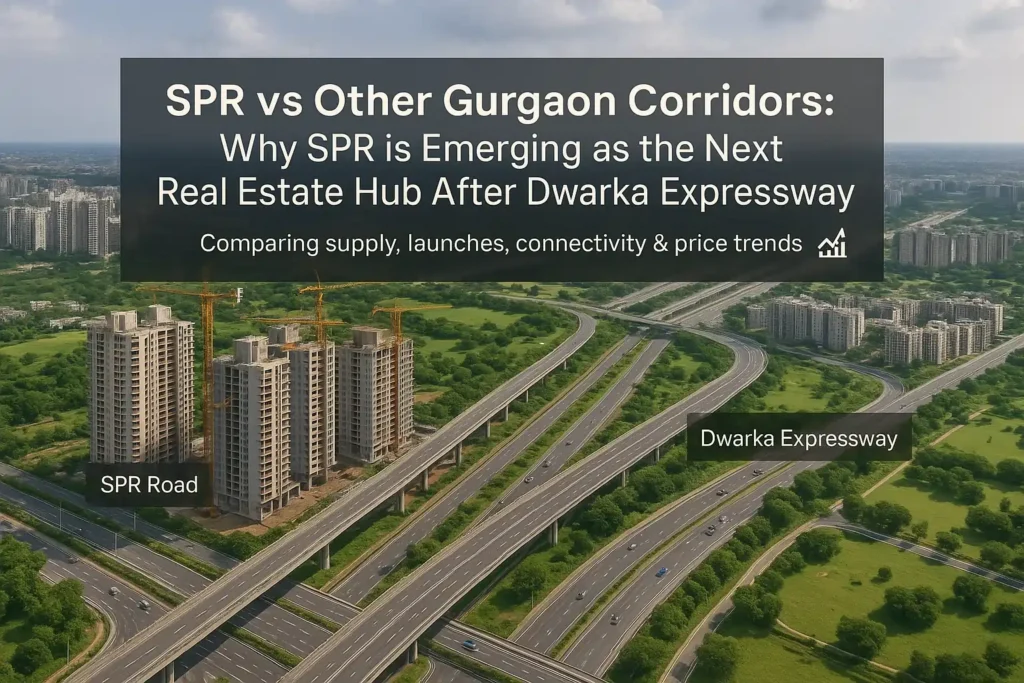
1) What is SPR and why it matters now
The Southern Peripheral Road (SPR) is an arterial loop that connects Sohna Road, Golf Course Road, NH-8 and other parts of Gurugram. Over the last 2–3 years SPR has seen a wave of residential launches, new commercial plots and improved roadworks. Developers point to SPR as a strategic corridor because it links established employment nodes with growing suburban supply, while simultaneously providing a bypass that eases city-centre congestion. Recent flyover projects and active launches are accelerating on-ground demand.
2) Connectivity: SPR’s advantage (and how it stacks up)
Connectivity remains the single biggest value driver for real estate corridors — that’s what made Dwarka Expressway a runaway success. SPR’s connectivity strengths include:
- Multi-directional links: SPR connects directly to Sohna Road, Golf Course Road and NH-8, giving residents multiple routes to workplaces and the airport without funneling all traffic through central Gurgaon.
- Upcoming elevated / interchange works: Plans for a major clover-leaf near Vatika Chowk and other elevated links will further smooth traffic flow and reduce travel times between SPR, NH-8 and Dwarka Expressway.
- Metro & mass transit tailwinds: New Gurgaon metro initiatives are expected to uplift multiple micro-markets including parts of SPR and Dwarka by improving last-mile access and attracting office demand.
Compared to Dwarka Expressway: Dwarka’s main strength has been direct, high-speed access to Delhi and IGI Airport — a clear driver for sharp appreciation. SPR’s strength is more about creating a high-quality ring that ties several demand pockets together and unlocks previously less-connected land.
3) Price movement & market momentum
Recent market trackers show strong appreciation along both corridors, but with different timelines and magnitudes:
- Dwarka Expressway: The corridor recorded dramatic gains after expressway completion and related link roads — prices nearly doubled in recent years as demand surged.
- SPR: Rates along SPR have also risen sharply — some clusters recorded price jumps of over 100% in the last 4–5 years, with current apartment rates largely in the ₹11,000–₹17,000 per sq. ft. range depending on location and project. This suggests SPR is following a Dwarka-style trajectory, though it is catching up rather than leapfrogging.
Investor takeaway: Dwarka’s earlier gains have made it pricier and in some pockets less affordable. SPR offers a growth story that’s still in a high-appreciation phase but with more entry points and a wider supply mix.
4) Commercial demand and employment catchment
Long-term corridor value depends on jobs and commercial floorspace. SPR is attracting office projects, retail and logistics because of its ring connectivity and proximity to existing employment centres. As more Grade-A office inventory gets planned or launched nearby, SPR stands to pick up rental and occupancy demand that reinforces residential prices. Dwarka Expressway’s initial boom came from its airport and Delhi access which pulled corporate interest; much of that demand is already priced in.
5) Lifestyle & supply mix
SPR is being positioned as a lifestyle corridor — large integrated townships, cluster-style gated projects, schools and healthcare hubs. That mix appeals to families seeking larger units and more green/open spaces. Dwarka, by contrast, has more tightly packed mid-rise and high-rise projects aimed at buyers chasing direct Delhi connectivity and shorter commutes.
6) Risks and caveats (what an informed buyer should check)
No corridor is risk-free. Here are the real challenges to watch:
- Infrastructure delivery uncertainty: Many valuation jumps rely on completion of flyovers, interchanges and metro lines. Delays can slow appreciation.
- Quality & micro-location variance: SPR is a long corridor; price performance differs drastically between well-connected junctions and less developed stretches.
- Construction/maintenance issues elsewhere: Experience from Dwarka shows that infrastructure imperfections (like underpass seepage and drainage issues) can emerge even in large projects — a reminder to factor in ongoing civic maintenance risks.
- Speculative overheating: Rapid headline appreciation attracts speculators. Sustainable demand signals like office leasing, school/hospital openings, and end-user sales are more reliable indicators of long-term growth.
7) How to evaluate opportunities on SPR (practical checklist)
If you’re considering SPR, use this practical framework:
- Micro-location audit: Check nearest junctions, feeder roads and proposed flyovers. Confirm actual commute times at peak hours.
- Project status: Prefer ready-to-move-in or near-ready projects to lower execution risk. For under-construction buys, verify builder track record and RERA compliance.
- Connectivity milestones: Note which projects and metro/flyovers are officially sanctioned and have clear timelines.
- Demand signals: Look at leased office space, new schools/hospitals, and retail openings — these are long-term anchors for residential resale and rentals.
- Exit strategy: In corridors with rapid growth, plan both a 3–5 year horizon (for project completion and early infrastructure deliveries) and a 7–10 year horizon (for maturity and broader commercial absorption).
8)Is SPR the next big hub?
Yes — but with nuance. SPR combines strong strategic connectivity, fresh supply, and significant infrastructure projects that together create a compelling growth runway. It is not an instant substitute for Dwarka Expressway’s direct Delhi link, but it is carving its own identity as a broad, integrated corridor that can deliver sustained appreciation — especially for buyers who pick micro-locations with proven road, transit and commercial anchors. For investors, SPR offers a mid-term growth play with multiple entry points; for end-users, it offers newer inventory and lifestyle choices with improving access to employment nodes.
Frequently Asked Questions
1. What is the Southern Peripheral Road (SPR) in Gurgaon?
SPR, or Southern Peripheral Road, is a key corridor in Gurgaon that connects Sohna Road, Golf Course Extension Road, and NH-8. It serves as a loop that links major residential and commercial zones, offering alternative routes to avoid city-centre congestion.
2. Why is SPR being compared to Dwarka Expressway?
Dwarka Expressway gained popularity for its direct link to Delhi and the airport. Similarly, SPR is now attracting buyers and investors due to its strategic connectivity, upcoming flyovers, metro expansion, and increasing residential and commercial projects. Both corridors have shown strong property appreciation, making SPR the next big growth hub.
3. How have property prices along SPR moved in recent years?
Property prices on SPR have nearly doubled in the last 4–5 years, with average rates currently ranging between ₹11,000 and ₹17,000 per sq. ft., depending on the project and micro-location. This growth mirrors the trajectory seen on Dwarka Expressway a few years earlier.
4. What infrastructure projects are boosting SPR’s growth?
Key projects include a major clover-leaf flyover at Vatika Chowk, multiple elevated roadworks, and the planned Gurgaon metro expansion. These developments will significantly reduce travel time and improve connectivity with NH-8, Sohna Road, and Dwarka Expressway.
5. Is SPR better for end-users or investors?
SPR works for both. End-users benefit from lifestyle-focused projects, integrated townships, schools, and hospitals. Investors find it attractive because property values are still in a growth phase, offering potential for high ROI in the medium to long term.
6. What are the risks of investing in SPR?
Risks include possible delays in flyover and metro projects, varying quality across micro-locations, and speculative pricing. Buyers should carefully check project status, developer credibility, and actual on-ground infrastructure before investing.
7. How does SPR compare with other Gurgaon corridors?
- Dwarka Expressway: Best for Delhi and airport connectivity, but prices are already high.
- New Gurgaon (Pataudi Road, NH-8 side): Affordable options with future potential, but still developing.
- Golf Course Extension Road: Established, premium corridor with limited new supply.
- SPR: Balanced mix of affordability, connectivity, and growth potential — currently one of the hottest corridors.
8. What is the ideal investment horizon for SPR?
Investors should consider a 5–10 year horizon. The first 3–5 years will see benefits from ongoing project completions, while the full impact of metro and flyovers will likely be realized in the 7–10 year window, driving long-term appreciation.