A real estate buyer will find Goa’s real estate market appealing when it comes to buying homes, holiday accommodations, investment land, and plots for future construction. One term that can cause confusion in real estate sales is Comunidade land.
The buyer may see a home that is being sold at a very inexpensive price and find out that the land is Comunidade. A token payment is not just a token payment, so it is best to understand what this entails and if the property can legally be passed on and the documents that should be reviewed before paying a token.
Thus, is the purchase of Comunidade land in Goa possible? The answer is not a simple yes or no. The legal position is determined by the type of land and rights, the record/s available and the approvals and restrictions that apply.
So what Is Comunidade Land In Goa?
Comunidade is a traditional, historical village level institution in Goa. Comunidade lands typically are linked to community ownership and traditional systems of land management within villages.
These properties may be recorded in the land records and real estate transactions, but their legal nature may be different from that of a private land.
This is significant because a buyer should not presume to have clear private ownership as a result of possession, an agreement, a mutation entry or a development that has been made on the land.
Is it possible to buy land in the community?
Depending on the characteristics of the land and the proposed transaction, it is possible to obtain rights over Comunidade land.
The term “for sale” does not automatically imply that the seller has full rights of ownership. The buyer is responsible for determining exactly what is being transferred.
There can be valid interests, rights, leases and grants in Comunidade property in certain circumstances. These should not be assumed to be the same as outright private property.
Hence, it is best for buyers to not make a token payment on the basis of a broker’s statement or a sale contract.
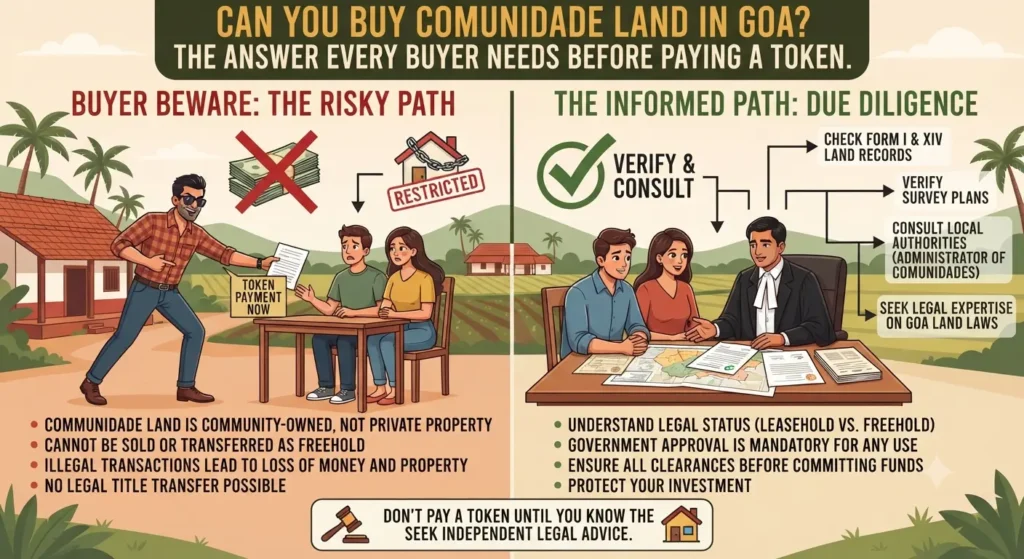
Proceed with caution when paying token amounts.
Buyers frequently pay token money in order to signal their desire to buy a property. If the underlying title of the land or transferability of the land is unclear, however, it can become complicated to recover the money or to complete the transaction.
Ask before paying a token:
- Who is the legal owner of the land?
- Does it belong to a Private owner or is it related to a Comunidade?
- What is on the land record now?
- Does the seller have a transferable right?
- Are there any conditions of occupancy, grant or lease?
- Would the transaction be legally allowed?
- Have there been any outstanding claims or disputes?
- Is it possible to register the property in the buyers name?
- Is there any restriction in construction/development?
- Do you have all the permissions available?
Here are some questions that can be asked to help determine potential issues before the transaction of money.
Check The Land Records Carefully
A key aspect of property due diligence is a review of the relevant land records.
Documents and records can encompass the Form I & XIV, mutation documents, survey documents, previous title documents, registered deeds or any other documents that apply to the property.
The point isn’t just to gather documents; it is to know the series of rights to a piece of land.
If the land is linked to a Comunidade, the buyer is advised to get professional information about the records that will apply, and the precise nature of the rights of the seller.
Avoid becoming possessive; don’t own others
One of the common pitfalls in land deals is to take the premise that the longer someone has been in possession of a land, the more clear ownership of the land is.
The 2009 proposed legislation, if enacted, would allow a person to occupy or use land for many years before they had an unconstrained right to sell it as private land.
Likewise, the construction of any property is not a sufficient proof of the existence of a clear and marketable title on the land that underlies it.
When it comes to buying, the big question is:
What right(s) do I get as a result of the transaction that can be transferred to me?
The question should be addressed with documents, not verbal assurances.
Confirm a Seller’s Authority
When being approached with land for sale and the land is to be used for Comunidade then check the legal rights of the seller in entering into the proposed transaction.
Don’t use just:
- The receipt for a property tax.
- An electricity bill
- A possession letter
- An old agreement
- A broker’s confirmation
- A mutation entry
- A copy of a document that has not been identified.
These documents could be relevant, but should be reviewed in conjunction with the full title and property history.
A qualified property lawyer should go through the original documents and see if the proposed transfer is legal or not.
Review the restrictions and/or development rights
Purchasing land and development is two different issues.
Development may involve adherence to planning regulations, land-use rules, zoning requirements, environmental restrictions and other appropriate approvals, even if a buyer has a legally recognised interest in the property.
When looking to buy a plot for a villa, apartment, commercial project or holiday home, ask them if the use of the plot is legal.
This is especially relevant in Goa, where land-use types and planning controls can be important factors to consider when determining development potential.
What about Sale Agreements and Token Receipts?
Don’t rely on a token receipt or sale agreement to indicate that title is clear.
Should the buyer find that there is a title issue later, it could be a delay, conflict, or a problem to be able to register.
The safer way to do it is to condition the payment on the verification of the legality being satisfactory. The agreement should also explicitly define the property, parties, consideration, obligations, refund conditions, and consequences of an inability to complete the transaction pursuant to the agreement.
It’s important that you get a qualified lawyer to check the exact wording before signing.
Incorporate the following items into a Due Diligence Checklist:
If you are considering paying token money for any land in Goa that may have any relationship with the Comunidade, you should take a moment to check:
- Survey number and boundary of the properties.
- Most recent Form I & XIV or related land records.
- Mutation history
- The previous registered title documents.
- The nature and source of the rights of the seller.
- The number of people in the community is recorded, if applicable.
- Outstanding claims and encumbrances
- Court proceedings or conflicts.
- Land-use classification
- Planning and development permits
- Access and right-of-way
- Whether the proposed transfer is a registered transfer.
This checklist is intended to be customized to the specific property since the legal history may not be the same for all land transactions.
Why Independent Legal Verification Matters
There are multiple parties to property transactions – owners, brokers, developers, investors and intermediaries. Documents or explanations can be given by each party in their own perspective.
Independent Legal Due Diligence provides the purchaser with a chance to thoroughly review the process prior to investing significant capital.
The professional verification is particularly relevant in case of Comunidade-related property as the legal nature of the land and the rights that come with it may not be clear from a property advertisement.
Is there any Comunidade land for sale in Goa? There is no universal answer to this for all properties.
Final Thoughts
It is important that a property is not just called “Comunidade land”. The buyer must ascertain the legal status of the property, the rights of the seller, whether such rights can be transferred to the buyer, and whether the proposed use of the property would be legal.The best advice that can be given is not to pay a token simply because the property appears to be attractive or the price appears to be too good to be true.Ensure that the title and land records are in order, the land is legally owned by the seller, the land is subject to the appropriate Comunidade status, no encumbrances, no disputes, and permitted development. After determining the legal situation, the buyer will have a much better basis for deciding whether to proceed.In Goa, land purchase should be based on documents and not token money.
Can You Buy Comunidade Land in Goa?
Essential Answers Every Buyer Needs Before Paying a Token
1. Can you legally buy Comunidade land in Goa?
No, you cannot outright “buy” or hold absolute freehold ownership of Comunidade land. Comunidade lands belong to traditional village communities governed by the Goa, Daman and Diu Comunidades Code, 1955. Private individuals can only acquire leasehold rights or specific temporary usage grants, subject to strict government and administrative approvals.
2. What happens if I pay a token advance for Comunidade land without verification?
Paying a token amount without proper legal verification is extremely risky. Because ownership cannot be transferred to individuals, you may lose your money entirely if the transaction is deemed illegal under the Comunidades Code, and getting refunds from unauthorized sellers or brokers is often legally impossible.
3. Can a person get a clear title or Sale Deed for Comunidade land?
No. A Sale Deed transfers absolute ownership. Since Comunidade land is communal property managed under state supervision, the managing committees or individual gaunkars (members) cannot execute a legal Sale Deed transferring ownership to private third parties.
4. What types of rights (if any) can be acquired on Comunidade land?
Under specific circumstances and through formal legal channels, individuals or entities may obtain long-term leases, development rights, or licenses for specific utilities (such as industrial or infrastructural projects), but these require explicit sanction from the Government of Goa and the Administrator of Comunidades.
5. How can I verify if a property parcel is Comunidade land before buying?
You can verify land ownership status by checking the village Form I & XIV survey records, consulting the Directorate of Settlement and Land Records (DSLR), and submitting an inquiry directly to the respective regional Administrator of Comunidades to check survey numbers.
6. Are structures built on Comunidade land considered legal?
Most independent residential or commercial structures built directly on unauthorized Comunidade land are illegal. They often lack proper panchayat licenses, conversion Sanads, and TCP (Town and Country Planning) approvals, making them vulnerable to demolition orders.
7. What is the role of the Administrator of Comunidades?
The Administrator of Comunidades is a government-appointed authority responsible for overseeing the functioning, leasing, financial accounting, and protection of Comunidade assets to prevent illegal encroachments and unauthorized land transfers.
8. Can power of attorney (POA) or agreement of sale make Comunidade land safe to buy?
No. Fraudulent brokers often use General Power of Attorney (GPA), Special Power of Attorney (SPA), or unregistered Agreements of Sale to bypass legal restrictions. Courts and revenue authorities regularly invalidate these arrangements when dealing with Comunidade properties.
9. What should I do if a real estate agent pressures me to pay a token amount immediately?
Never give in to high-pressure sales tactics or pay a token amount. Insist on getting copies of all historical land titles, survey documents, and consultation with an independent real estate lawyer in Goa specializing in land laws before parting with any money.
10. Where can I get reliable legal advice regarding land purchases in Goa?
You should consult a licensed advocate practicing at the High Court of Bombay at Goa or local civil courts who has proven expertise in property title verification, land revenue laws, and the Goa Comunidades Code before finalizing any real estate transaction.