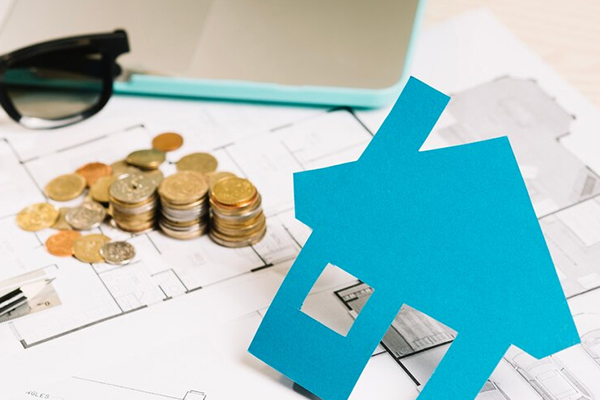
If you want to convert agricultural land to residential commercial property, you generally need approval from the competent state or local authority before using the land for a different purpose. The exact procedure depends on the state, location, zoning plan and proposed use.
Agricultural land does not automatically become residential or commercial land because the owner starts construction or uses it for business. Government guidance confirms that the land classification can remain agricultural until the required change of land use is approved and applicable charges are paid.
Can Agricultural Land Be Converted for Residential or Commercial Use?
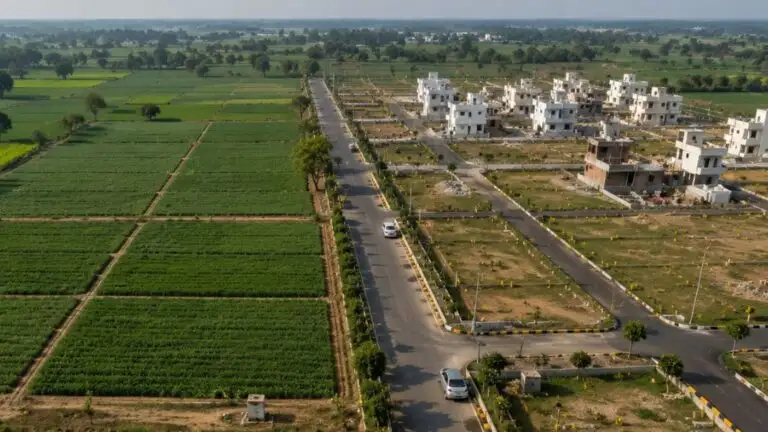
Yes, agricultural land can be converted in eligible cases, but conversion is not available for every parcel.
Before starting the application, check:
- Current land classification
- Ownership and revenue records
- Master plan or development plan
- Zoning restrictions
- Road access
- Acquisition status
- Forest or environmental restrictions
- Proposed residential or commercial use
For example, Rajasthan’s land conversion rules specifically provide for conversion of eligible agricultural land for residential units, residential projects, commercial and industrial purposes. The same rules also identify categories where conversion cannot be granted.
This is why checking eligibility should come before paying conversion fees or planning construction.
Also Read. CLU in Property in India
What Is the Land Conversion Process in India?
The land conversion process in India varies between states, but the broad sequence is similar.
1. Check Whether the Land Is Eligible
Start with the revenue record and planning status of the property. Verify the survey number, ownership, land classification and permitted use.
A master plan or zoning map can be equally important because a parcel may have agricultural classification but still face restrictions on the proposed development.
2. Prepare the Required Documents
The document list varies by state. Common documents include:
| Document | Purpose |
|---|---|
| Sale deed or title document | Establishes ownership |
| Revenue records | Confirms land classification |
| Mutation records | Shows recorded ownership changes |
| Site plan | Identifies the property and proposed use |
| Land schedule | Provides property details |
| Identity documents | Identifies the applicant |
| NOCs | Required where applicable |
| Access permission | May be required near certain roads |
Haryana’s official CLU checklist, for example, includes ownership and revenue documents such as jamabandi and mutation records, site plans, land schedules, land utilization plans and certain access related NOCs.
3. Apply to the Competent Authority
The authority depends on the state and location. It may be a revenue department, district administration, development authority, town planning department or urban local body.
The terminology also changes. One state may call the approval NA conversion while another may use CLU or conversion permission.
Punjab, for example, provides an online CLU process through its government system, while Haryana has separate procedures for CLU applications within municipal areas.
4. Site Verification and Department Reports
The authority may verify the property details and request reports from relevant departments.
The review can cover:
- Land boundaries
- Existing land use
- Road access
- Zoning
- Revenue records
- Proposed development
- Applicable restrictions
This stage can take longer when records do not match or additional NOCs are required.
5. Pay Applicable Charges
After the application is examined, the authority may raise a demand for conversion charges and other applicable fees.
This brings us to one of the most searched questions about Convert Agricultural Land to Residential Commercial Property.
How Much Does It Cost to Convert Agricultural Land to Commercial?
There is no single India wide conversion fee.
The cost depends on the state, location, land area, proposed use and applicable development or infrastructure charges.
Possible charges can include:
- Conversion fee
- CLU charges
- Development charges
- Betterment charges
- Infrastructure charges
- Scrutiny fee
- Mutation related charges
For example, Haryana’s official CLU information lists a scrutiny fee of ₹10 per square metre and states that EDC, conversion charges and IDC where applicable are raised during the approval process.
Punjab’s official CLU procedure also states that conversion charges are raised according to the notified government rates.
So avoid using one fixed percentage as the national conversion cost. A figure applicable in one state may be completely wrong for another.
How to Convert Agricultural Land to Residential Property
To Convert Agricultural Land to Residential use, first confirm that residential development is permitted under the applicable master plan and zoning rules.
The usual process involves:
- Verify ownership and land records.
- Check zoning and development plan status.
- Prepare the required site and revenue documents.
- Submit the conversion application.
- Complete inspection and required departmental reports.
- Pay the notified charges.
- Obtain the conversion or CLU approval.
- Update land records where required.
- Apply separately for building or layout approval before construction.
Conversion approval should not be treated as automatic building permission. Building regulations can require another approval after the land use has been changed.
Haryana’s building approval system, for example, separately deals with building plan permissions and identifies different competent authorities for CLU and building approval matters.
How to Convert Agricultural Land to Commercial Property
The process to convert agricultural land to commercial use follows the same basic legal route but commercial development can involve additional planning requirements.
The proposed activity matters. A small shop, warehouse, office building, hotel or larger commercial project may fall under different development rules.
Before applying, check:
- Permitted commercial activity
- Road width and access
- Zoning
- Floor area requirements
- Parking requirements
- Fire safety requirements
- Environmental permissions where applicable
- Local development regulations
Do not assume that getting land conversion approval gives permission to start every type of commercial activity. The proposed project may need separate approvals.
What Is the Difference Between CLU and NA Conversion?
The terms can be confusing because states use different legal terminology.
| Term | Meaning |
|---|---|
| CLU | Change of Land Use from one permitted category to another |
| NA Conversion | Approval to use agricultural land for non agricultural purposes |
| Conversion Order | Formal approval issued by the competent authority |
| Building Approval | Permission for construction under applicable building rules |
The important point is the legal change in permitted land use. The name of the approval depends on the state.
Can You Build on Agricultural Land Before Conversion?
You should not assume that agricultural ownership gives you the right to construct a residential or commercial building.
The Ministry of Road Transport and Highways has specifically noted that land does not become legally commercial merely because an owner has constructed a shop on it. The applicable change of land use must be approved by the competent authority and prescribed charges must be paid.
Construction without the required permission can lead to penalties, refusal of later approvals or other legal complications depending on the state rules.
How Long Does Land Conversion Take?
There is no universal timeline for converting agricultural land to residential commercial property applications.
The timeline depends on document verification, site inspection, departmental reports and the applicable state process.
Some government systems publish specific service timelines. Punjab’s official CLU process lists a total processing time of 23 days when the required reports and documents are completed within the prescribed stages. Haryana’s official information lists 60 days for its CLU approval process.
These figures should not be treated as a national standard.
What Happens After Land Conversion?
Getting the conversion order is an important step, but the property may still need additional approvals.
Depending on the project, you may need to:
- Update revenue records
- Complete mutation
- Obtain layout approval
- Obtain building plan approval
- Secure utility permissions
- Meet fire or environmental requirements
- Follow local development regulations
The next approval depends on what you plan to develop.
Common Mistakes to Avoid
If you plan to convert agricultural land to residential commercial property, avoid these mistakes:
Buying first and checking zoning later: A property may have restrictions that make the proposed conversion difficult or impossible.
Using another state’s fee structure: conversion charges are state specific.
Confusing conversion with construction permission: Land use approval and building approval are separate matters in many situations.
Ignoring access: Road access can affect development eligibility and required permissions.
Relying only on seller documents: Verify revenue records and ownership independently.
Starting construction before approval: This can create compliance problems later.
Final Answer
The process to convert agricultural land to residential commercial property is legal only when the proposed use is permitted and the competent authority grants the required approval. The exact process, terminology, charges and timeline vary by state.
If your objective is to convert agricultural land to residential, check zoning, revenue records and residential development permissions before applying. If the objective is to convert agricultural land to commercial also verify whether the proposed commercial activity is permitted at that location.
The safest approach is to verify the current state rules and official charges before making a purchase or starting development.
Frequently Asked Questions
Is it possible to change agricultural land to commercial?
Yes, but only by the permission of the state or local government and only as authorized by the master plan or zoning. Green belt, farm zone and reserved area are typical areas that are not likely to be converted. The odds are much greater if your property is in a commercial or mixed-use zoning area, or if your property is located in a road that is zoned for commercial use. You will not legally be permitted to construct shops, offices or a warehouse on the land until the land use change is approved and recorded.
What are the processes for converting agricultural land to residential?
Make a revenue department or District Collector / local development authority application for change of land use (also called NA, CLU or DC conversion, depending on the state). First make sure that your plot is located in a residential area or a future development area in the master plan. Finally, send the application along with the ownership and revenue documentation, site plan and NOCs. Authorities check the plot, the conversion fee and charges are paid and the land record is revised. Don’t start building until you’ve received the order.
Do you have an easy transition from commercial to residential?
Not always. It is easier in a mixed use area and difficult in a strictly business area. Permission from the local authority still required and they will review zoning, road width, parking and building bye-laws. There will also be conversion fees to pay and changes to the rate of your property tax and utilities. In the case of a property belonging to a commercial complex or society, it might be necessary to obtain an NOC from the society as well. Before making plans, see if there is a zone to check.
How to calculate land conversion charges?
Conversion Fee = Plot Area (in sq. mtr.) × Notified Land Rate (per sq. mtr.) × Multiplier / Percentage Factor
as each state has its own rates. In most locations, the entire totals up this way:
The conversion fee (as a percentage of circle rate/mark value) of the land plus development charge and scrutiny or processing fee plus stamp duty or any other state charge.
As a rough idea, a circle rate of ₹5,000 per sq m, with a land value of ₹50 lakh. If your state has a conversion fee of 5%, then it means a loss of ₹2.5 lakh and then there is the development and processing fee. The 5% in this instance is just a sample. Before you budget, check the current rate card with your local revenue or town planning office.
Which documents are needed to change agricultural land?
Typically, you will require:
- The deed for a sale or title deed
- Jamabandi, 7/12 extract or khasra-khataun (as per state)
- The most recent land tax receipts
- A site or location plan and a survey map.
- ID and address of the applicant.
- NOCs are obtained from various departments including revenue, town planning/gram panchayat, and sometimes irrigation and environment.
- Application Form along with fee challan