The Delhi-Mumbai Expressway is one of the ambitious infrastructures in India as it will bond together the national capital with the financial hub of the nation. Spanning a distance of 1,386km in the eight-lane (expandable to twelve) expressway, does not merely serve as a roadway, but a gateway of prospects with huge economic and property advantages to be unleashed in various states.
On this blog, we dissect the importance of the expressway, discuss the best areas to invest in real estate along its pathway, and show you why these corridors are the best places by giving the rationality based on the urban planning trends and economic figures. This guide will be useful to both the experienced investor and the first time purchaser to know where and why to invest along this life changing path.
What is the Delhi-Mumbai Expressway?
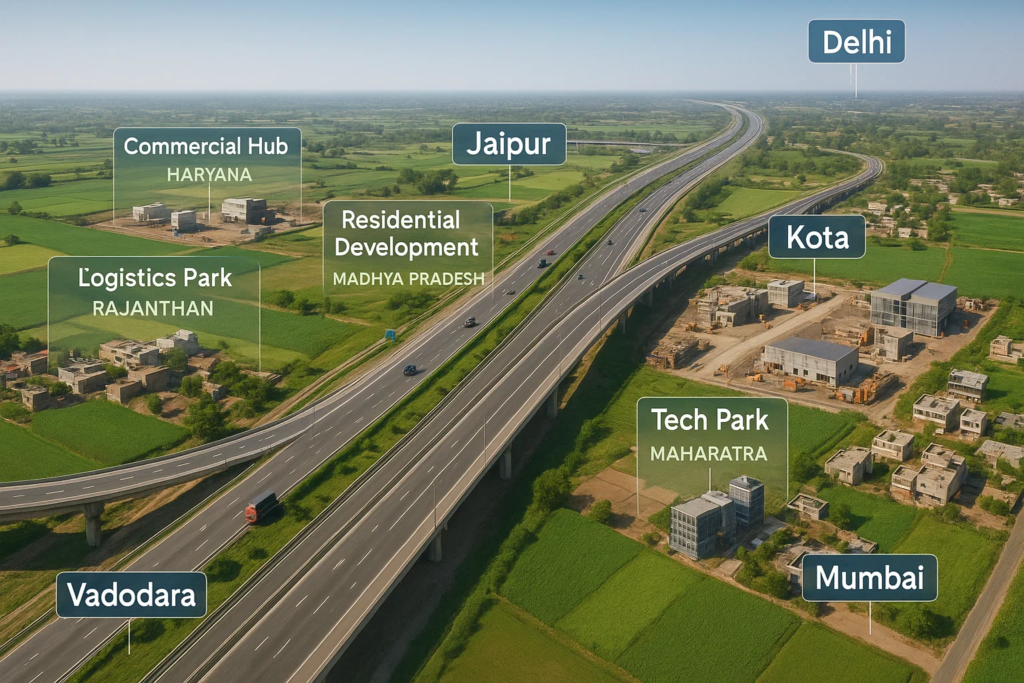
Delhi-Mumbai Expressway (DME) is one of the signature projects of the Bharatmala Pariyojana, was conceived, and led by the Ministry of Road Transport and Highways (MoRTH), and being built by the National Highways Authority of India (NHAI). When it becomes entirely operational, it will cut the time of travelling between Delhi and Mumbai to 12 hours as compared to 24 hours.
Key Facts:
- Length: 1,386 km
- States Covered: Delhi, Haryana, Rajasthan, Madhya Pradesh, Gujarat, Maharashtra
- Estimated Cost: ₹1 lakh crore+
- Expected Completion: 2025
- Smart Features: E-Highway elements like e-charging stations, wildlife overpasses, rainwater harvesting systems, and smart traffic systems
Why Is the Delhi-Mumbai Expressway a Game-Changer?
- Boost to Logistics and Industrial Growth
The corridor will catalyze the growth of logistics parks, warehousing hubs, and industrial townships, aligning with India’s PM Gati Shakti plan. - Reduction in Travel Time and Cost
A shorter travel time will significantly reduce fuel usage, CO2 emissions, and logistics costs for businesses. - Development of Greenfield Cities
Townships and satellite cities are planned along the route, offering opportunities for early-stage property investments. - Decongestion of Existing Routes
The expressway will ease traffic on NH-48 and other arterial roads, improving overall road safety and quality of life.
Top Real Estate Investment Corridors Along the Delhi-Mumbai Expressway
The real estate potential along the DME is immense. Let’s explore the most promising investment corridors along the route:
1. Sohna (Haryana) – Gateway to Delhi NCR’s Expansion
Why it’s a hot spot:
Located just south of Gurugram, Sohna is rapidly emerging as a real estate and industrial hub. With its integration into the expressway and proximity to the upcoming Global City in Gurugram, Sohna offers a mix of plotted developments, mid-range apartments, and future commercial projects.
Investment Highlights:
- Residential plots and townships
- Direct connectivity to the expressway and Southern Peripheral Road (SPR)
- Growing demand due to upcoming industrial clusters
Projects in Demand:
DLF Gardencity Enclave, Godrej Nature+, Eldeco Accolade
2. Dausa & Alwar (Rajasthan) – Rising Investment Destinations
Why it’s a hot spot:
Through the expressway, where there is direct connectivity to Delhi and Jaipur, investors are taking an interest in Dausa and Alwar with regard to their low cost land availability, and logistic opportunities.
Investment Highlights:
- Affordable land prices
- Proximity to tourism hotspots and industrial zones
- Growing warehousing and logistics interest
Emerging Areas:
- Naugaon (along the Delhi-Alwar highway) for farmhouses and plotted development
- Neemrana-Behror corridor as an industrial investment zone
3. Kota (Rajasthan) – From Education Hub to Investment Magnet
Why it’s a hot spot:
Kota has long been known for its coaching centers, but with the DME passing through, it’s witnessing a wave of residential and commercial development.
Investment Highlights:
- Improving infrastructure
- Plans for logistics parks and smart townships
- Stable rental market due to student population
4. Ratlam & Mandsaur (Madhya Pradesh) – Hidden Gems
Why it’s a hot spot:
These lesser-known districts are poised for growth due to improved connectivity. The expressway will shorten access to Gujarat, giving a boost to agribusiness, processing units, and logistics parks.
Investment Highlights:
- Low entry cost for land
- High potential for long-term capital appreciation
- Government interest in corridor development
5. Vadodara & Bharuch (Gujarat) – The Industrial Giants
Why it’s a hot spot:
These are already established industrial cities, and the DME adds an infrastructure advantage. As part of the Delhi-Mumbai Industrial Corridor (DMIC), these areas are expected to witness robust growth.
Investment Highlights:
- Excellent infrastructure and connectivity
- Growing demand for industrial plots and logistics warehouses
- Strong employment base
6. Palghar & Vasai-Virar (Maharashtra) – Affordable Mumbai Alternatives
Why it’s a hot spot:
On the outskirts of Mumbai, these areas offer affordable residential options. The DME is expected to reduce commute times to Mumbai, encouraging more homebuyers and developers.
Investment Highlights:
- Affordable housing under ₹50 lakhs
- Expanding rail and road connectivity
- Large residential and commercial projects in the pipeline
Strategic Investment Tips for Buyers
- Invest Early:
Prices in underdeveloped zones are currently low, making it ideal for long-term investors. - Check Land Titles & Zoning Laws:
Especially in semi-rural areas like Dausa, Ratlam, or Naugaon, ensure due diligence to avoid legal hassles. - Look for Government-Supported Zones:
Corridors under DMIC, Gati Shakti, or with upcoming logistics parks offer more security and better appreciation. - Diversify Your Portfolio:
Combine residential plots, logistics-related lands, and commercial spaces across different states for better returns.
Final Thoughts
The Delhi-Mumbai Expressway is not just a highway, but regional development catalyst, a revolution of logistics, and a real estate gold mine. The expressway is transforming the lifestyle, commuting and even investment in the entire India as it moves from Sohna located in the north to Vasai in the south.
Investing in the next urban wave is a long-term strategy and careful planning and early action by the investors can make them beneficial. These rising corridors are a sound environment where you could explore either in terms of land, residential plot or even commercial places to invest in.
Frequently Asked Questions: Delhi-Mumbai Expressway Real Estate Investment
1. How does the Delhi-Mumbai Expressway impact real estate investments along its corridor?
The Delhi-Mumbai Expressway serves as a massive economic catalyst. By slashing travel times between major urban centers, it unlocks previously peripheral land parcels, transforming them into high-demand residential, commercial, and logistics hubs with strong capital appreciation potential.
Housing Schemes+ 1
2. Which regions in the Delhi NCR are experiencing the highest real estate demand due to the expressway?
In the NCR, areas along the Sohna Road corridor, New Gurgaon, and Faridabad are seeing exponential growth. Direct entry links and feeder routes have made these pockets preferred alternatives for buyers seeking respite from saturated, high-priced core metro markets.
JMS Group
3. What types of properties yield the best returns near the expressway corridor?
- Plotted Developments & Land: Offer high flexibility and rapid long-term appreciation.
- Low-Rise Independent Floors: Highly sought after by modern homebuyers looking for community living without high-density vertical congestion.
- Commercial & Logistics Parks: Warehousing and high-street retail land parcels thrive due to improved freight mobility.
4. How are Tier-II and Tier-III cities benefiting from the expressway project?
Cities along the route—such as Jaipur, Kota, Udaipur, Vadodara, and Ahmedabad—are emerging as major real estate investment hotspots. Reduced transit times to metro hubs are fueling commercial expansion, industrial growth, and a surge in housing demand outside primary megacities.
MagicBricks
5. What is the typical property price appreciation expected in these emerging corridors?
Depending on the micro-market and proximity to key interchanges, emerging residential and commercial corridors are witnessing steady annual price appreciation trends ranging between 8% to 18%, outperforming traditional stagnant zones.
MagicBricks
6. Why is this phase considered an ideal window for investors?
As the expressway nears its final stages of completion, the region sits at a sweet spot: infrastructure connectivity is largely established, but land and property prices have not yet peaked compared to fully mature inner-city areas.
JMS Group
7. How does the expressway influence commercial and warehousing investments?
By drastically reducing transit times and logistics friction, the corridor has unlocked massive demand for grade-A warehousing, fulfillment centers, and industrial parks, lowering supply chain costs for businesses operating across northern and western India.
8. Are there risks associated with investing in land parcels along expressways?
Like all real estate investments, buyers must verify clear land titles, government zoning approvals (such as commercial, industrial, or residential master plans), and RERA compliance to avoid litigation or delays in localized infrastructure rollouts.
9. How does improved connectivity affect rental yields for investors?
As corporations, retail brands, and working professionals migrate toward well-connected suburban hubs and structured townships along the expressway, rental demand steadily climbs, ensuring healthy and consistent rental yields for early investors.
10. What factors should an investor check before buying property near the expressway?
Investors should evaluate distance to official expressway entry/exit interchanges, local master plan zoning, builder reputation, availability of supporting civic utilities (water, power, sewerage), and proximity to planned industrial or commercial zones.
Would you like a curated list of high-potential real estate investment options or plotted projects located near the Delhi-Mumbai Expressway approach links?