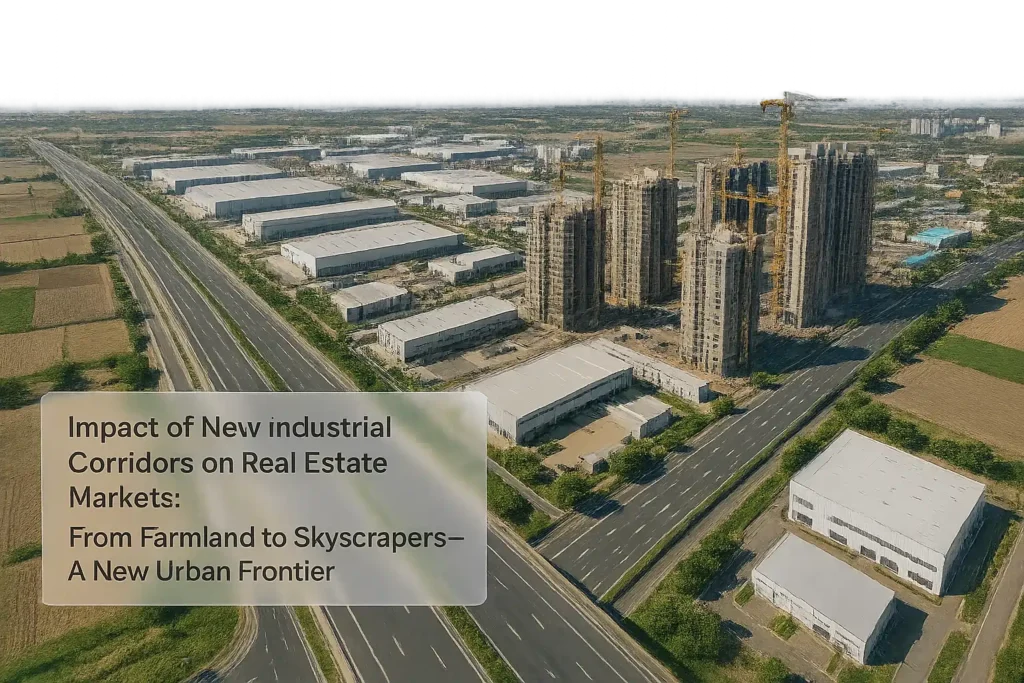
Infrastructure and industrial ecosystem of India is going through a major change. Some of the major efforts that are leading to this shift are the industrial corridors like the Delhi-Mumbai Industrial Corridor (DMIC), Chennai-Bengaluru Industrial Corridor (CBIC), Amritsar-Kolkata Industrial Corridor (AKIC), etc. These megaprojects aim to establish globally competitive manufacturing and logistics hubs, and redefine the real estate markets around them.
In this article, we’ll explore the impact of new industrial corridors on real estate markets in India—covering residential, commercial, and industrial segments—with insights backed by expert analysis and industry data.
What Are Industrial Corridors and Why Are They Important?
Industrial corridors are mega infrastructure projects that link mega cities, ports and industrial clusters with exclusive freight corridors, highways, power and smart cities.
For instance, the Delhi-Mumbai Industrial Corridor (DMIC), one of the world’s largest infrastructure projects, spans six states and aims to integrate:
- 24 industrial regions and cities
- High-speed freight and logistics networks
- Manufacturing hubs with global competitiveness
The goal is not just to boost industrial output but also to decongest urban centers, attract foreign direct investment (FDI), and generate millions of jobs.
How Industrial Corridors Drive Real Estate Growth
The ripple effect of industrial corridors on real estate is profound. Let’s break it down:
1. Commercial Real Estate Demand
- Office Spaces: With the establishment of plants, R&D centers, and back-office operations of multinational companies, Grade-A office space also experiences a boom in demand as a result of these investments, particularly near industrial nodes.
- Warehousing & Logistics: Corridors such as the DMIC link with Dedicated Freight Corridors (DFC) resulting in the development of huge logistics parks, warehouses and cold storage units.
- Retail Growth: As new townships and industrial clusters emerge, retail spaces like malls, high streets, and mixed-use developments also gain traction.
2. Residential Real Estate
- Affordable Housing Demand: Large-scale migration of workers and professionals to corridor regions fuels demand for mid-income and affordable housing projects.
- Premium Housing: Senior executives, expats, and industrialists driving businesses in these corridors push demand for luxury residential options.
- Integrated Townships: Developers are increasingly planning self-sustainable residential complexes with schools, healthcare, and recreational facilities.
3. Land Value Appreciation
- In addition, proximity to industrial hubs, freight corridors and expressways has already resulted in a boom in land values in critical nodes such as Neemrana (Rajasthan), Dholera (Gujarat), Manesar (Haryana) and Aurangabad (Maharashtra).
- Early investors in these regions have witnessed land price appreciation between 20–40% in the last five years, depending on infrastructure progress.
Case Study: Delhi-Mumbai Industrial Corridor (DMIC)
The DMIC is the most advanced corridor, offering a clear picture of real estate transformation:
- Neemrana-Behror (Rajasthan): Once a quiet stretch, it is now a hotspot for Japanese and Korean industrial zones, pushing up both land and housing demand.
- Dholera (Gujarat): Marketed as India’s first greenfield smart city, Dholera is attracting attention from both global investors and real estate developers.
- Manesar (Haryana): Located near Gurgaon, it has emerged as a manufacturing and warehousing hub, boosting housing demand in nearby areas.
Expert Insights
Industry experts believe that industrial corridors will be long-term value creators for real estate investors.
- Anarock Research notes that industrial corridors can unlock $1 trillion in investment opportunities over the next decade, particularly in logistics and warehousing.
- JLL India highlights that demand for Grade-A warehousing in India has grown at a CAGR of 20% in the past five years, much of it driven by corridor-linked infrastructure.
- Developers are increasingly aligning projects with government initiatives such as Make in India, Smart Cities Mission, and National Infrastructure Pipeline (NIP) to leverage corridor-led growth.
Opportunities for Investors
For investors, industrial corridors present multiple opportunities:
- Residential Property: Early entry into affordable housing projects near industrial nodes.
- Land Investments: Strategic land parcels near expressways, logistics parks, and proposed smart cities.
- Commercial Assets: Warehouses, co-working hubs, and retail spaces catering to the growing population.
Tip: Investors should carefully analyze infrastructure completion timelines, state-level policies, and demand projections before committing capital.
Risks and Challenges
While the outlook is promising, investors should remain cautious of:
- Execution Delays: Large infrastructure projects often face bureaucratic, environmental, or financial delays.
- Speculative Investments: Buying land solely on hype without due diligence may lead to low or stagnant returns.
- Uneven Development: Not all nodes along a corridor develop at the same pace—some may flourish while others lag.
While the opportunities are massive, targeted investment supported by due diligence is the key to sustainable returns.
Conclusion
The emerging industrial corridors are changing the real estate environment in India because national development and massive infrastructure are being experienced owing to the development of new industrial corridors.
These corridors are not only improving the level of connectivity and efficiency in logistics but also providing new residential, commercial and industrial property investment hotspots.
The values of land as well as the housing and office space will continue to house more people as more job opportunities emerge and urbanization starts to grow around such corridors.
As the infrastructure, investor confidence and government support continue to improve, industrial corridors are re-writing a new path in the growth trajectory of the real estate in India to create a balanced regional development and long term economic sustainability. Simply put, the collaboration between the booming industrialization and the development of real estate is establishing the principle of the next phase of the inclusive and sustainable urbanization of India.
FAQs – Impact of New Industrial Corridors on Real Estate Markets
1. What are industrial corridors and why are they important?
Industrial corridors are large-scale infrastructure zones connecting major cities and ports to promote manufacturing, trade, and regional development. They act as growth engines for the economy and real estate sector.
2. How do new industrial corridors impact real estate markets?
They drive increased demand for residential, commercial, and industrial properties by improving connectivity, job creation, and infrastructure in surrounding areas.
3. Which major industrial corridors are influencing India’s real estate growth?
Key corridors include the Delhi-Mumbai Industrial Corridor (DMIC), Bengaluru-Mumbai Economic Corridor (BMEC), and Amritsar-Kolkata Industrial Corridor (AKIC),
4. What kind of real estate development is happening along these corridors?
Developments include affordable housing, logistics parks, warehouses, commercial complexes, and smart cities, catering to the growing workforce and business ecosystem.
5.What is the future outlook for real estate around industrial corridors?
The future looks promising, with consistent growth in housing, logistics, and commercial segments, making these regions the next frontiers for real estate investment.