A tenant name in Form I and XIV Goa doesn’t automatically void a sale but it can freeze one until the Mamlatdar settles the tenancy. Many buyers learn this only after they’ve paid a token amount and signed an agreement. You don’t have to be one of them.
This guide explains what the entry means, why it can leave a Goa plot unsellable, and what to check before any money moves. It’s written for plot buyers, NRIs and owners who plan to sell.
The short answer
- A tenant entry means the land record recognises someone’s tenancy claim over the parcel.
- Under Goa’s tenancy law, that tenant may already count as the buyer of the land.
- Only the Mamlatdar can confirm or clear the claim. A private letter usually can’t.
- Don’t pay the balance until the tenancy question is settled in writing.
What Form I and XIV Goa Actually Shows?
Form I and XIV Goa is the Record of Rights for rural land, issued through the taluka Mamlatdar and the state’s land records portal. It has two parts, and each does a different job. Form I describes the land. Form XIV describes the people connected to it.
| Part | What it records | Why buyers care |
|---|---|---|
| Form I | Survey and sub-division number, area, land type, assessment | Confirms you’re looking at the right parcel and its classification |
| Form XIV | Occupant, tenant, mundkar, other rights, mutation references | Shows who else has a claim on the land |
Two habits will save you trouble:
- Ask the seller for the signed or certified copy. The portal’s on-screen preview is informational only.
- Treat the form as one piece of the puzzle. It shows who holds and uses the land, but it isn’t a title deed.
What a Tenant Name on Form 1 and 14 Really Means?
When you see a tenant name on Form 1 and 14, the record is telling you that someone claims to cultivate this land as a tenant under the Goa, Daman and Diu Agricultural Tenancy Act, 1964. That one line can outweigh the seller’s confidence, so read it slowly.
Not every entry means the same thing, though. Here are the situations you’re likely to meet:
| Situation | What it usually means | Risk level |
|---|---|---|
| Live tenant | Someone still cultivates the land | High |
| Tenant’s heirs | The claim passed to the family | High |
| Tenant who already vested | The tenant may already own the land under the Act | Very high |
| Stale entry | The person left or died, but the record never changed | Medium, needs proof |
| Wrong entry | Recorded by mistake or challenged | Medium, needs an order |
You can’t tell which one applies by reading the column alone. The Mamlatdar’s records can.
Also Read. Can You Buy Comunidade Land in Goa
The Goa Agricultural Tenancy Act Deemed Purchaser Rule Explained
This rule is the reason a tenant name in Form I and XIV Goa carries so much weight. The Goa Agricultural Tenancy Act deemed purchaser provision says that, on the notified “tillers’ day,” each tenant is treated as having bought the land he cultivates. The land then vests in him. In other words, the person named as owner on paper may no longer own that land in practice.
Here’s how the process generally runs:
- The tenant is recognised as a deemed purchaser.
- The Mamlatdar issues notice and fixes the purchase price.
- The tenant pays, either in a lump sum or in instalments.
- The Mamlatdar issues a certificate of purchase.
After that, the land can’t be freely sold, gifted, mortgaged or leased. A sale generally needs the Mamlatdar’s permission.
The Act also sets notice and price rules for a landlord who sells to someone other than the tenant. If the landlord skips those steps, the sale is invalid.
Why a Goa Plot Becomes Unsellable?

A Goa plot unsellable situation rarely comes from one big problem. It comes from several small ones stacking up:
- Ownership is unclear. The tenant may hold rights the seller can’t override.
- Permission is missing. A sale of tenant-vested land may need the Mamlatdar’s sanction, and the seller may not have it.
- Mutation gets stuck. You can register the deed, but your name may not reach the record cleanly.
- Use is restricted. Goa’s Land Use (Regulation) Act, 1991 bars using tenant-vested agricultural land for anything except agriculture. That can kill your plan for a villa or a layout.
- Lawyers and lenders ask questions. Expect every serious professional to want the tenancy explained before they sign off.
“Unsellable” doesn’t mean permanent. It means unsellable until the tenancy is resolved through the right authority.
Also Read: How to Choose Top Real Estate Consultant in Goa
Why a Tenant’s NOC Isn’t Enough?
Many sellers say, “We’ll just get a no-objection letter from the tenant.” It sounds sensible, but it may not work. Goan court rulings hold that a tenant or deemed purchaser can’t give up rights through a private compromise or agreement. Surrender is meant to go through the Mamlatdar.
So a signed letter can make you feel safe while leaving the legal risk untouched. Before you rely on any NOC, ask your lawyer whether it’s valid for this specific parcel.
Mamlatdar Negative Declaration Goa: How a Tenancy Gets Cleared
The Mamlatdar is the authority that decides whether a person is a tenant. That includes the power to declare that a claimant is not a tenant at all. Lawyers call this a negative declaration, and a Mamlatdar negative declaration Goa buyers can rely on is often the cleanest way to clear a doubtful entry.
Here are the usual routes:
| Situation | Likely route | Who decides |
|---|---|---|
| Person claims tenancy but isn’t a tenant | Negative declaration | Mamlatdar |
| Tenant wants to give up rights | Surrender through the statutory process | Mamlatdar |
| Tenant is a deemed purchaser and the sale is planned | Permission for the transfer | Mamlatdar |
| Entry is stale or wrong | Correction after an inquiry | Mamlatdar or revenue authority |
Timelines and costs vary case by case, so ask your lawyer for a realistic estimate instead of trusting a seller’s promise.
Also Read: Top Beaches in Goa 2026
Goa Land Due Diligence Before Buying a Plot: Your Tenant Checklist
Good Goa land due diligence before buying plot starts with the record, not the brochure. Follow this order:
- Get the survey and sub-division number from the seller and match it to the sale deed.
- Pull the signed Form I and XIV and read every name in Form XIV, not just the owner’s.
- Compare each name with the title documents. Spelling differences matter.
- Check the mutation history. Look for pending or disputed entries.
- Ask for any Mamlatdar tenancy orders or case status connected to the parcel.
- Confirm the land classification and conversion status against your intended use.
- Review the Land Use Act impact if the land may be tenant-vested.
- Have a Goa property lawyer read the full file before you sign.
- Tie payments to clearance. Pay in stages linked to the documents you actually receive.
Tenant vs Mundkar: Don’t Mix Them Up
Buyers often treat these as the same thing. They aren’t.
| Tenant | Mundkar | |
|---|---|---|
| Law | Goa, Daman and Diu Agricultural Tenancy Act, 1964 | Goa Mundkars (Protection from Eviction) Act, 1975 |
| Connected to | Cultivating the land | Living in a dwelling on the land |
| Typical effect | Deemed purchase and sale restrictions | Protection from eviction |
If Form XIV shows either one, you need the Mamlatdar’s clarity before you buy.
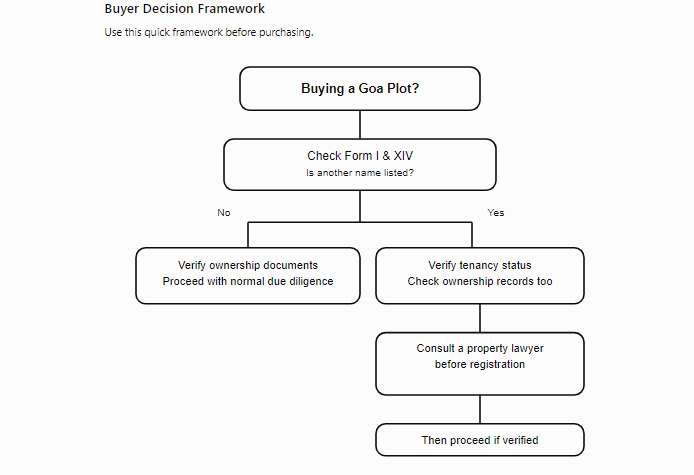
What to Do If You Find a Tenant Name
You have three practical options:
- Walk away. This is the safest choice if the seller can’t produce clear orders.
- Verify first. Ask for the Mamlatdar’s records, and give the seller a deadline to clear the entry.
- Restructure the deal. Make the sale conditional on a negative declaration or permission, and hold back the balance payment.
My recommendation: verify first, and walk away if the seller won’t share documents. A seller who dodges the question is telling you something.
Common Myths About Tenant Entries
- Myth: “Form I and XIV proves ownership.” Reality: It shows possession and rights. Ownership rests on the title documents.
- Myth: “A tenant’s NOC fixes everything.” Reality: Private surrenders may not hold up.
- Myth: “An old entry doesn’t count.” Reality: It stands until an authority corrects it.
- Myth: “A registered deed makes me the owner.” Reality: Registration doesn’t remove a tenant’s statutory rights.
Conclusion
Finding a tenant name in Form I and XIV Goa should never be ignored, but it should not automatically stop a property purchase either. The key is understanding what the entry represents and verifying it against the complete set of property documents.
Proper Goa land due diligence before buying plot involves checking ownership records, survey details, mutation records, and tenancy-related documentation together. That approach helps buyers make informed decisions and reduces the risk of future legal complications.
Frequently Asked Questions
Can I sell a Goa plot if someone else name appears in Form I and XIV?
Yes – having another person’s name on Form I & XIV does not automatically block the sale Form I & XIV is simply a revenue register of the land not the final title. It may list occupants or tenants, but the plot can still be sold once you verify the title. A buyer should ensure the registered Sale Deed and mutation records match Form I & XIV and that any tenant’s rights have been legally resolved. (In other words, do full due diligence on the title rather than assuming the name entry makes the land unsellable.)
Does a tenant’s name on Form I and XIV Goa mean they own the land?
No, A name listed as a “tenant” in Form I & XIV indicates someone has tenancy rights under Goa’s law, but it does not prove ownership. The Form XIV specifically records who occupies the land and holds tenancy rights under the Goa Tenancy Act. Legal ownership is confirmed by the registered Sale Deed and mutation (Record of Rights) not by Form I & XIV alone. In short a tenant entry is about cultivator/occupier rights not legal title.
What is the Goa Tenancy Act’s “deemed purchaser” concept?
Goa Daman & Diu Agricultural Tenancy Act, 1964, presumes that each agricultural tenant has purchased the land he cultivates on a fixed “tiller’s day” in practice the law assumes that the tenant is the landowner as of that day. The land vests in the tenant free of previous encumbrances, subject to paying the statutory purchase price (Essentially tenants are automatically converted into owners by law, with the responsibility to pay the government and former owner the prescribed amounts.)
What is a Mamlatdar negative certificate (negative declaration)?
The official Goa tenancy laws does not explicitly define what is meant by the term “Mamlatdar negative certificate”. This term typically means a certificate or declaration by the Mamlatdar’s office that there are no known encumbrances or tenancy claims against the land. The certificate is usually requested by the buyers to ensure that, as per revenue records, no tenants are on the plot. This will help make sure that the property has no undisclosed tenancy encumbrances before it is purchased.
What documents should I verify when buying land in Goa (due diligence)?
Always obtain a cross check on several records such as the Form I & XIV extract from the Mamlatdar’s office (or online portal) and the corresponding Matriz certificate (the old Portuguese land register) and Registo Predial entry (the Sale Deed record). Verify the area the survey number against all three of the sellers, Mutation (ROR) and any land conversion or land use approvals. Having all these documents in harmony can help confirm good title and the absence of hidden claims—such as tenants who have not been disclosed—on the property.